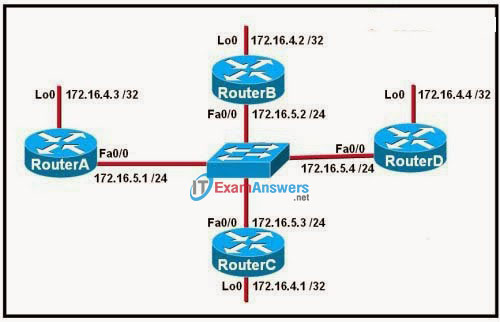
Refer to the exhibit. RouterA, RouterB, and RouterC in the diagram are running OSPF on their Ethernet interfaces. Router D was just added to the network. Routers are configured with the loopback interfaces (Lo 0) that are shown in the exhibit. What happens to the OSPF DR/BDR after RouterD is added to the network?
IT Exam Items Repository › Category: CCNA 2 v4 › Refer to the exhibit. RouterA, RouterB, and RouterC in the diagram are running OSPF on their Ethernet interfaces. Router D was just added to the network. Routers are configured with the loopback interfaces (Lo 0) that are shown in the exhibit. What happens to the OSPF DR/BDR after RouterD is added to the network?
Refer to the exhibit. RouterA, RouterB, and RouterC in the diagram are running OSPF on their Ethernet interfaces. Router D was just added to the network. Routers are configured with the loopback interfaces (Lo 0) that are shown in the exhibit. What happens to the OSPF DR/BDR after RouterD is added to the network?
- RouterB takes over as DR and RouterD becomes the BDR.
- RouterD becomes the BDR and RouterA remains the DR.
- RouterD becomes the DR and RouterA becomes the BDR.
- RouterC acts as the DR until the election process is complete.
- RouterD becomes the DR and RouterB remains the BDR.
- There is no change in the DR or BDR until either current DR or BDR goes down.
Related exam: CCNA Exploration 2: ERouting Chapter 11 Exam Answers
About The Author

The ITExamAnswers Editorial Team is a dedicated group of certified IT professionals and network engineers. We rigorously review, verify, and update all exam materials to ensure you receive the most accurate and reliable resources for your certification journey.