
Case 1:
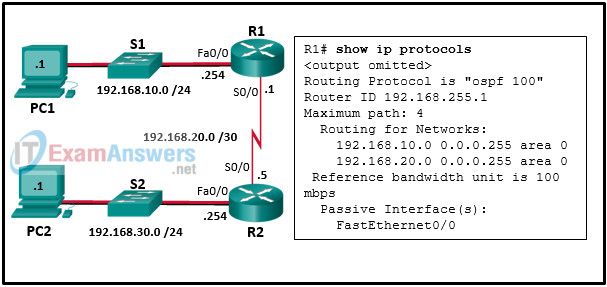
Refer to the exhibit. A network administrator has configured OSPFv2 on the two Cisco routers as shown. The routers are unable to form a neighbor adjacency. What should be done to fix the problem?
- Add the command network 192.168.30.0 0.0.0.255 area 0 on router R1.
- Change the IP address on S0/0 of router R2 to 192.168.20.2.
- Remove the FastEthernet0/0 passive interface configuration on router R1.
- Add the command network 192.168.20.1 0.0.0.0 area 0 on router R1.
Explanation: In order to form OSPFv2 neighbor adjacencies, two connected router interfaces must share the same subnet. Router R2 is shown in the topology with an IP address of 192.168.20.5 and does not exist on the same subnet as the 192.168.20.1 /30 IP address of S0/0 on router R1.
Related exam: CCNA 3 Practice Final Exam Answers
Related exam: CCNA 3 Final Exam Answers
Related exam: Practice Final - ENSA
Related exam: CCNP ENARSI 8 Modules 6 - 10 Checkpoint Exam: OSPF Exam
Case 2:
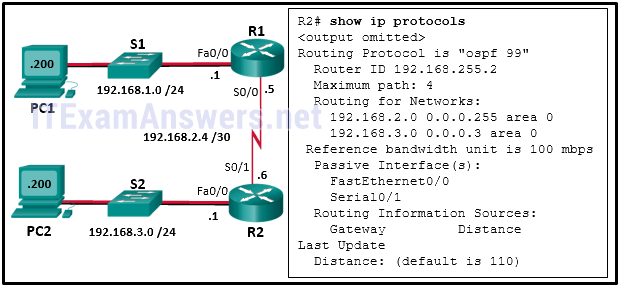
Refer to the exhibit. A network administrator has configured OSPFv2 on the two Cisco routers as shown. The routers are unable to form a neighbor adjacency. What should be done to fix the problem?
- Implement the command no passive-interface Serial0/1.
- Implement the command network 192.168.2.4 0.0.0.3 area 0 on router R2.
- Implement the command network 192.168.3.0 0.0.0.255 area 0 on router R2.
- Change the router-id of router R2 to 2.2.2.2.
Related exam: CCNA 3 ScaN (v5.0.3 + v6.0) Final Exam Answers
