
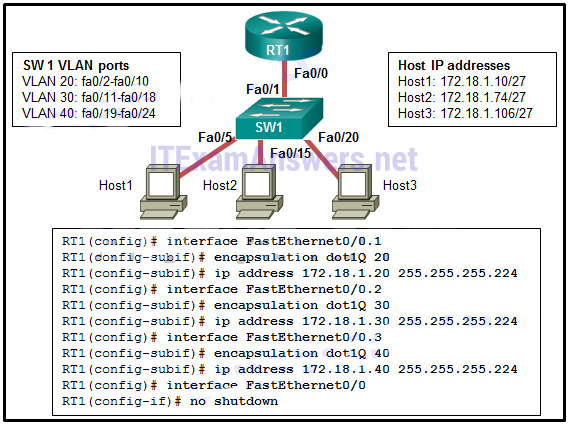
Refer to the exhibit. A network administrator is configuring RT1 for inter-VLAN routing. The switch is configured correctly and is functional. Host1, Host2, and Host3 cannot communicate with each other. Based on the router configuration, what is causing the problem?
- Interface Fa0/0 is missing IP address configuration information.
- IP addresses on the subinterfaces are incorrectly matched to the VLANs.
- Each subinterface of Fa0/0 needs separate no shutdown commands.
- Routers do not support 802.1Q encapsulation on subinterfaces.
Explanation: Since Host 1 (in VLAN 20) has the IP 172.18.1.10/27, the subinterface Fa0/0.1 should be configured with an IP address in the network 172.168.1.0/27. Similarly, Fa0/0.2 should be with an IP address in the network 172.168.1.64/27 and Fa0/0.3 should be with an IP address in the network 172.168.1.96/27.
Related exam: CCNA 2 v7 Checkpoint Exam: Switching Concepts, VLANs, and Inter-VLAN Routing Exam Answers
Related exam: CCNA 2 (v5.0.3 + v6.0) Chapter 5 Exam Answers
Related exam: CCNA Exploration 3: ESwitching Final Exam
