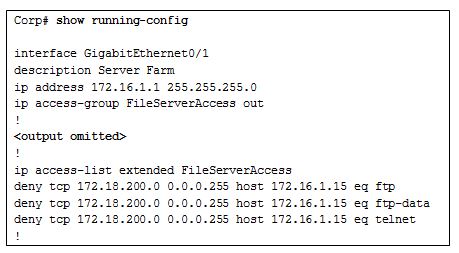
Refer to the exhibit. A new network policy requires an ACL denying FTP and Telnet access to a Corp file server from all interns. The address of the file server is 172.16.1.15 and all interns are assigned addresses in the 172.18.200.0/24 network. After implementing the ACL, no one in the Corp network can access any of the servers. What is the problem?
IT Exam Items Repository › Category: CCNA › Refer to the exhibit. A new network policy requires an ACL denying FTP and Telnet access to a Corp file server from all interns. The address of the file server is 172.16.1.15 and all interns are assigned addresses in the 172.18.200.0/24 network. After implementing the ACL, no one in the Corp network can access any of the servers. What is the problem?
Question:
Refer to the exhibit. A new network policy requires an ACL denying FTP and Telnet access to a Corp file server from all interns. The address of the file server is 172.16.1.15 and all interns are assigned addresses in the 172.18.200.0/24 network. After implementing the ACL, no one in the Corp network can access any of the servers. What is the problem?
- Inbound ACLs must be routed before they are processed.
- The ACL is implicitly denying access to all the servers.
- Named ACLs require the use of port numbers.
- The ACL is applied to the interface using the wrong direction.
Explanation: Both named and numbered ACLs have an implicit deny ACE at the end of the list. This implicit deny blocks all traffic.
Related exam: CCNA 3 v7 Checkpoint Exam: Network Security Exam Answers
Related exam: CCNA 2 RSE (v5.0.3 + v6.0) Final Exam Answers
About The Author

The ITExamAnswers Editorial Team is a dedicated group of certified IT professionals and network engineers. We rigorously review, verify, and update all exam materials to ensure you receive the most accurate and reliable resources for your certification journey.