Refer to the exhibit. All router interfaces are up and RIP version 2 is configured as the routing protocol. The users in networks 172.16.8.0 /24 and 172.16.9.0/24 are not able to reach users in the 172.16.16.0/24 network. The network administrator examines the routing tables and finds that even though all directly connected networks have been entered in the RIP configuration, not all routes are present. What is the most likely cause of this problem?
IT Exam Items Repository › Category: CCNA Discovery v4 › Refer to the exhibit. All router interfaces are up and RIP version 2 is configured as the routing protocol. The users in networks 172.16.8.0 /24 and 172.16.9.0/24 are not able to reach users in the 172.16.16.0/24 network. The network administrator examines the routing tables and finds that even though all directly connected networks have been entered in the RIP configuration, not all routes are present. What is the most likely cause of this problem?
Refer to the exhibit. All router interfaces are up and RIP version 2 is configured as the routing protocol. The users in networks 172.16.8.0 /24 and 172.16.9.0/24 are not able to reach users in the 172.16.16.0/24 network. The network administrator examines the routing tables and finds that even though all directly connected networks have been entered in the RIP configuration, not all routes are present. What is the most likely cause of this problem?
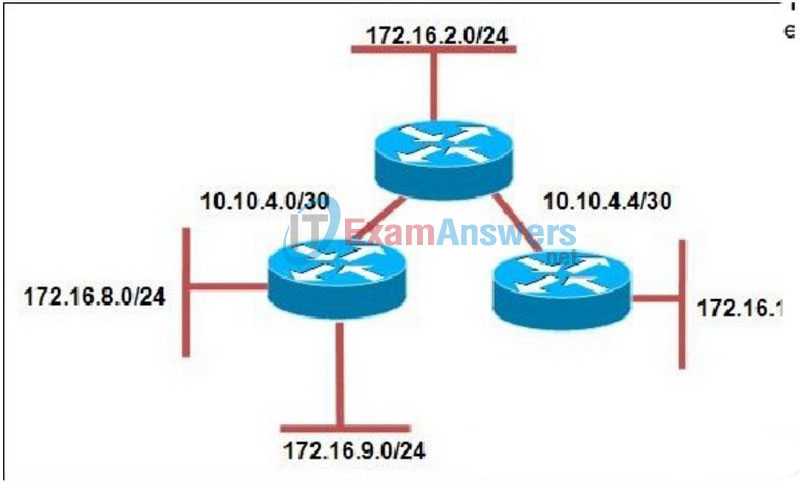
- Autosummarization is enabled on all routers.
- The split-horizon rule is disabled on all routers.
- RIP version 2 does not support classless routing.
- RIP version 1 should have been used instead of version 2.
- The 10.10.4.0 networks should be replaced with 192.168.4.0 networks.
Related exam: CCNA Discovery 4: DCompNtwk Final Exam
About The Author

The ITExamAnswers Editorial Team is a dedicated group of certified IT professionals and network engineers. We rigorously review, verify, and update all exam materials to ensure you receive the most accurate and reliable resources for your certification journey.