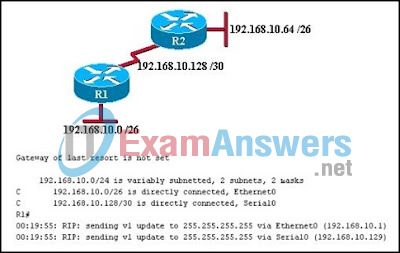
Refer to the exhibit. Both routers are configured using RIPv1. Both routers are sending updates about the directly connected routes. R1 can successfully ping the serial interface of R2. The routing table on R1 does not contain any dynamically learned routes from R2, and the routing table on R2 shows no dynamically learned routes from R1. What is the problem?
IT Exam Items Repository › Category: CCNA Discovery v4 › Refer to the exhibit. Both routers are configured using RIPv1. Both routers are sending updates about the directly connected routes. R1 can successfully ping the serial interface of R2. The routing table on R1 does not contain any dynamically learned routes from R2, and the routing table on R2 shows no dynamically learned routes from R1. What is the problem?
Refer to the exhibit. Both routers are configured using RIPv1. Both routers are sending updates about the directly connected routes. R1 can successfully ping the serial interface of R2. The routing table on R1 does not contain any dynamically learned routes from R2, and the routing table on R2 shows no dynamically learned routes from R1. What is the problem?
- Subnetting is not supported by RIPv1.
- One of the routers needs a clock rate on the serial interface.
- The serial link between the two routers is unstable.
- VLSM is not supported by RIPv1.
Related exam: CCNA Discovery 3: DRSEnt Chapter 9 Exam
About The Author

The ITExamAnswers Editorial Team is a dedicated group of certified IT professionals and network engineers. We rigorously review, verify, and update all exam materials to ensure you receive the most accurate and reliable resources for your certification journey.