Refer to the exhibit. Branch A has a Cisco router and Branch B has a non-Cisco router that is using IETF encapsulation . After the commands that are shown are entered, R2 and R3 fail to establish the PVC. The R2 LMI is Cisco, and the R3 LMI is ANSI. The LMI is successfully established at both locations. Why is the PVC failing?
IT Exam Items Repository › Category: CCNA 4 v4 › Refer to the exhibit. Branch A has a Cisco router and Branch B has a non-Cisco router that is using IETF encapsulation . After the commands that are shown are entered, R2 and R3 fail to establish the PVC. The R2 LMI is Cisco, and the R3 LMI is ANSI. The LMI is successfully established at both locations. Why is the PVC failing?
Refer to the exhibit. Branch A has a Cisco router and Branch B has a non-Cisco router that is using IETF encapsulation . After the commands that are shown are entered, R2 and R3 fail to establish the PVC. The R2 LMI is Cisco, and the R3 LMI is ANSI. The LMI is successfully established at both locations. Why is the PVC failing?
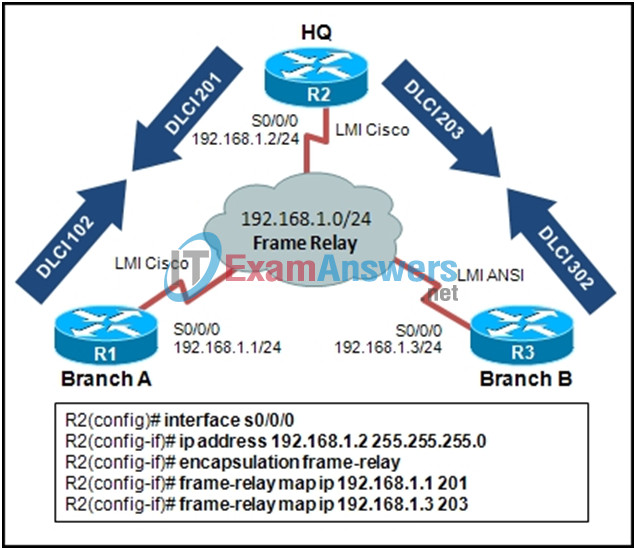
- The PVC to R3 must be point-to-point.
- LMI types cannot be different on each end of a PVC.
- A single port can only support one encapsulation type.
- The IETF parameter is missing from the frame-relay map ip 192.168.1.3 203 command.
Related exam: CCNA Exploration 4: EWAN Practice Final Exam
About The Author

The ITExamAnswers Editorial Team is a dedicated group of certified IT professionals and network engineers. We rigorously review, verify, and update all exam materials to ensure you receive the most accurate and reliable resources for your certification journey.