
Refer to the exhibit. Which sequence of commands should be used to configure router A for OSPF?
[caption id="attachment_64762" align="aligncenter" width="452"]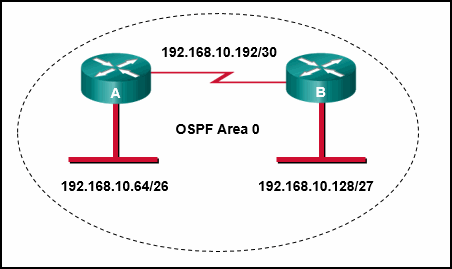 i386046n1v2.gif[/caption]
router ospf 1
network 192.168.10.0 area 0
router ospf 1
network 192.168.10.0
router ospf 1
network 192.168.10.64 255.255.255.192
network 192.168.10.192 255.255.255.252
router ospf 1
network 192.168.10.64 0.0.0.63 area 0
network 192.168.10.192 0.0.0.3 area 0
Explanation: To configure OSPFv2, you must first enable the OSPF process using the router ospf [process-id] command. You then use the network statement to identify which interfaces participate in the routing process for a specific area.
The configuration requires two key components for each subnet:
- Wildcard Mask: This is calculated by subtracting the subnet mask from 255.255.255.255.
- For the /26 subnet (255.255.255.192), the wildcard is 0.0.0.63.
- For the /30 WAN link (255.255.255.252), the wildcard is 0.0.0.3.
- Area ID: Since the topology specifies the backbone area, both network statements must include area 0.
Related exam: Enterprise Networking, Security, and Automation ( Version 7.00) - ENSA Final Exam
