
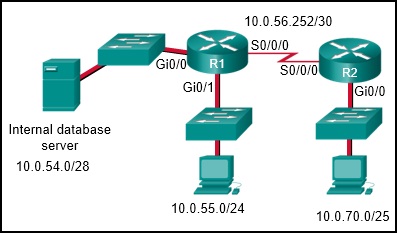
Refer to the exhibit. Which two configurations would be used to create and apply a standard access list on R1, so that only the 10.0.70.0/25 network devices are allowed to access the internal database server? (Choose two.)
- A.
R1(config)# interface GigabitEthernet0/0
R1(config-if)# ip access-group 5 out - B.
R1(config)# access-list 5 permit 10.0.54.0 0.0.1.255 - C.
R1(config)# interface Serial0/0/0
R1(config-if)# ip access-group 5 in - D.
R1(config)# access-list 5 permit 10.0.70.0 0.0.0.127 - E.
R1(config)# access-list 5 permit any
Correct Answer: AD
Explanation:
Creating the ACL (D): Standard ACLs filter traffic based solely on the source IPv4 address. To permit only the 10.0.70.0/25 network, the correct wildcard mask is 0.0.0.127 (calculated by subtracting the subnet mask 255.255.255.128 from 255.255.255.255).
Applying the ACL (A): According to best practices, standard ACLs should be placed as close to the destination as possible. Since the internal database server is the destination and is connected to R1’s GigabitEthernet0/0 interface, the ACL should be applied outbound (out) on that interface to filter traffic just before it exits the router toward the server. Applying it elsewhere (like inbound on the serial interface) could unnecessarily block the 10.0.70.0/25 network from reaching other segments connected to R1, such as the 10.0.55.0/24 workstation.
Related exam: Enterprise Networking, Security, and Automation ( Version 7.00) - ENSA Final Exam
