
Refer to the exhibit. Based on the show ip bgp summary and debug ip bgp output, which two statements must be true? (Choose two.)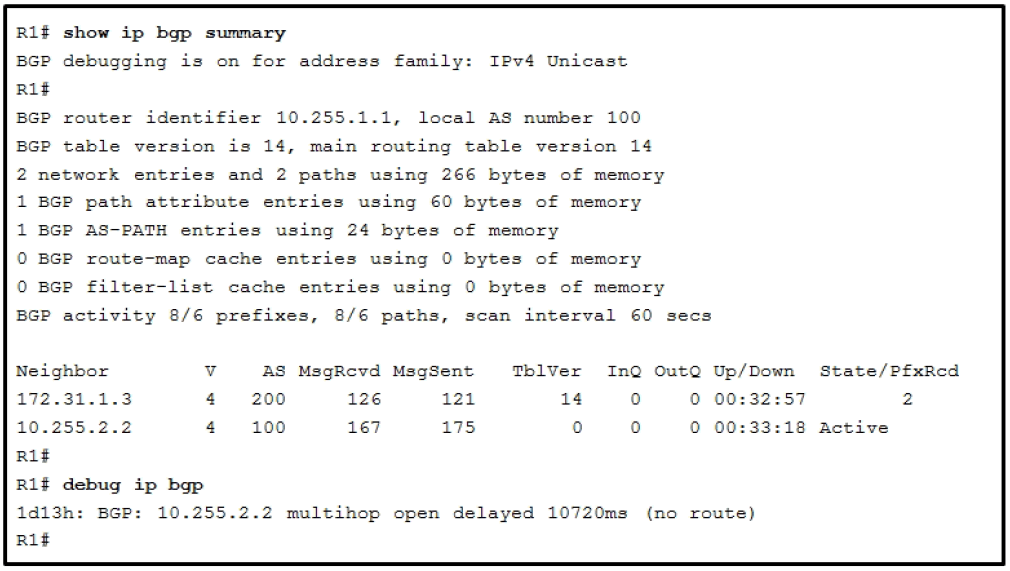
- R1 is directly connected to an IBGP peer.
- R1 cannot route BGP packets to 10.255.2.2.
- The router at 10.255.2.2 is an EBGP peer.
- The ebgp multi-hop command is missing from the BGP configuration.
- R1 has established an EBGP peering relationship.
Explanation: The debug output explicitly states (no route) for neighbor 10.255.2.2, indicating that R1 lacks a path in its routing table to reach that neighbor's IP address.
For neighbor 172.31.1.3, the AS is 200 (different from local AS 100, making it EBGP), and the "State/PfxRcd" column shows a numeric value ("2"), which indicates the BGP session is in the Established state.
Related exam: CCNP ROUTE (Version 6.0) Chapter 6 Exam
Related exam: CCNP ROUTE Chapter 7 Exam Answers (Version 7)
Related exam: Checkpoint Exam: Layer 3 Technologies – BGP
