1. When an incoming BGP route update is processed on a router, what filtering tool is checked first?
- Prefix-list
- Access-list
- Filter-list
- Route-map
Explanation: Topic 11.5.3
When a router receives a BGP update, it processes incoming filters in a specific order: first Route maps, then Filter lists (AS-path filtering), and finally Prefix lists.
2. Which BGP verification command displays the BGP table version?
- show ip bgp neighbors
- show ip bgp summary
- show ip route bgp
- show ip bgp
Explanation: Topic 13.3.0
The show ip bgp summary command provides a summary of the BGP process, where the first section explicitly displays the BGP table version (the version number of the local BGP table, which increases whenever the table changes).
3. Which two statements are true of IBGP peers? (Choose two.)
- Updates between peers are sent using Reliable Transport Protocol (RTP).
- BGP updates are sent every 10 seconds.
- A TCP session must be established before a peer adjacency is made.
- IBGP peers must be directly connected.
- Routes learned from an IBGP peer are not propagated to other IBGP peers.
Explanation: Topic 10.8.0
BGP requires a TCP session (port 179) to be established before any updates are exchanged. Furthermore, the IBGP split-horizon rule dictates that a router will not advertise a route learned from one IBGP peer to another IBGP peer to prevent routing loops within an AS.
4. Which two of these options are advantages of exchanging IPv4 and IPv6 address families over a single IPv4 session? (Choose two.)
- need to set the next hop
- potentially simpler configuration
- no need for MP-BGP extensions
- fewer sessions
- no need to set the next hop
- limited need for MP-BGP extensions
Explanation: Topic 12.2.3
Using a single neighbor session to carry both IPv4 and IPv6 address families can reduce the number of neighbor sessions required, which significantly lowers the size and complexity of the configuration in environments with many neighbors.
5. Which BGP attribute can be configured on IBGP speakers so they will choose a desired path out of the autonomous system to an outside network?
- MED
- next hop
- aggregate
- local preference
Explanation: Topic 11.3.2
The local preference attribute indicates the preference for exiting the AS to the destination network. The local preference is not advertised between eBGP peers and is typically used to influence the next-hop address for outbound traffic (that is, leaving an autonomous system). Local preference can be set for specific routes by using a route map or for all routes received from a specific neighbor. A higher value is preferred over a lower value.
6. Which verification command displays whether a link between BGP neighbors is treated as internal or external?
- show ip bgp
- show ip bgp neighbors
- show ip bpg summary
- show ip bgp prefix
Explanation: Topic 13.5.0
The show ip bgp neighbors command provides detailed information about BGP peers, explicitly displaying whether a neighbor is an "internal link" (IBGP) or an "external link" (EBGP).
7. Refer to the exhibit. In what BGP neighbor state is neighbor 1.1.1.1?

- Idle
- Active
- Opensent
- Established
Explanation: Topic 10.10.1
In the show ip bgp summary output, the State/PfxRcd column shows either a text string (for non-established states like Idle or Active) or a numeric value. A number indicates the quantity of prefixes received, which confirms that the session is in the Established state. For neighbor 1.1.1.1, the value is "0", meaning the session is up even though no prefixes have been received yet.
8. Which statement is not correct regarding MP-BGP?
- A single BGP forwarding table is used for both IPv4 and IPv6 address families.
- IPv4 can be used as the BGP transport for both IPv4 and IPv6 sessions.
- The show bgp all neighbors command can be used to show BGP neighbor adjacencies for IPv4 and IPv6.
- Neighbors must be activated with the address family using the neighbor activate command.
Explanation: Topic 12.2.1
This statement is not correct because MP-BGP maintains separate BGP tables (databases) for each address family (e.g., IPv4 unicast and IPv6 unicast). Verification commands such as show bgp ipv4 unicast and show bgp ipv6 unicast demonstrate that these databases are independent and contain different sets of routing information. While Source mentions the command in Option C in a list of objectives, statement A is a fundamental architectural error as the protocol is designed for the separation of control and data for different address families.
9. Refer to the exhibit. Which statement is true?
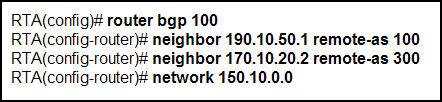
- The neighbor at 190.10.50.1 is an external peer.
- RTA is going to advertise network 150.10.0.0 to its neighbors if 150.10.0.0 or its subnets are in the IP routing table.
- RTA is going to advertise that it is part of AS 300.
- The neighbor at 170.10.20.2 is an internal peer.
Explanation: Topic 10.10.1
In BGP, the network command is used to specify which routes from the local IP routing table should be injected into the BGP table. For the advertisement to occur, an exact match for the prefix (address and mask) must exist in the router's main routing table.
10. What filtering is checked last when an MP-BGP update is transmitted to a BGP neighbor?
- Distribute list
- Prefix list
- Filter list
- Route map
Explanation: Topic 11.5.3
When BGP updates are transmitted (outbound) to a neighbor, the router applies filters in a specific order: first the prefix list, followed by the filter list (AS-path filtering), and finally the route map.
11. Which routing protocol is used inside a transit AS to carry routes learned via EBGP?
Explanation: Topic 10.6.0
IBGP is the only protocol used within a transit AS to carry external routes learned via EBGP because it can preserve all BGP attributes across the backbone. Other IGPs like OSPF or EIGRP cannot scale to handle the volume of Internet routes or carry BGP-specific attributes.
12. Which command enables IBGP load balancing?
- ebgp-multihop
- maximum-paths ibgp
- traffic-share
- variance
Explanation: Topic 10.7.0
The maximum-paths ibgp command enables a BGP-speaking router to install multiple parallel internal BGP paths into its IP routing table for load sharing, provided all BGP attributes for those paths are identical.
13. What hashing algorithm is used by BGP authentication?
Explanation: Topic 11.12.0
BGP neighbor authentication utilizes the MD5 hashing algorithm. It generates a message digest using a shared secret key and portions of the IP and TCP headers to authenticate every segment sent over the BGP connection.
14. Verifying the MP-BGP IPv6 table shows a prefix with a next-hop of ::FFFF:10.10.10.10. What does this address represent?
- This is a broadcast address used to reach the advertised prefix.
- This is a reachable next-hop address.
- This is a multicast address used to reach the advertised prefix.
- This is an unreachable next-hop address.
Explanation: Topic 12.4.1
This address is an IPv4-mapped IPv6 address derived from an IPv4 next-hop. Because such addresses are considered unreachable by the IPv6 routing process, the BGP route will not be marked as "best" and will not be installed in the IPv6 routing table.
15. What format does the BGP router ID take when configuring MP-BGP?
- 64-bit hex value
- 128-bit hex value
- 32-bit dotted decimal value
- 16-bit hex value
Explanation: Topic 11.7.1
BGP defines a 32-bit router ID (RID) that is always written in dotted-decimal notation. If a router is running BGP over an IPv6 transport with no IPv4 addresses, the RID must be manually configured using this 32-bit format.
16. Redundant BGP route reflectors are supported through the use of which BGP attribute?
- Local preference
- Atomic aggregate
- MED
- Cluster-list
Explanation: Topic 11.10.1
To prevent routing loops in redundant route reflector designs, BGP uses the cluster-list attribute. When a route is reflected, the route reflector adds its Cluster ID to the cluster-list; if a reflector receives an update containing its own Cluster ID, it ignores the update to prevent a loop.
17. How is the weight attribute used in BGP?
- The weight attribute is used for BGP peer groups only.
- The weight attribute is advertised to EBGP neighbors.
- The weight attribute is advertised to IBGP neighbors.
- The weight attribute is used locally only.
Explanation: Topic 11.2.0
The weight attribute is a Cisco-defined parameter that is local to the router. It is not included in BGP updates and is never propagated to any EBGP or IBGP neighbors.
18. Refer to the exhibit. Based on the show ip bgp summary and debug ip bgp output, which two statements must be true? (Choose two.)
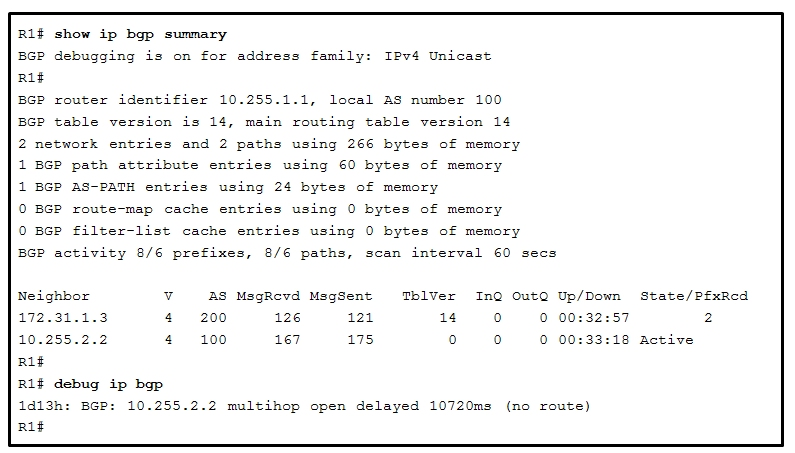
- The ebgp multi-hop command is missing from the BGP configuration.
- The router at 10.255.2.2 is an EBGP peer.
- R1 cannot route BGP packets to 10.255.2.2.
- R1 has established an EBGP peering relationship.
- R1 is directly connected to an IBGP peer.
Explanation: Topic 13.2.1
The debug output explicitly states (no route) for neighbor 10.255.2.2, indicating that R1 lacks a path in its routing table to reach that neighbor's IP address.
For neighbor 172.31.1.3, the AS is 200 (different from local AS 100, making it EBGP), and the "State/PfxRcd" column shows a numeric value ("2"), which indicates the BGP session is in the Established state.
19. BGP Route Reflectors offer a solution for what IBGP issue?
- large number of EBGP peers
- IGP redistribution into BGP
- large number of TCP sessions
- BGP timer mismatch
Explanation: Topic 11.8.0
In a classic full-mesh IBGP environment, the number of required TCP sessions grows exponentially with the number of routers. Route reflectors solve this scalability issue by eliminating the need for a full mesh, thereby significantly reducing the number of TCP sessions each router must maintain.
20. How does a route reflector process an update from a nonclient IBGP peer?
- The update is sent to all peers.
- The update is dropped.
- The update is sent to EBGP peers and clients.
- The update is sent to EBGP peers.
Explanation: Topic 11.9.0
According to route reflector split-horizon rules, when a route reflector receives an update from a non-client IBGP peer, it reflects that update to all of its clients and also advertises it to its EBGP peers. It does not, however, send the update to other non-client peers.
21. Which BGP feature ensures a loop-free IBGP path?
- IBGP AS path filter list
- IBGP Peer groups
- IBGP Multihop
- IBGP Split Horizon
Explanation: Topic 10.8.0
The IBGP split horizon rule is the primary mechanism for preventing routing information loops within an autonomous system (AS). It dictates that any routing information received from an IBGP peer must not be forwarded to another IBGP neighbor, ensuring that updates are only relayed toward EBGP neighbors.
22. A network administrator has set up a dual-homed BGP connection with an ISP. The administrator would like to influence the ISP router so that all traffic from the ISP enters the autonomous system through a specific entry point. Which BGP attribute can the administrator configure to achieve this?
- Next-hop
- Aggregate
- MED
- Local preference
- Weight
Explanation: Topic 11.4.0
The Multi-Exit Discriminator (MED), also known as the BGP metric, is used to influence the path that external neighbors (such as an ISP) choose to reach a local AS when multiple entry points exist. While Local Preference and Weight influence outbound traffic selection, MED is explicitly designed to provide a "hint" to adjacent autonomous systems about the preferred entry path.
23. Which debug command displays information about BGP AS misconfigurations?
- debug ip bgp status
- debug ip bgp event
- debug ip bgp packets
- debug ip bgp transactions
Explanation: Topic 13.4.3
The debug ip bgp event command is essential for troubleshooting neighbor relationship failures. It provides visibility into BGP session establishment and specifically identifies AS number mismatches by displaying notifications such as "(peer in wrong AS)" when a session is terminated due to misconfiguration.
24. What is the purpose of BGP peer groups?
- used for SHA authentication between BGP peers
- used for IBGP multihop
- used for IGP redistribution
- used as a configuration template when multiple BGP peers are configured
Explanation: Topic 11.6.0
A BGP peer group serves as a configuration template for multiple peers that share identical parameters, such as route maps, prefix lists, or AS-path filters. Beyond simplifying management, peer groups reduce CPU utilization because the router generates a single update for the group leader and replicates it to all members, rather than processing updates individually for every neighbor.
25. Which two of the following are carrier protocols that can be used to carry IPv6 MP-BGP updates? (Choose two.)
Explanation: Topic 12.1.0
MP-BGP is designed to be transport-independent, meaning it can exchange routing information (NLRI) for various address families over either IPv4 or IPv6 transport sessions. For example, a single TCP session established over IPv4 can be activated to carry both IPv4 and IPv6 routing updates.
26. Which reliability protocol does BGP use when establishing a neighbor adjacency?
Explanation: Topic 10.2.0
BGP uses standard TCP (port 179) as its reliable transport mechanism. Because TCP handles error checking, sequencing, and acknowledgment, BGP does not need to implement its own reliability protocol for managing update exchanges.
27. Which two of these options are IPv6-specific extensions of MP-BGP? (Choose two.)
- IPv6-specific AS path
- next-hop attribute in IPv6 format
- IPv6 NLRI
- IPv6 TLV
- IPv6 LSA
Explanation: Topic 12.2.0
To support IPv6, MP-BGP uses new multiprotocol attributes. The IPv6 NLRI (Network Layer Reachability Information) allows BGP to carry IPv6 prefix information, and the next-hop attribute is extended to carry the global or link-local IPv6 address of the next-hop router.
28. With which DHCPv6 device role does a switch reject a DHCP Offer message?
- relay and server role
- client role
- server role
- relay role
Explanation: Topic 10.1.0
In network security features such as DHCPv6 Guard, switch ports are assigned specific roles to protect against rogue DHCPv6 servers. An interface configured with the client role is treated as a port where only DHCPv6 clients are connected. Consequently, the switch will reject and drop any "server-to-client" messages—such as DHCP Offer (Advertisement) or Reply messages—if they arrive on a port designated as a client role, as these messages should only originate from trusted server or relay ports.