
Refer to the exhibit. Routers R1 and R2 are directly connected via their serial interfaces and are both running the EIGRP routing protocol. R1 and R2 can ping the directly connected serial interface of their neighbor, but they cannot form an EIGRP neighbor adjacency. What action should be taken to solve this problem?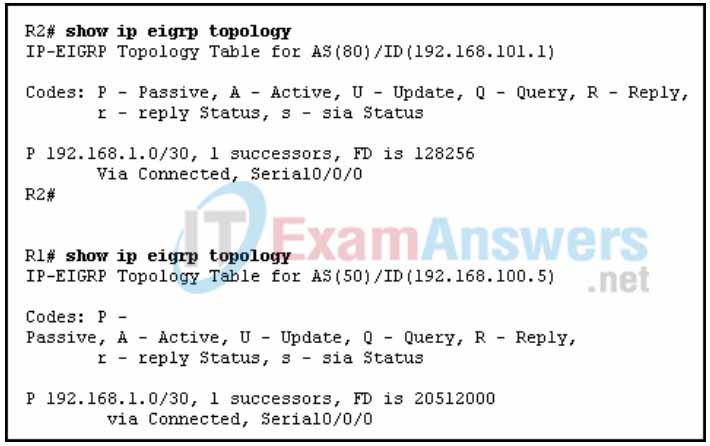
- Enable the serial interfaces of both routers.
- Configure EIGRP to send periodic updates.
- Configure the same hello interval between the routers.
- Configure both routers with the same EIGRP process ID.
Explanation: In EIGRP configuration, the command that starts the EIGRP process is followed by a number that is the autonomous system (AS) number, router eigrp as-number. The as-number must be the same in all routers that are in the same EIGRP routing domain. In this case R2 is configured with AS 80 and R1 is configured with AS 50.
Related exam: CCNA 3 (v5.0.3 + v6.0) Chapter 7 Exam Answers
Related exam: CCNA 3 (v5.0.3 + v6.0) Chapter 8 Exam Answers
Related exam: CCNP ENARSI 8 Modules 1 - 5 Checkpoint Exam: Routing Concepts and EIGRP Exam
Related exam: Quiz – Troubleshooting EIGRP for IPv4 CCNPv8 ENARSI
Related exam: CCNA Exploration 2: ERouting Final Exam
Related exam: CCNA 3 ScaN (v5.0.3 + v6.0) Final Exam Answers
