1. Which frame field is created by a source node and used by a destination node to ensure that a transmitted data signal has not been altered by interference, distortion, or signal loss?
- transport layer error check field
- frame check sequence field
- User Datagram Protocol field
- error correction process field
- flow control field
2. Which data link layer addressing scheme is used in a point-to-point logical topology?
- IPv4 addressing
- IPv6 addressing
- ring addressing
- multi-access addressing
- Layer 2 addressing not required for this topology
3. What do network hosts use data link layer addresses for?
- remote delivery
- local and remote delivery
- local delivery
- remote delivery using routers
4. Which three basic parts are common to all frame types supported by the data link layer? (Choose three.)
- header
- type field
- MTU size
- data
- trailer
- CRC value
5. What are two characteristics of the controlled media access method? (Choose two.)
- It is known as a deterministic access method.
- There are no collisions when this type of method is in use.
- Any station can transmit at any time.
- Bandwidth is more efficiently utilized than in a contention-based access method.
- Stations must determine if the media is carrying a signal before they can transmit.
6. Which of the following are sublayers of the Data Link layer?
- ACL, LMC
- MAC, LAC
- MAC, LLC
- OSI, LLC
7. Which of the following are data link layer encapsulation details? (Choose two.)
- A header and trailer are added.
- Data is converted into packets.
- Packets are packaged into frames.
- Frames are divided into segments.
- Packets are changed into bits for Internet travel.
8. What is achieved by the encapsulation process at the data link layer?
- Packets are put into frames.
- Data is packaged into a packet.
- Packets are divided into segments.
- Data is converted for Internet transmission.
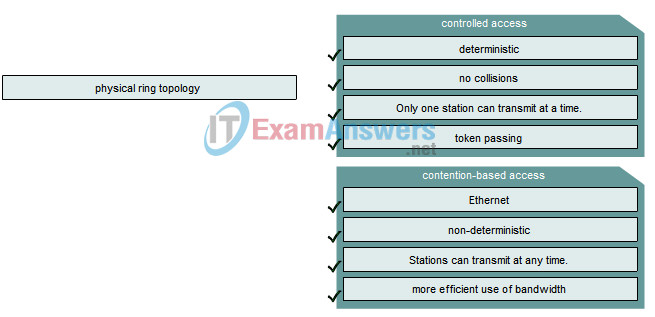
9. Drag the characteristics on the left to the associated media access control methods on the right. (Not all options are used.)
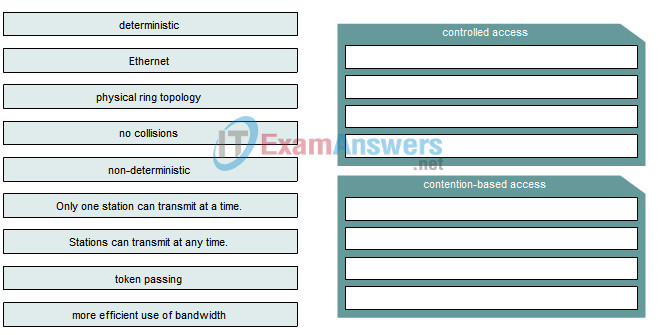
Answer
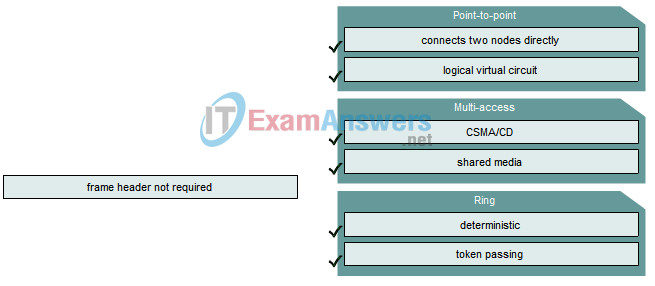
10. Drag the characteristics on the left to the associated topology type on the right. (Not all options are used.)
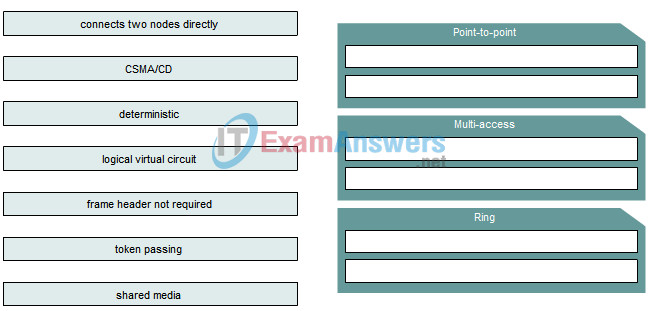
Answer