
14.9.10 Packet Tracer - Implement STP Security Answers Version
Topology
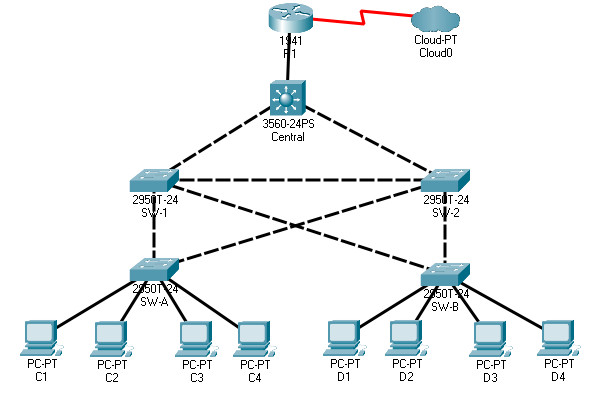
Objectives
- Assign the Central switch as the root bridge.
- Secure spanning-tree parameters to prevent STP manipulation attacks.
Background / Scenario
There have been a number of attacks on the network recently. For this reason, the network administrator has assigned you the task of configuring Layer 2 security.
For optimum performance and security, the administrator would like to ensure that the root bridge is the 3560 Central switch. To prevent spanning-tree manipulation attacks, the administrator wants to ensure that the STP parameters are secure.
All switch devices have been preconfigured with the following:
- Enable password: ciscoenpa55
- Console password: ciscoconpa55
- SSH username and password: SSHadmin / ciscosshpa55
Instructions
Part 1: Configure Root Bridge
Step 1: Determine the current root bridge.
From Central, issue the show spanning-tree command to determine the current root bridge, to see the ports in use, and to see their status.
Question:
Which switch is the current root bridge?
Current root is SW-1.
Based on the current root bridge, what is the resulting spanning tree? (Draw the spanning-tree topology.)
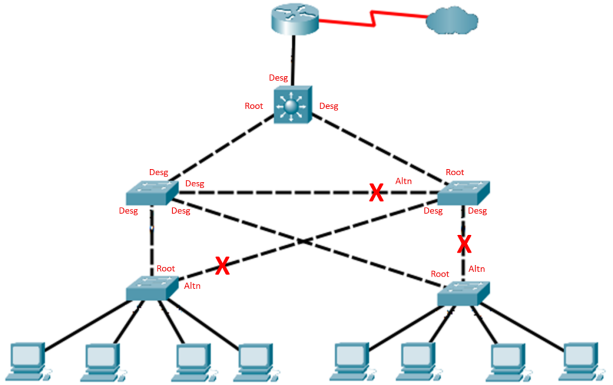
Step 2: Assign Central as the primary root bridge.
Using the spanning-tree vlan 1 root primary command and assign Central as the root bridge.
Central(config)# spanning-tree vlan 1 root primary
Step 3: Assign SW-1 as a secondary root bridge.
Assign SW-1 as the secondary root bridge using the spanning-tree vlan 1 root secondary command.
SW-1(config)# spanning-tree vlan 1 root secondary
Step 4: Verify the spanning-tree configuration.
Issue the show spanning-tree command to verify that Central is the root bridge.
Central# show spanning-tree
VLAN0001
   Spanning tree enabled protocol ieee
   Root ID Priority 24577
           Address  00D0.D31C.634C
           This bridge is the root
           Hello Time 2 sec Max Age 20 sec Forward Delay 15 sec
Questions:
Which switch is the current root bridge?
Current root is Central.
Based on the new root-bridge, what is the resulting spanning tree? (Draw the spanning-tree topology.)
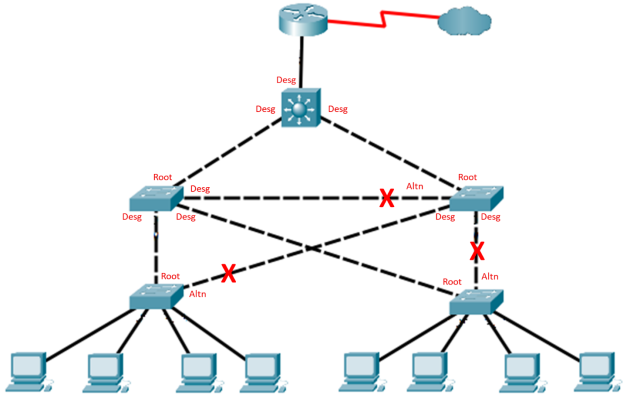
Part 2: Protect Against STP Attacks
Secure the STP parameters to prevent STP manipulation attacks.
Step 1: Enable PortFast on all access ports.
PortFast is configured on access ports that connect to a single workstation or server to enable them to become active more quickly. On the connected access ports of the SW-A and SW-B, use the spanning-tree portfast command.
SW-A(config)# interface range f0/1 - 4

SW-A(config-if-range)# spanning-tree portfast

SW-B(config)# interface range f0/1 - 4

SW-B(config-if-range)# spanning-tree portfast
Step 2: Enable BPDU guard on all access ports.
BPDU guard is a feature that can help prevent rogue switches and spoofing on access ports. Enable BPDU guard on SW-A and SW-B access ports.
SW-A(config)# interface range f0/1 - 4

SW-A(config-if-range)# spanning-tree bpduguard enable

SW-B(config)# interface range f0/1 - 4

SW-B(config-if-range)# spanning-tree bpduguard enable
Note: Spanning-tree BPDU guard can be enabled on each individual port using the spanning-tree bpduguard enable command in interface configuration mode or the spanning-tree portfast bpduguard default command in global configuration mode. For grading purposes in this activity, please use the spanning-tree bpduguard enable command.
Step 3: Enable root guard.
Root guard can be enabled on all ports on a switch that are not root ports. It is best deployed on ports that connect to other non-root switches. Use the show spanning-tree command to determine the location of the root port on each switch.
On SW-1, enable root guard on ports F0/23 and F0/24. On SW-2, enable root guard on ports F0/23 and F0/24.
SW-1(config)# interface range f0/23 - 24

SW-1(config-if-range)# spanning-tree guard root

SW-2(config)# interface range f0/23 - 24

SW-2(config-if-range)# spanning-tree guard root
Device Configs - Final
SWITCH Central
! ==============================================================
!--- 14.9.10 Packet Tracer - Implement STP Security
!--- ANSWER SCRIPT FOR SWITCH Central
!--- Usage: copy this whole file and paste it into the Central terminal (start at the Central> prompt). Every line beginning with "!" is a comment; IOS ignores it, so pasting a comment by accident is harmless.
! ==============================================================

enable
configure terminal

! --------------------------------------------------------------
!--- Part 1: Configure Central as the Primary Root Bridge.
! --------------------------------------------------------------

!--- Lower Central's bridge priority for VLAN 1 below every other switch's, making it the root bridge.
spanning-tree vlan 1 root primary

end

! --------------------------------------------------------------
!--- Save the configuration to NVRAM. (Press Enter when prompted for the destination filename.)
! --------------------------------------------------------------
copy running-config startup-config


! ==============================================================
!--- Verification:
!---   show spanning-tree vlan 1 -> confirms "This bridge is the root" and Priority 24577 (or lower)
!--- Note: "root primary" is a macro — it reads the current lowest bridge priority in the VLAN and sets
!--- Central's priority below it (24576 if none is below that already), rather than a fixed value; this is
!--- why the verification output in the lab shows exactly Priority 24577 (24576 + VLAN 1 system ID extension).
! ==============================================================
SWITCH SW-1
! ==============================================================
!--- 14.9.10 Packet Tracer - Implement STP Security
!--- ANSWER SCRIPT FOR SWITCH SW-1
!--- Usage: copy this whole file and paste it into the SW-1 terminal (start at the SW-1> prompt). Every line beginning with "!" is a comment; IOS ignores it, so pasting a comment by accident is harmless.
! ==============================================================

enable
configure terminal

! --------------------------------------------------------------
!--- Part 1: Configure SW-1 as the Secondary Root Bridge.
! --------------------------------------------------------------

!--- Set a bridge priority that takes over as root for VLAN 1 only if Central goes down.
spanning-tree vlan 1 root secondary

! --------------------------------------------------------------
!--- Part 2: Enable Root Guard on the Non-Root-Facing Trunk Ports.
! --------------------------------------------------------------

!--- Enable root guard on F0/23-24 — the ports connecting to other non-root switches (SW-A/SW-B side),
!--- so no rogue or misconfigured switch attached there can be elected root.
interface range fastethernet 0/23 - 24
 spanning-tree guard root
 exit

end

! --------------------------------------------------------------
!--- Save the configuration to NVRAM. (Press Enter when prompted for the destination filename.)
! --------------------------------------------------------------
copy running-config startup-config


! ==============================================================
!--- Verification:
!---   show spanning-tree vlan 1 -> confirms SW-1 is no longer "the root" but shows a priority just above
!---                                Central's (secondary root)
!---   show spanning-tree summary | include Root guard -> confirms root guard is active on F0/23-24
!--- Note: if a port with root guard enabled receives a superior BPDU (one claiming to be a better root),
!--- it goes into "root-inconsistent" state (traffic blocked) instead of allowing a re-election — this
!--- protects Central's root-bridge role from STP manipulation attacks entering through SW-1.
! ==============================================================
SWITCH SW-2
! ==============================================================
!--- 14.9.10 Packet Tracer - Implement STP Security
!--- ANSWER SCRIPT FOR SWITCH SW-2
!--- Usage: copy this whole file and paste it into the SW-2 terminal (start at the SW-2> prompt). Every line beginning with "!" is a comment; IOS ignores it, so pasting a comment by accident is harmless.
! ==============================================================

enable
configure terminal

! --------------------------------------------------------------
!--- Part 1: Enable Root Guard on the Non-Root-Facing Trunk Ports.
! --------------------------------------------------------------

!--- Enable root guard on F0/23-24 — the ports connecting to other non-root switches (SW-A/SW-B side),
!--- so no rogue or misconfigured switch attached there can be elected root.
interface range fastethernet 0/23 - 24
 spanning-tree guard root
 exit

end

! --------------------------------------------------------------
!--- Save the configuration to NVRAM. (Press Enter when prompted for the destination filename.)
! --------------------------------------------------------------
copy running-config startup-config


! ==============================================================
!--- Verification:
!---   show spanning-tree summary | include Root guard -> confirms root guard is active on F0/23-24
!--- Note: unlike SW-1, SW-2 is not assigned as secondary root in this lab — only Central (primary) and
!--- SW-1 (secondary) get explicit root-bridge priorities; SW-2 only gets the root-guard hardening.
! ==============================================================
SWITCH SW-A
! ==============================================================
!--- 14.9.10 Packet Tracer - Implement STP Security
!--- ANSWER SCRIPT FOR SWITCH SW-A
!--- Usage: copy this whole file and paste it into the SW-A terminal (start at the SW-A> prompt). Every line beginning with "!" is a comment; IOS ignores it, so pasting a comment by accident is harmless.
! ==============================================================

enable
configure terminal

! --------------------------------------------------------------
!--- Part 1: Harden the Access Ports Connecting to PCs (F0/1-4).
! --------------------------------------------------------------

!--- Enable PortFast so these access ports skip listening/learning and go straight to forwarding when a PC connects.
interface range fastethernet 0/1 - 4
 spanning-tree portfast

!--- Enable BPDU guard — if this access port ever receives a BPDU (e.g. a rogue switch plugged in), it is
!--- immediately error-disabled instead of being allowed to participate in the spanning tree.
 spanning-tree bpduguard enable
 exit

end

! --------------------------------------------------------------
!--- Save the configuration to NVRAM. (Press Enter when prompted for the destination filename.)
! --------------------------------------------------------------
copy running-config startup-config


! ==============================================================
!--- Verification:
!---   show running-config interface fastethernet 0/1 -> confirms "spanning-tree portfast" and
!---                                        "spanning-tree bpduguard enable" on each of F0/1-4
!---   show spanning-tree summary | include BPDU  -> confirms BPDU guard is active on these ports
!--- Note: per the lab's own instructions, use "spanning-tree bpduguard enable" per interface (not the
!--- global "spanning-tree portfast bpduguard default" command) — the activity is graded on this exact
!--- per-interface command.
! ==============================================================
SWITCH SW-B
! ==============================================================
!--- 14.9.10 Packet Tracer - Implement STP Security
!--- ANSWER SCRIPT FOR SWITCH SW-B
!--- Usage: copy this whole file and paste it into the SW-B terminal (start at the SW-B> prompt). Every line beginning with "!" is a comment; IOS ignores it, so pasting a comment by accident is harmless.
! ==============================================================

enable
configure terminal

! --------------------------------------------------------------
!--- Part 1: Harden the Access Ports Connecting to PCs (F0/1-4).
! --------------------------------------------------------------

!--- Enable PortFast so these access ports skip listening/learning and go straight to forwarding when a PC connects.
interface range fastethernet 0/1 - 4
 spanning-tree portfast

!--- Enable BPDU guard — if this access port ever receives a BPDU (e.g. a rogue switch plugged in), it is
!--- immediately error-disabled instead of being allowed to participate in the spanning tree.
 spanning-tree bpduguard enable
 exit

end

! --------------------------------------------------------------
!--- Save the configuration to NVRAM. (Press Enter when prompted for the destination filename.)
! --------------------------------------------------------------
copy running-config startup-config


! ==============================================================
!--- Verification:
!---   show running-config interface fastethernet 0/1 -> confirms "spanning-tree portfast" and
!---                                        "spanning-tree bpduguard enable" on each of F0/1-4
!---   show spanning-tree summary | include BPDU  -> confirms BPDU guard is active on these ports
!--- Note: per the lab's own instructions, use "spanning-tree bpduguard enable" per interface (not the
!--- global "spanning-tree portfast bpduguard default" command) — the activity is graded on this exact
!--- per-interface command.
! ==============================================================


