How to find: Press "Ctrl + F" in your browser and type key terms to locate the specific exam item or explanation. If the item is not listed on this page, please search for it in our comprehensive IT Exam Items Repository.
Networking Essentials 3.0: Course Final Exam
1. To which component of the CIA triad security information principle does tokenization apply?
- confidentiality
- availability
- authorization
- integrity
Explanation: Topic 39.1.3
To accomplish confidentiality without encryption, tokenization is a substitution technique that can isolate data elements from exposure to other data systems.
2. Which troubleshooting method involves swapping a device suspected of having issues with a known good device to see if the problem is solved?
- educated guess
- comparison
- substitution
- divide-and-conquer
Explanation: Topic 36.1.4
With the substitution troubleshooting method, a know suitable device is used to replace a suspected bad device. If this fixes the problem, then the problem was with the removed device. If the issue remains, the cause resides someplace else, and the troubleshooting continues.
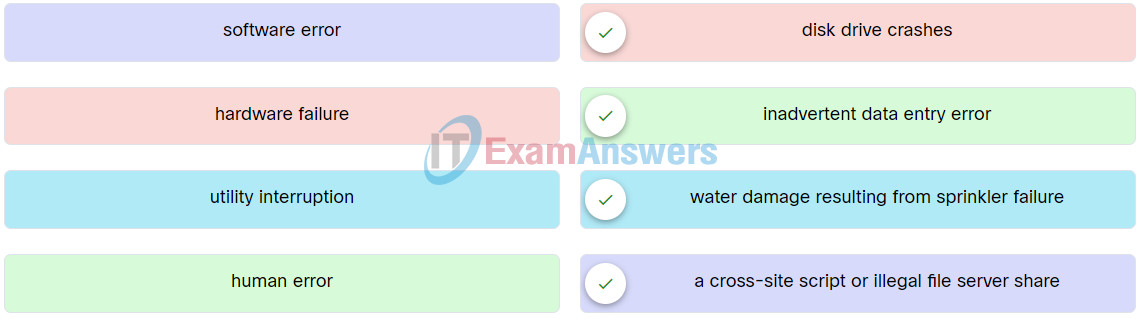
3. Match the examples of cyber threat to the description.
Network Support and Security Final Exam Q15
Explanation: Topic 38.1.2
Place the options in the following order:
| hardware failure |
disk drive crashes |
| human error |
inadvertent data entry error |
| utility interruption |
water damage resulting from sprinkler failure |
| software error |
a cross-site script or illegal file server share |
4. Which statement describes an advanced persistent threat (APT)?
- an attack that modifies the operating system through malware and creates a backdoor on the infected system.
- an attack that takes advantage of algorithms in a piece of legitimate software to generate unintended behaviors.
- an attack by threat actors performing unauthorized network probing and port scanning on the targeted network.
- a continuous attack that uses elaborated espionage tactics involving multiple threat actors and sophisticated malware to gain access to the targeted network.
Explanation: Topic 38.1.2
An advanced persistent threat (APT) is a continuous attack that uses elaborate espionage tactics involving multiple actors and sophisticated malware to gain access to the targeted network.
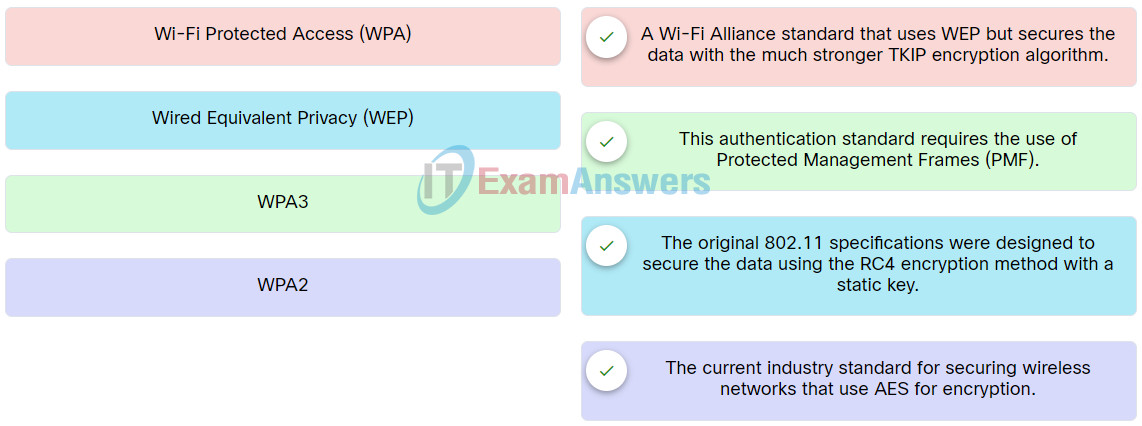
5. Match the authentication method to description.
Network Support and Security Course Final Exam Q24
Explanation: Topic 39.6.10
Place the options in the following order:
| Wi-Fi Protected Access (WPA) |
A Wi-Fi Alliance standard that uses WEP but secures the data with the much stronger TKIP encryption algorithm. |
| WPA3 |
This authentication standard requires the use of Protected Management Frames (PMF). |
| Wired Equivalent Privacy (WEP) |
The original 802.11 specifications were designed to secure the data using the RC4 encryption method with a static key. |
| WPA2 |
The current industry standard for securing wireless networks that use AES for encryption. |
6. Which Apple security feature ensures that only authentic, digitally-signed software that an Apple-notarized software developer has created is permitted to be installed?
- XProtect
- Security-focused hardware
- Gatekeeper
- MRT
Explanation: Topic 39.3.8
Gatekeeper, an Apple macOS security feature, ensures that only authentic, digitally-signed software that an Apple-notarized software developer has created can be installed.
7. Which type of cyber threat would cause electrical power outages?
- human error
- sabotage
- utility interruption
- hardware failure
Explanation: Topic 38.1.2
Utility interruption is a cyber threat that can cause Electrical power outages and water damage resulting from sprinkler failure.
8. Employees in an organization report that they cannot access the customer database on the main server. Further investigation reveals that the database file is now encrypted. Shortly afterward, the organization receives a threatening email demanding payment for the decryption of the database file. What type of attack has the organization experienced?
- trojan horse
- ransomware
- DoS attack
- man-in-the-middle attack
Explanation: Topic 38.3.3
In a ransomware attack, the attacker compromises the victum computer and encrypts the hard drive so that data can no longer be accessed by the user. The attacker then demands payment from the user to decrypt the drive.
9. Refer to the exhibit. How many bits are represented by each group of four hexadecimal values contained between the colons in an IPv6 address?

Explanation: Topic 10.2.2
The four hexadecimal values contained in a hextet represent 16 bits. There are eight hextets in an IPv6 address that make up the total 128 bits of the address. (16 x 8 = 128).
10. Which network design has the fewest broadcast domains?
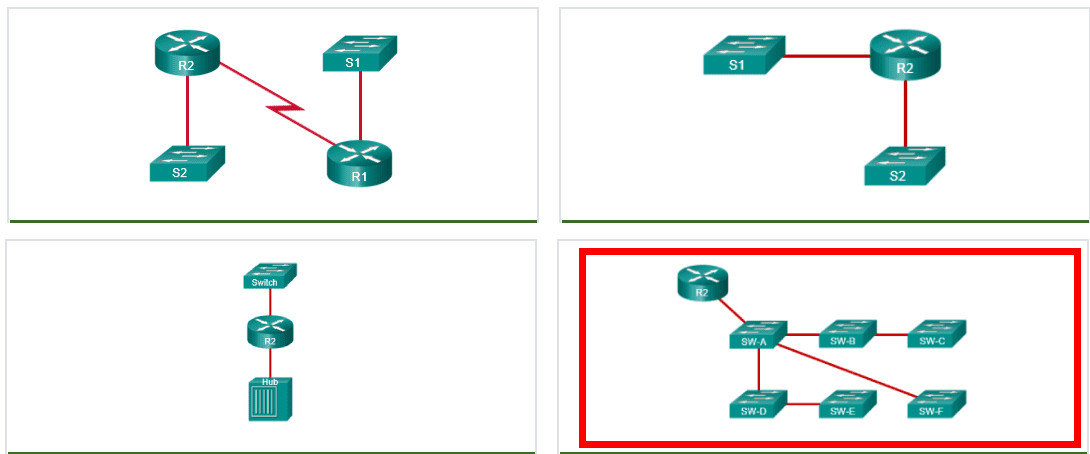
Explanation: Topic 13.2.2
Routers break networks into separate broadcast domains. Each LAN is a broadcast domain. The correct answer has only one broadcast domain. All other answers have two broadcast domains.
11. A company uses DHCP servers to dynamically assign IPv4 addresses to employee workstations. The address lease duration is set as 5 days. An employee returns to the office after an absence of one week. When the employee boots the workstation, it sends a message to obtain an IP address. Which Layer 2 and Layer 3 destination addresses will the message contain?
- FF-FF-FF-FF-FF-FF and 255.255.255.255
- MAC address of the DHCP server and 255.255.255.255
- FF-FF-FF-FF-FF-FF and IPv4 address of the DHCP server
- both MAC and IPv4 addresses of the DHCP server
Explanation: Topic 25.2.3
When the lease of a dynamically assigned IPv4 address has expired, a workstation will send a DHCPDISCOVER message to start the process of obtaining a valid IP address. Because the workstation does not know the addresses of DHCP servers, it sends the message via broadcast, with destination addresses of FF-FF-FF-FF-FF-FF and 255.255.255.255.
12. What are two characteristics of multicast transmission? (Choose two.)
- The source address of a multicast transmission is in the range of 224.0.0.0 to 224.0.0.255.
- Multicast transmission can be used by routers to exchange routing information.
- A single packet can be sent to a group of hosts.
- Multicast messages map lower layer addresses to upper layer addresses.
- Computers use multicast transmission to request IPv4 addresses.
Explanation: Topic 9.1.6
Broadcast messages consist of single packets that are sent to all hosts on a network segment. These types of messages are used to request IPv4 addresses, and map upper layer addresses to lower layer addresses. A multicast transmission is a single packet sent to a group of hosts and is used by routing protocols, such as OSPF and RIPv2, to exchange routes. The address range 224.0.0.0 to 224.0.0.255 is reserved for link-local addresses to reach multicast groups on a local network.
13. All employees in an organization receive an email stating that their account password will expire immediately and that they should reset their password within five minutes. Which of the following statements best describes this email?
- It is a DDoS attack.
- It is a hoax.
- It is a piggyback attack.
- It is an impersonation attack.
Explanation: Topic 38.2.5
A hoax is an act intended to deceive or trick someone. This type of email can cause unnecessary disruption, extra work, and fear.
14. Which is an example of a behavioral characteristic?
- voice
- ear features
- face
- DNA
Explanation: Topic 39.2.7
There are two types of biometric identifiers:
- Physical characteristics: fingerprints, DNA, face, hands, retina, or ear features.
- Behavioral characteristics: behavior patterns such as gestures, voice, gait, or typing rhythm.
15. What is the limitation of using a stateful firewall in a network?
- Less information is provided in the logs compared to a packet-filtering firewall.
- No defense against spoofing and DoS attacks.
- Weak packet filtering.
- Difficult to defend against dynamic port negotiation.
Explanation: Topic 39.5.5
The limitations of a stateful firewall are:
- No Application Layer inspection
- Limited tracking of stateless protocols
- Difficult to defend against dynamic port negotiation
- No authentication support
16. Which Windows utility would a technician use to discover which user was logged in to the system when a critical problem occurred?
- Event Viewer
- Device Manager
- Task Manager
- Users and Groups MMC
Explanation: Topic 37.3.8
When a critical issue arises, technicians can investigate the system using the Windows Event Viewer. Windows Event Viewer logs contain information about events affecting the system, including when a user logs into the system.
17. Which statement describes the principle of availability in the CIA information security triad?
- Cryptographic encryption algorithms such as AES may be required to encrypt and decrypt data.
- Data must be protected from unauthorized alteration.
- Only authorized individuals, entities, or processes can access sensitive information.
- Redundant services, gateways, and links must be implemented.
Explanation: Topic 39.1.2
According to the CIA information security triad, the principle of availability means that authorized users must have uninterrupted access to important resources and data. It requires implementing redundant services, gateways, and links.
18. Which scenario is suitable for deploying twisted-pair cables?
- to connect network devices in backbone networks
- to connect a TV set to the wall plug at home
- to connect data centers with high bandwidth requirements over long distances
- to connect PC workstations in an office
Explanation: Topic 6.1.3
Ethernet technology generally uses twisted-pair cables to interconnect devices. Because Ethernet is the foundation for most local networks, twisted-pair is the most commonly used type of network cabling for connecting office computers.
19. Which three types of nodes should be assigned static IP addresses on a network? (Choose three.)
- desktop PCs
- printers
- mobile laptops
- gateways
- tablets
- servers
Explanation: Topic 25.2.1
Servers, printers, and intermediary devices, such as routers, switches, and access points should have statically assigned IP addresses so that they are accessible to users and available for remote management.
20. Match the host-based security solution to the description.
Explanation: Topic 39.3.5
Place the options in the following order:
| Host-based firewall |
It runs on a device to restrict incoming and outcoming network activity for that device. It can allow or deny traffic between the device and the network. |
| Host intrusion detection system |
It is installed on a device or server to monitor suspicious activity. It can also monitor configuration information about the device held in the system registry. |
| Host intrusion prevention system |
It monitors a device for known attacks and anomalies (deviations in bandwidth, protocols, and ports) or finds red flags by assessing the protocols in packets. |
| Endpoint detection and response |
It is an integrated security solution that continuously monitors and collects data from an endpoint device. It then analyzes the data and responds to any threats it detects. |
| Data loss prevention |
The tools provide a centralized way to ensure that sensitive data is not lost, misused or accessed by unauthorized users. |
| Next-generation firewall |
It is a network security device that combines a traditional firewall with other network-device-filtering functions. |
21. What layer is responsible for routing messages through an internetwork in the TCP/IP model?
- network access
- session
- transport
- internet
Explanation: Topic 5.3.5
The TCP/IP model consists of four layers: application, transport, internet, and network access. Of these four layers, it is the internet layer that is responsible for routing messages. The session layer is not part of the TCP/IP model but is rather part of the OSI model.
22. What data encoding technology is used in copper cables?
- electrical pulses
- modulation of specific frequencies of electromagnetic waves
- modulation of light rays
- pulses of light
Explanation: Topic 6.1.2
Data is transmitted across a network on media. Modern networks primarily use three types of media to interconnect devices:
- Metal wires within cables (copper cable, such as twisted-pair and coaxial cable) - Data is encoded into electrical impulses.
- Glass or plastic fibers within cables (fiber-optic cable) - Data is encoded into pulses of light.
- Wireless transmission - Data is encoded via modulation of specific frequencies of electromagnetic waves.
23. What information is added to the switch table from incoming frames?
- destination IP address and incoming port number
- source MAC address and incoming port number
- source IP address and incoming port number
- destination MAC address and incoming port number
Explanation: Topic 21.4.2
A switch “learns” or builds the MAC address table based on the source MAC address as a frame comes into the switch. A switch forwards the frame onward based on the destination MAC address.
24. At which layer of the OSI model would a logical address be added during encapsulation?
- network layer
- physical layer
- transport layer
- data link layer
Explanation: Topic 22.1.2
Logical addresses, also known as IP addresses, are added at the network layer. Physical addresses are edded at the data link layer. Port addresses are added at the transport layer. No addresses are added at the physical layer.
25. Which type of network model describes the functions that must be completed at a particular layer, but does not specify exactly how each protocol should work?
- reference model
- hierarchical design model
- protocol model
- TCP/IP model
Explanation: Topic 5.3.4
There are two common types of network communication models:
Protocol model – This model closely matches the structure of a particular protocol suite and describes the functions that occur at each layer of protocols within the suite. The TCP/IP model is an example of a protocol model.
Reference model – The primary purpose is to aid in a clearer understanding of the functions and processes necessary for network communications.This type of model does not specify exactly how a function should be accomplished. The OSI model is an example of a reference model.
26. What type of route is indicated by the code C in an IPv4 routing table on a Cisco router?
- directly connected route
- default route
- dynamic route learned from another router
- static route
Explanation: Topic 32.2.6
Some of the IPv4 routing table codes include the following:
C – directly connected
S – static
D – EIGRP
* – candidate default
27. A small accounting office is setting up a wireless network to connect end devices and to provide internet access. In which two scenarios does a wireless router perform Network Address Translation (NAT)? (Choose two.)
- when a host is sending packets to the ISP in order to request a speed increase for Internet services
- when a host is sending packets to a local server in order to update the network media settings and music playlists
- when a host is sending packets to a remote site owned by the manufacturer of the wireless router in order to request a digital copy of the device manual
- when a host is sending a print job to a network printer on the LAN
- when a host is sending HTTP packets to the wireless router in order to update the network addressing of the LAN
Explanation: Topic 12.3.1
A wireless router will perform Network Address Translation (NAT) whenever a private (local) source IPv4 address is translated to a public (global) address.
28. Refer to the exhibit. A switch with a default configuration connects four hosts. The ARP table for host A is shown. What happens when host A wants to send an IP packet to host D?
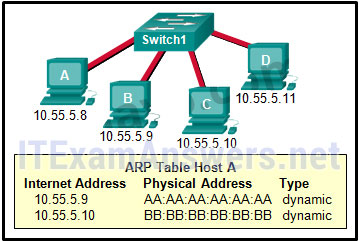
- Host A sends out the packet to the switch. The switch sends the packet only to the host D, which in turn responds.
- Host D sends an ARP request to host A.
- Host A sends an ARP request to the MAC address of host D.
- Host A sends out a broadcast of FF:FF:FF:FF:FF:FF. Every other host connected to the switch receives the broadcast and host D responds with its MAC address.
Explanation: Topic 13.2.5
Whenever the destination MAC address is not contained within the ARP table of the originating host, the host (host A in this example) will send a Layer 2 broadcast that has a destination MAC address of FF:FF:FF:FF:FF:FF. All devices on the same network receive this broadcast. Host D will respond to this broadcast.
29. What will a Cisco LAN switch do if it receives an incoming frame and the destination MAC address is not listed in the MAC address table?
- Send the frame to the default gateway address.
- Drop the frame.
- Forward the frame out all ports except the port where the frame is received.
- Use ARP to resolve the port that is related to the frame.
Explanation: Topic 21.4.2
A LAN switch populates the MAC address table based on source MAC addresses. When a switch receives an incoming frame with a destination MAC address that is not listed in the MAC address table, the switch forwards the frame out all ports except for the ingress port of the frame. When the destination device responds, the switch adds the source MAC address and the port on which it was received to the MAC address table.
30. Which number grouping is a valid IPv6 address?
- 1234:1230::1238::1299:1000::
- 1b10::1100::2001::2900::ab11::1102::0000::2900
- 2001:0db8:3c55:0015:1010:0000:abcd:ff13
- 12aa::1298:1200::129b
Explanation: Topic 10.2.2
An IPv6 address is made up of 128 bits represented in hexadecimal numbers.There are two rules that help reduce the number of digits needed to represent an IPv6 address.
- Rule 1 - Omit leading zeros in any 16-bit section.
- Rule 2 – Replace any single group of consecutive zeros with a double colon (::). This can only be used once within an IPv6 address.
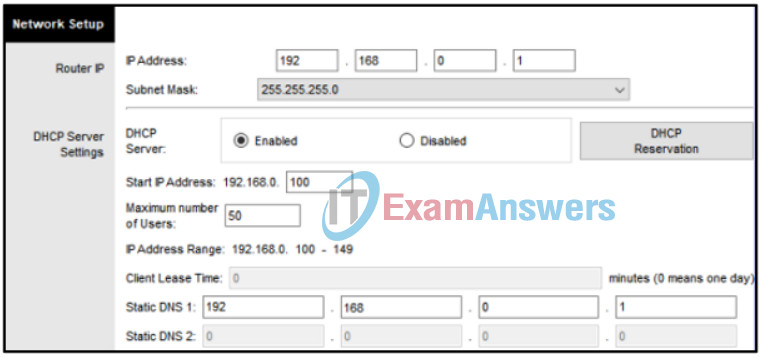
31. Refer to the exhibit. A newly purchased client laptop has just connected to the local area network. The local area network is using a wireless router that is providing dynamic addressing as shown. Which IP address does the laptop use as a destination address when requesting a dynamically assigned address?
- 192.168.0.100
- 255.255.255.255
- 192.168.0.255
- 255.255.255.0
- 192.168.0.1
Explanation: Topic 25.2.3
When a new client device is installed on a network that uses dynamic IP addressing, the client will send out a DHCP request message with the destination IPv4 address of 255.255.255.255.
32. Two pings were issued from a host on a local network. The first ping was issued to the IP address of the default gateway of the host and it failed. The second ping was issued to the IP address of a host outside the local network and it was successful. What is a possible cause for the failed ping?
- The default gateway is not operational.
- The TCP/IP stack on the default gateway is not working properly.
- Security rules are applied to the default gateway device, preventing it from processing ping requests.
- The default gateway device is configured with the wrong IP address.
Explanation: Topic 29.2.3
If the ping from one host to another host on a remote network is successful, this indicates that the default gateway is operational. In this scenario, if a ping from one host to the default gateway failed, it is possible that some security features are applied to the router interface, preventing it from responding to ping requests.
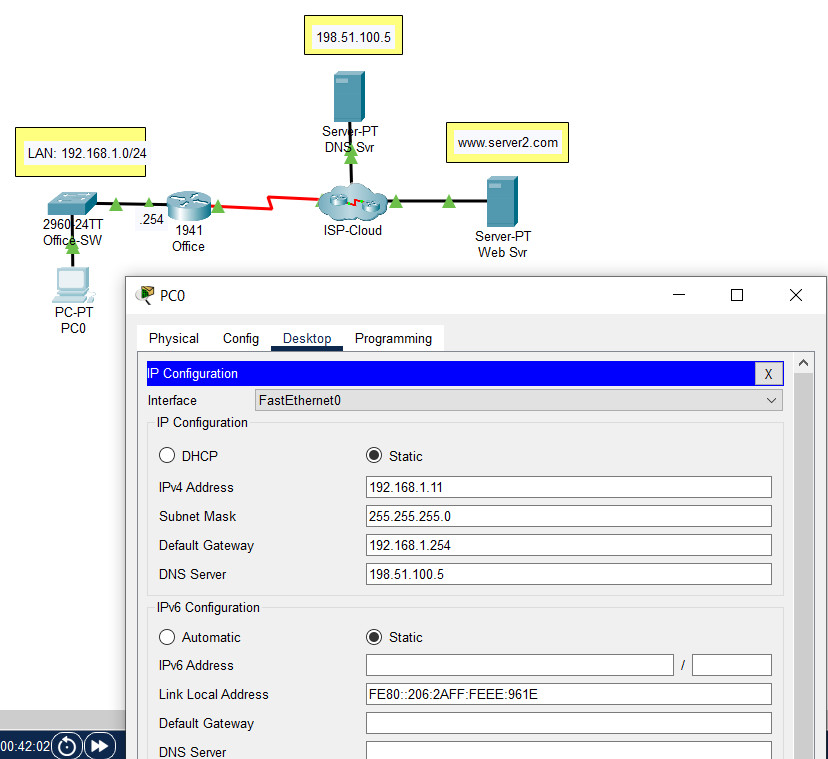
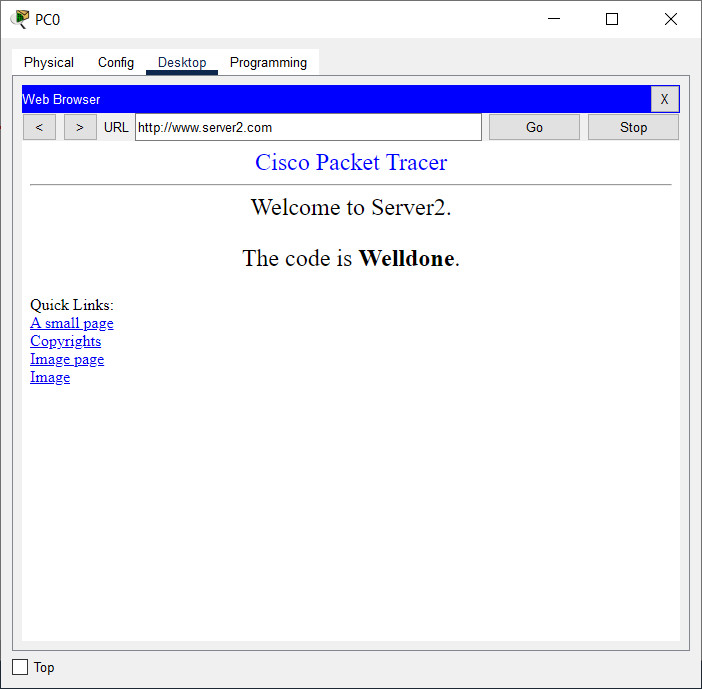
33. Open the PT activity. Perform the tasks in the activity instructions and then answer the question. What is the code displayed on the web page?
- Success
- Correct
- Welldone
- Configured Right
Explanation: Topic 23.1.2
The IP address configuration on PC0 requires the following:
- IP address - any valid host address on the LAN, except for .254
- Subnet mask - default value for the network
- Gateway - the nearest router interface
- DNS - the DNS server on the ISP network
34. What process involves placing one message format inside of another message format?
- flow control
- encapsulation
- encoding
- segmentation
Explanation: Topic 7.1.2
When a message is placed inside of another message, this is known as encapsulation. On networks, encapsulation takes place when one protocol data unit is carried inside of the data field of the next lower protocol data unit.
35. A cable installation company is trying to convince a customer to use fiber-optic cabling instead of copper cables for a particular job. What is one advantage of using fiber-optic cabling compared to copper cabling?
- The installation skills required for fiber-optic cabling are lower.
- Fiber-optic cabling can transmit signals without attenuation.
- Fiber-optic cabling is completely immune to EMI and RFI.
- The cost of fiber-optic connectors is lower.
Explanation: Topic 30.5.6
When comparing UTP cabling with fiber-optic cabling, note the following: fiber-optic connectors have higher costs, technician installation skills required are higher, fiber bandwidth supported is higher, and fiber-optic cabling is immune to RFI and EMI, and can transmit signals with less attenuation.
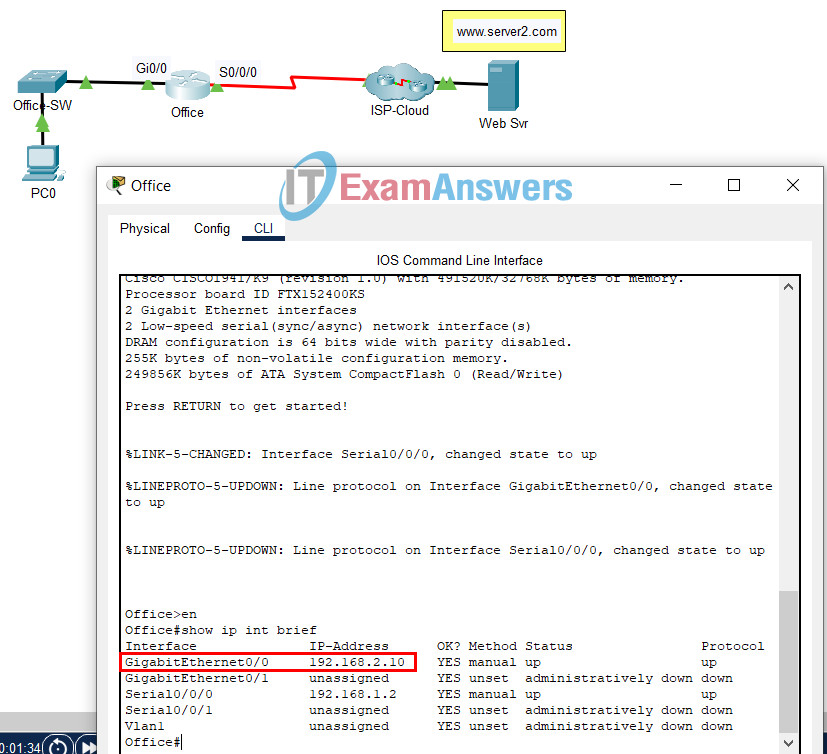
36. Open the PT activity. Perform the tasks in the activity instructions and then answer the question. Which IP address should be used as the default gateway address on PC0?
Networking Basics Course Final Exam
- 192.168.2.10
- 192.168.1.1
- 192.168.2.5
- 192.168.1.2
Explanation: Topic 32.1.2
The default gateway address identifies a network device through which end user devices on the LAN can communicate with hosts on remote networks. The default gateway is usually the router interface attached to the LAN.
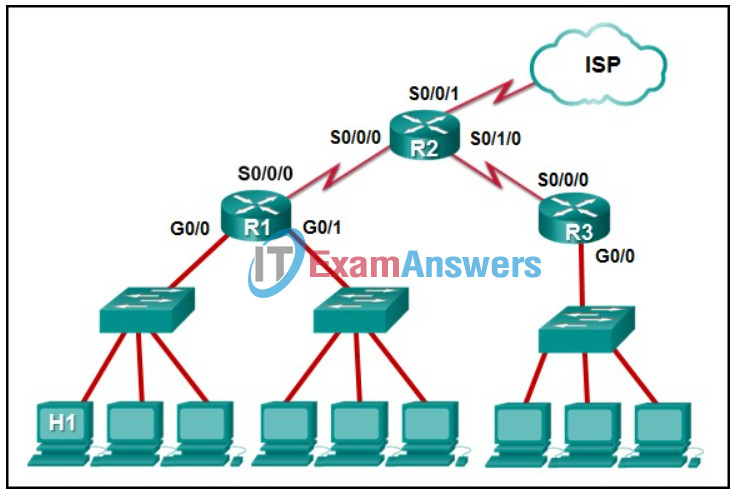
37. Refer to the exhibit. The IP address of which device interface should be used as the default gateway setting of host H1?
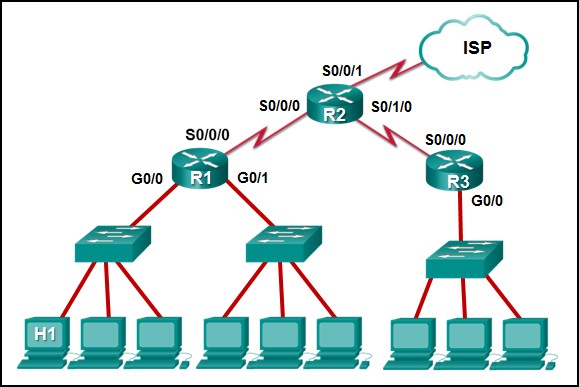
- R1: G0/0
- R2: S0/0/1
- R1: S0/0/0
- R2: S0/0/0
Explanation: Topic 32.1.2
The default gateway for host H1 is the router interface that is attached to the LAN that H1 is a member of. In this case, that is the G0/0 interface of R1. H1 should be configured with the IP address of that interface in its addressing settings. R1 will provide routing services to packets from H1 that need to be forwarded to remote networks.
38. A network administrator has a multi-floor LAN to monitor and maintain. Through careful monitoring, the administrator has noticed a large amount of broadcast traffic slowing the network. Which device would you use to best solve this problem?
- switch
- router
- host
- server
Explanation: Topic 13.2.2
All hosts within a single LAN belong to one broadcast domain. As the number of hosts increase, it could cause more traffic on the segment and may slow network performance. To solve the performance issue, a router would be the device used to segment the single LAN into multiple LANs.
39. Which two criteria are used to help select a network medium for a network? (Choose two.)
- the environment where the selected medium is to be installed
- the cost of the end devices that are used in the network
- the number of intermediate devices that are installed in the network
- the distance the selected medium can successfully carry a signal
- the types of data that need to be prioritized
Explanation: Topic 6.1.2
Criteria for choosing a network medium include the following:
The distance the selected medium can successfully carry a signal in the environment in which the selected medium is to be installed
The amount of data and the speed at which the data must be transmitted
The cost of the medium and its installation
40. What benefit does DHCP provide to a network?
- DHCP allows users to refer to locations by a name rather than an IP address.
- Hosts always have the same IP address and are therefore always reachable.
- Hosts can connect to the network and get an IP address without manual configuration.
- Duplicate addresses cannot occur on a network that issues dynamic addresses using DHCP and has static assignments.
Explanation: Topic 25.2.1
DHCP provides automatic IP address configuration to hosts on a network. Hosts will be dynamically assigned an address when they connect to the network, although not necessarily the same address each time they connect. If there are static and dynamic addresses used together on the network there could still be the possibility of address conflicts. DNS can be used in conjunction with DHCP to allow users to communicate using names rather than IP addresses.
41. Which wireless technology allows a customer to connect to a payment terminal in the store with a smartphone?
Explanation: Topic 3.1.3
NFC, or Near Field Communications, is a wireless technology for communication between devices at extremenly short distances and is used in contactless payment systems.
42. What are two methods typically used on a mobile device to provide internet connectivity? (Choose two.)
- Bluetooth
- cellular
- NFC
- GPS
- Wi-Fi
Explanation: Topic 3.1.3
Mobile devices commonly use Wi-Fi and cellular to connect to the internet. The cellular connection uses the cellular data network for a fee. The Wi-Fi connection uses an 802.11 wireless network in the area to connect to the internet.
43. What information does an Ethernet switch examine and use to build its address table?
- destination IP address
- destination MAC address
- source IP address
- source MAC address
Explanation: Topic 21.4.2
An Ethernet switch examines the source MAC address of an incoming frame. If the source MAC address is not in the MAC address table, the switch will add it to the table with the associated ingress Ethernet port.
44. Which two OSI model layers have the same functionality as two layers of the TCP/IP model? (Choose two.)
- transport
- network
- data link
- session
- physical
Explanation: Topic 5.3.5
The OSI transport layer is functionally equivalent to the TCP/IP transport layer, and the OSI network layer is equivalent to the TCP/IP internet layer. The OSI data link and physical layers together are equivalent to the TCP/IP network access layer. The OSI session layer (with the presentation layer) is included within the TCP/IP application layer.
45. Refer to the exhibit. A technician is attempting to configure the IPv6 address 2001:db8::1111::0200 on a device. Why does the device return an error message that indicates the address is not valid?
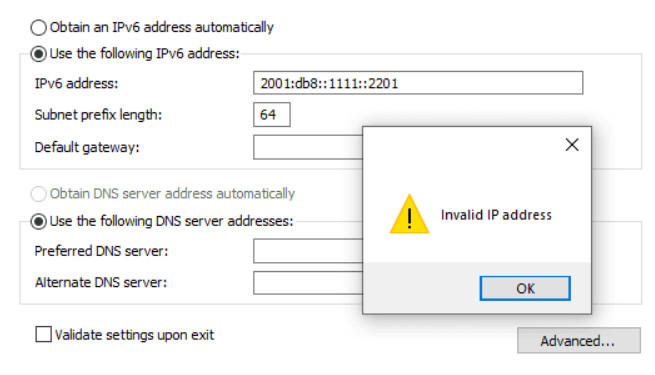
Networking Basics Course Final Exam 30
- The IPv6 address notation is incorrect.
- IPv6 is not implemented on this network.
- The device already is configured with an IPv4 address.
- The address is already in use on the network.
Explanation: Topic 10.2.5
The IP address entered by the technician is in an invalid notation format because it contains two instances of the double colon (::). When using a shortened IPv6 notation, a double colon can only be used once.
46. An employee is having connectivity issues. Why might a network technician try to ping the default gateway from the employee laptop?
- to verify connectivity with the device that provides access to remote networks
- to verify that an IP address was provided by the DHCP server
- to determine if the laptop address is included in the DNS server
- to verify that the SVI interface on the switch is configured correctly
Explanation: Topic 29.2.3
The default gateway address is usually the address of the router interface. The router provides access to remote networks, so a successful ping to the default gateway would mean that the laptop is able to communicate with the router.
47. Refer to the exhibit. PC1 issues an ARP request because it needs to send a packet to PC3. In this scenario, what will happen next?
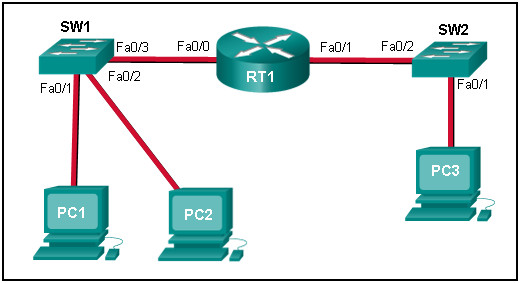
- SW1 will send an ARP reply with its Fa0/1 MAC address.
- RT1 will send an ARP reply with its own Fa0/0 MAC address.
- RT1 will send an ARP reply with the PC3 MAC address.
- RT1 will forward the ARP request to PC3.
- RT1 will send an ARP reply with its own Fa0/1 MAC address.
Explanation: Topic 24.1.5
When a network device has to communicate with a device on another network, it broadcasts an ARP request asking for the default gateway MAC address. The default gateway (RT1) unicasts an ARP reply with the Fa0/0 MAC address.
48. Which three addresses are valid public addresses? (Choose three.)
- 198.133.219.17
- 128.107.12.117
- 172.31.1.25
- 10.15.250.5
- 64.104.78.227
- 192.168.1.245
Explanation: Topic 9.2.1
The ranges of private IPv4 addresses are as folllows:
10.0.0.0 – 10.255.255.255
172.16.0.0 – 172.31.255.255
192.168.0.0 – 192.168.255.255
49. A technician is troubleshooting a network connectivity problem. Pings to the local wireless router are successful but pings to a server on the Internet are unsuccessful. Which CLI command could assist the technician to find the location of the networking problem?
- msconfig
- ipconfig/renew
- tracert
- ipconfig
Explanation: Topic 29.2.5
The tracert utlility (also known as the tracert command or tracert tool) will enable the technician to locate the link to the server that is down. The ipconfig command displays the computer network configuration details. The ipconfig/renew command requests an IP address from a DHCP server. Msconfig is not a network troubleshooting command.
50. Which two TCP header fields are used to confirm receipt of data? (Choose two.)
- FCS
- acknowledgment number
- sequence number
- preamble
- checksum
Explanation: Topic 26.6.3
Together the TCP sequence number and acknowledgment number fields are used by the receiver to inform the sender of the bytes of data that the receiver has accepted.
51. When analog voice signals are converted for use on a computer network, in what format are they encapsulated?
- IP packets
- segments
- frames
- bits
Explanation: Topic 16.7.4
When Voice over iP (VoIP) is being used, analog voice signals are translated into digital data in the form of IP packets. This translation allows the phone call to be carried through a computer network.
52. Refer to the exhibit. An administrator is trying to troubleshoot connectivity between PC1 and PC2 and uses the tracert command from PC1 to do it. Based on the displayed output, where should the administrator begin troubleshooting?
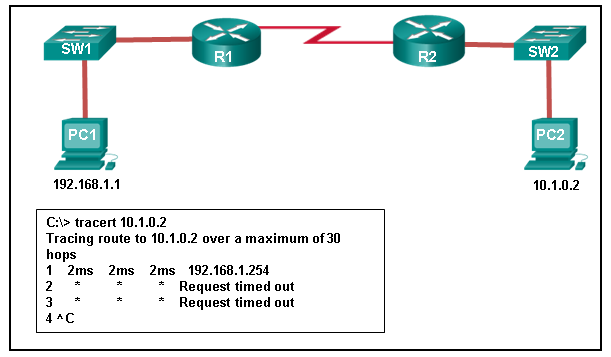
Explanation: Topic 29.2.5
Tracert is used to trace the path a packet takes. The only successful response was from the first device along the path on the same LAN as the sending host. The first device is the default gateway on router R1. The administrator should therefore start troubleshooting at R1.
53. A network technician attempts to ping www.example.net from a customer computer, but the ping fails. Access to mapped network drives and a shared printer are working correctly. What are two potential causes for this problem? (Choose two.)
- The Windows domain or workgroup name that is configured on the computer is incorrect.
- The computer has been assigned a static IP address.
- The target web server is down.
- DNS service is unavailable on the customer network.
- The HTTP protocol is not working properly on the target server.
Explanation: Topic 17.1.4
A ping would fail if the destination device was not operational. It would also fail if the DNS server was unavailable to convert the URL to an IP address. The fact that a computer had a static IP address is not a factor. Even if the target protocol (HTTP) is not functioning, the server would still respond to a ping.
54. A data center has recently updated a physical server to host multiple operating systems on a single CPU. The data center can now provide each customer with a separate web server without having to allocate an actual discrete server for each customer. What is the networking trend that is being implemented by the data center in this situation?
- maintaining communication integrity
- online collaboration
- virtualization
- BYOD
Explanation: Topic 19.2.2
Virtualization technology can run several different operating systems in parallel on a single CPU.
55. What is an example of cloud computing?
- a service that offers on-demand access to shared resources
- a network infrastructure that spans a large geographic area
- an architectural style of the World Wide Web
- a continuous interaction between people, processes, data, and things
Explanation: Topic 19.1.2
Cloud computing provides on-demand access to shared resources. With minimal management effort, resources can be deployed quickly at data centers.
56. Which two scenarios would benefit the user the most by adding quality of service (QoS) to the network? (Choose two.)
- Students are updating information about their sport activities on the class Facebook page.
- A student is sending emails to a friend.
- A student is communicating via Skype with a friend in another country.
- Students are watching a lecture from a YouTube site.
Explanation: Topic 18.1.5
Voice and video data need to be transmitted in a continuous stream. If packets are delayed, the audio and video quality will be poor, sometimes even not usable. QoS can give voice and video data high priority during the data transmission so that they would be sent first before other types of traffic, such as email, web surfing, and web page update.
57. An employee of a large corporation remotely logs into the company using the appropriate username and password. The employee is attending an important video conference with a customer concerning a large sale. It is important for the video quality to be excellent during the meeting. The employee is unaware that after a successful login, the connection to the company ISP failed. The secondary connection, however, activated within seconds. The disruption was not noticed by the employee or other employees.
What three network characteristics are described in this scenario? (Choose three.)
- scalability
- security
- integrity
- fault tolerance
- quality of service
- powerline networking
Explanation: Topic 18.1.1
Usernames and passwords relate to network security. Good quality video, to support video conferencing, relates to prioritizing the video traffic with quality of service (QoS). The fact that a connection to an ISP failed and was then restored but went unnoticed by employees relates to the fault tolerant design of the network.
58. Which three statements describe the functions of the Cisco hierarchical network design model? (Choose three.)
- The goal of the core layer is maximizing throughput.
- The distribution layer distributes network traffic directly to end users.
- The distribution layer is responsible for traffic filtering and isolating failures from the core.
- The access layer provides a means of connecting end devices to the network.
- Route summarization is not necessary at the core and distribution layers.
- The core layer usually employs a star topology.
Explanation: Topic 18.2.6
There are three layers of the hierarchical network design model.
- Access: Provides a connection point to end users.
- Distribution: Controls traffic flows between access and core layers.
- Core: Maximizes throughput moving traffic as quickly as possible.
59. What is the key difference between a type 1 hypervisor and a type 2 hypervisor?
- A type 1 hypervisor runs directly on the system hardware and a type 2 hypervisor requires a host OS to run.
- A type 1 hypervisor supports server virtualizations and a type 2 hypervisor only supports workstation virtualization.
- A type 1 hypervisor supports all server OS virtualization and a type 2 hypervisor supports Linux and Mac virtualization.
- A type 1 hypervisor runs on specialized systems and a type 2 hypervisor runs on desktop computers.
Explanation: Topic 19.2.2
There are two types of hypervisors:
- Type 1 - This type of hypervisor runs directly on the system hardware.
- Type 2 - This type of hypervisor requires a host OS to run.
Both types of hypervisors can run on regular computer systems and support multiple OS virtualizations.
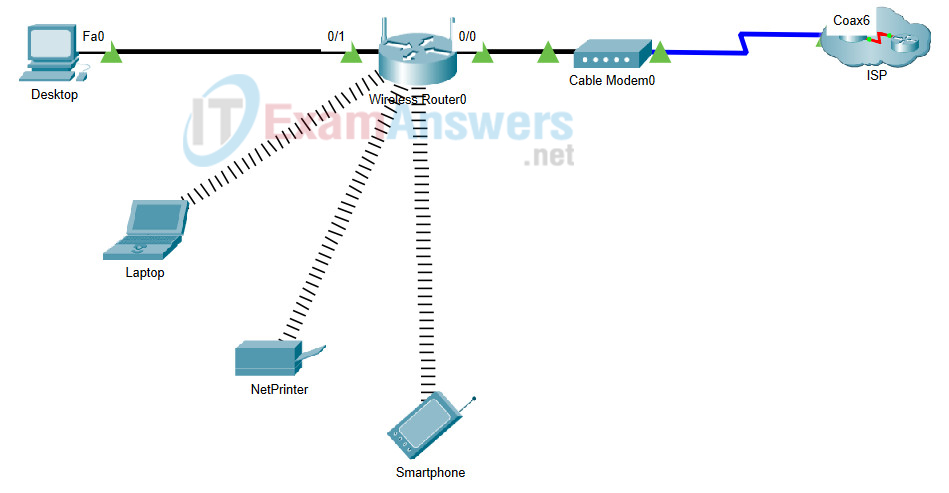
60. Open the PT activity. Perform the tasks in the activity instructions and then answer the question. What is the IP address of this server?
- 209.165.201.4
- 192.168.10.100
- 209.165.201.3
- 192.168.10.1
Explanation: Topic 25.1.2
The DNS server resolves Internet names to associated IP addresses.
61. Refer to the exhibit. Host H2 sends a unicast message to host H6. Which destination IP address is contained in the header of the packet when it reaches host H6?
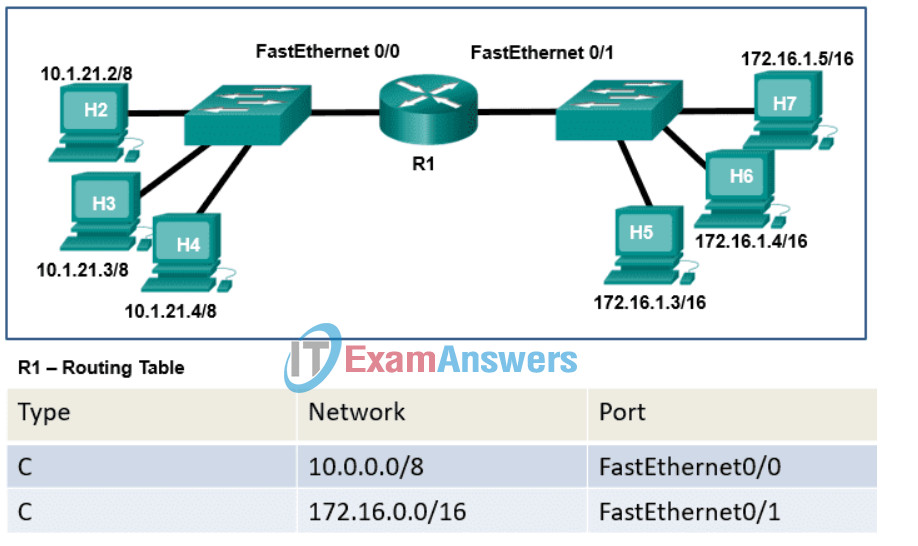
- the IP address assigned to the network adapter on host H2
- the IP address assigned to the network adapter on host H6
- the IP address of the FastEthernet0/1 interface on router R1
- the IP address of the FastEthernet0/0 interface on router R1
Explanation: Topic 22.2.2
When host H2 sends the packet to host H6, the source IP address is the address assigned to the network adapter on host H2. The destination address of the packet is the IP address assigned to the network adapter on host H6. The source and destination IP addresses do not change as the packet is forwarded through the routers. When the packet arrives at H6 the destination address of the packet is the address assigned to the network adapter on H6.
62. Refer to the exhibit. Host A sends a data packet to host B. What will be the addressing information of the data packet when it reaches host B?
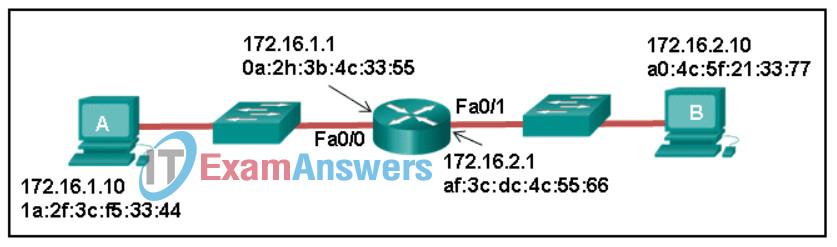
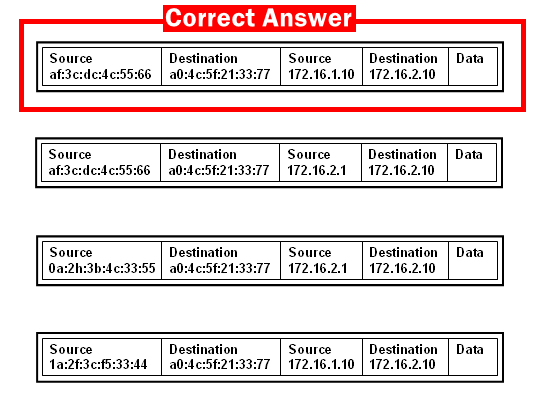
Explanation: Topic 13.1.2
63. Which command would a technician use to display network connections on a host computer?
- ipconfig
- nslookup
- tracert
- netstat
Explanation: Topic 15.2.4
The netstat command is a network utility that can be used to display active TCP connections that are open and running on a networked host.
64. Refer to the exhibit. PC1 attempts to connect to File_server1 and sends an ARP request to obtain a destination MAC address. Which MAC address will PC1 receive in the ARP reply?
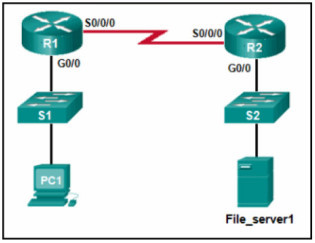
- the MAC address of the G0/0 interface on R2
- the MAC address of S2
- the MAC address of S1
- the MAC address of File_server1
- the MAC address of the G0/0 interface on R1
Explanation: Topic 24.1.5
PC1 must have a MAC address to use as a destination Layer 2 address. PC1 will send an ARP request as a broadcast and R1 will send back an ARP reply with its G0/0 interface MAC address. PC1 can then forward the packet to the MAC address of the default gateway, R1.
65. Match the definition to the type of cloud.
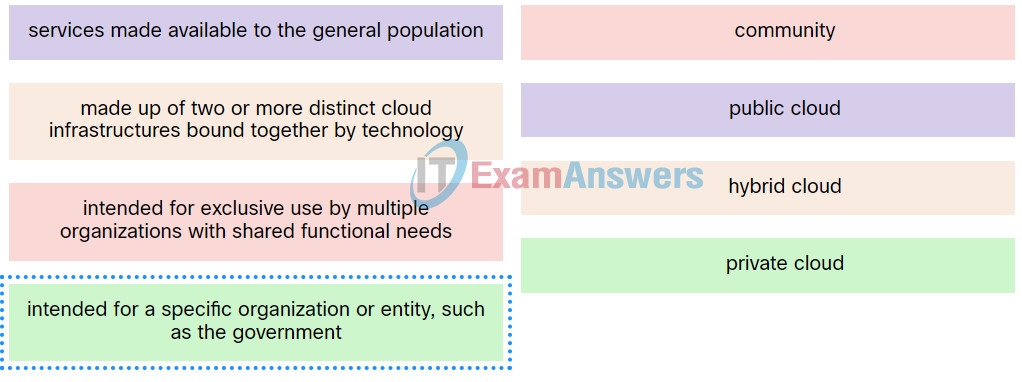
Explanation: Topic 19.1.2
Place the options in the following order:
| intended for exclusive use by multiple organizations with shared functional needs |
community |
| services made available to the general population |
public cloud |
| made up of two or more distinct cloud infrastructures bound together by technology |
hybrid cloud |
| intended for a specific organization or entity, such as the government |
private cloud |
66. Refer to the exhibit. Host A has sent a packet to host B. What will be the source MAC and IP addresses on the packet when it arrives at host B?
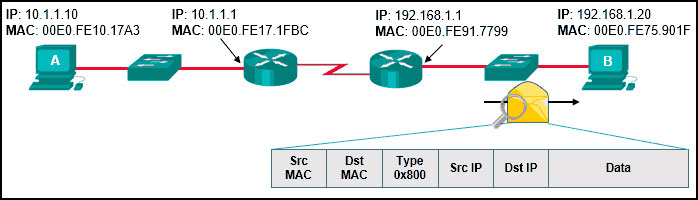
Source MAC: 00E0.FE91.7799
Source IP: 10.1.1.10
Source MAC: 00E0.FE91.7799
Source IP: 10.1.1.1
Source MAC: 00E0.FE10.17A3
Source IP: 10.1.1.10
Source MAC: 00E0.FE91.7799
Source IP: 192.168.1.1
Source MAC: 00E0.FE10.17A3
Source IP: 192.168.1.1
Explanation: Topic 13.1.2
As a packet traverses the network, the Layer 2 addresses will change at every hop as the packet is de-encapsulated and re-encapsulated, but the Layer 3 addresses will remain the same.
67. Which two statements are correct in a comparison of IPv4 and IPv6 packet headers? (Choose two.)
- The Time-to-Live field from IPv4 has been replaced by the Hop Limit field in IPv6.
- The Version field from IPv4 is not kept in IPv6.
- The Destination Address field is new in IPv6.
- The Source Address field name from IPv4 is kept in IPv6.
- The Header Checksum field name from IPv4 is kept in IPv6.
Explanation: Topic 22.3.3
The IPv6 packet header fields are as follows: Version, Traffic Class, Flow Label, Payload Length, Next Header, Hop Limit, Source Address, and Destination Address. The IPv4 packet header fields include the following: Version, Differentiated Services, Time-to-Live, Protocol, Source IP Address, and Destination IP Address. Both versions have a 4-bit Version field. Both versions have a Source (IP) Address field. IPv4 addresses are 32 bits; IPv6 addresses are 128 bits. The Time-to-Live or TTL field in IPv4 is now called Hop Limit in IPv6, but this field serves the same purpose in both versions. The value in this 8-bit field decrements each time a packet passes through any router. When this value is 0, the packet is discarded and is not forwarded to any other router.
68. Match the IPv6 packet header field with the description.
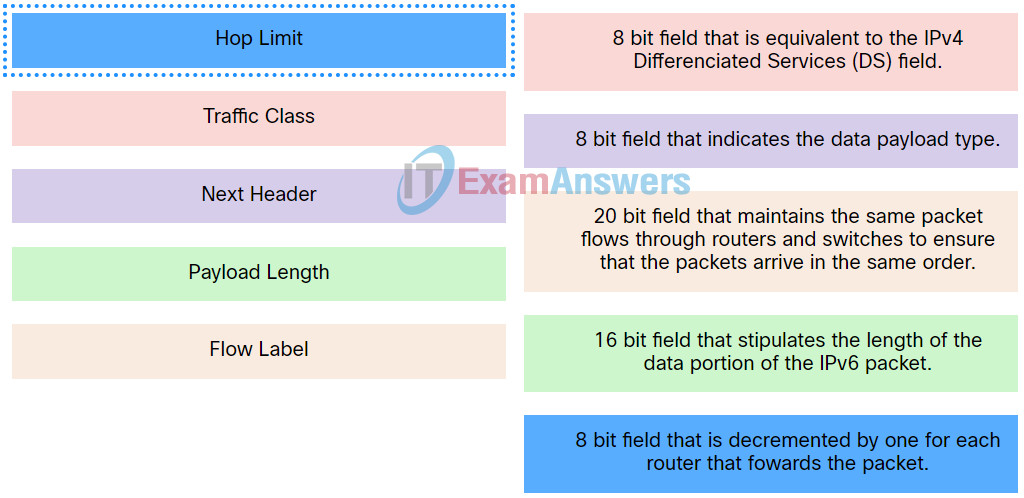
Explanation: Topic 22.3.4
Place the options in the following order:
| Traffic Class |
8 bit field that is equivalent to the IPv4 Differenciated Services (DS) field. |
| Next Header |
8 bit field that indicates the data payload type. |
| Flow Label |
20 bit field that maintains the same packet flows through routers and switches to ensure that the packets arrive in the same order. |
| Payload Length |
16 bit field that stipulates the length of the data portion of the IPv6 packet. |
| Hop Limit |
8 bit field that is decremented by one for each router that fowards the packet. |
69. Which three IPv4 header fields have no equivalent in an IPv6 header? (Choose three.)
- protocol
- fragment offset
- TTL
- version
- identification
- flag
Explanation: Topic 22.3.3
Unlike IPv4, IPv6 routers do not perform fragmentation. Therefore, all three fields supporting fragmentation in the IPv4 header are removed and have no equivalent in the IPv6 header. These three fields are fragment offset, flag, and identification. IPv6 does support host packet fragmentation through the use of extension headers, which are not part of the IPv6 header.
70. Which two items are used by a host device when performing an ANDing operation to determine if a destination address is on the same local network? (Choose two.)
- network number
- destination IP address
- source MAC address
- destination MAC address
- subnet mask
Explanation: Topic 23.1.4
The result of ANDing any IP address with a subnet mask is a network number. If the source network number is the same as the destination network number, the data stays on the local network. If the destination network number is different, the packet is sent to the default gateway (the router that will send the packet onward toward the destination network).
71. A home network has both wired and wireless connectivity. From a laptop computer, the user issues a ping to the wireless printer located in another room. The first two echo requests fail, but the last two succeed. Additional pings are all successful. Why do the first two echo requests fail?
- The computer and the printer must join the wireless network first and that process takes time.
- The distance between the computer and the printer causes delay on the first two pings.
- The wireless printer must be activated and that takes time.
- The computer must use ARP to obtain the MAC address of the printer and this process takes time.
Explanation: Topic 29.2.1
In order to successfully send a packet on an Ethernet network, the computer sending the ping needs four key pieces of information: (1) source MAC address, (2) destination MAC address, (3) source IP address, and (4) destination IP address. The computer sending the ping knows its own source IP address and source MAC address. The computer also knows from the ping command the destination IP address. The only information not known is the destination MAC address. The destination MAC address is discovered by using ARP.
72. Which statement is true regarding the UDP client process during a session with a server?
- A session must be established before datagrams can be exchanged.
- Datagrams that arrive in a different order than that in which they were sent are not placed in order.
- Application servers have to use port numbers above 1024 in order to be UDP capable.
- A three-way handshake takes place before the transmission of data begins.
Explanation: Topic 26.7.2
Because there are no sequence numbers in UDP segments, there is no possibility to arrange the datagrams in the correct order. Sessions and three-way handshake are related to TCP communications. UDP servers can use registered or nonregistered port numbers to listen to clients.
73. Match each DHCP message type with its description.
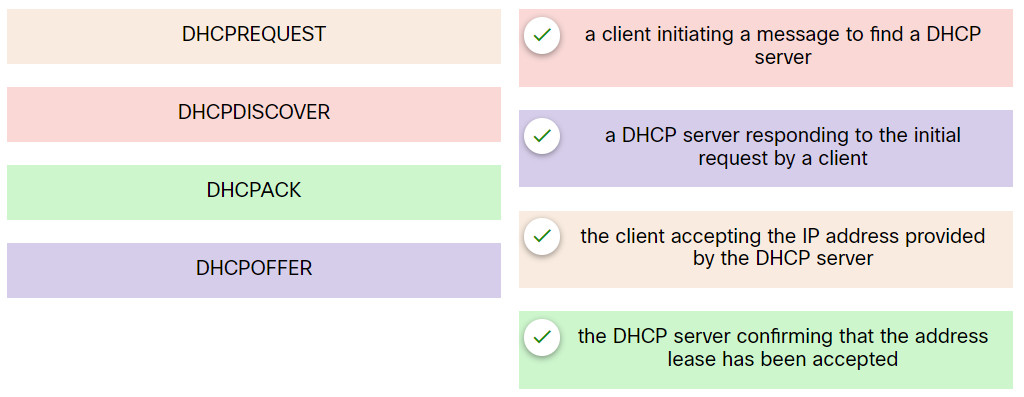
Networking Devices and Initial Configuration Course Final Exam 18
Explanation: Topic 25.2.3
Place the options in the following order:
| DHCPDISCOVER |
a client initiating a message to find a DHCP server |
| DHCPOFFER |
a DHCP server responding to the initial request by a client |
| DHCPREQUEST |
the client accepting the IP address provided by the DHCP server |
| DHCPACK |
the DHCP server confirming that the address lease has been accepted |
74. Refer to the exhibit. Which protocol was responsible for building the table that is shown?
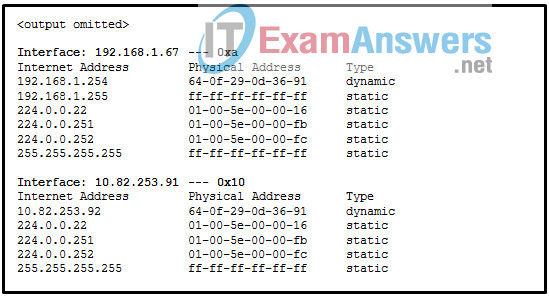
Explanation: Topic 24.1.7
The table that is shown corresponds to the output of the arp -a command, a command that is used on a Windows PC to display the ARP table.
75. Refer to the exhibit. A web designer calls to report that the web server web-s1.cisco.com is not reachable through a web browser. The technician uses command line utilities to verify the problem and to begin the troubleshooting process. Which two things can be determined about the problem? (Choose two.)
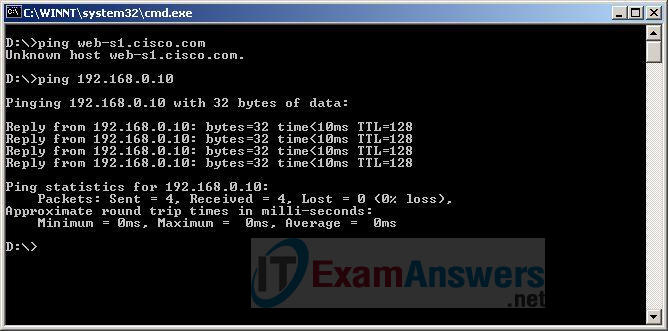
- A router is down between the source host and the server web-s1.cisco.com.
- The web server at 192.168.0.10 is reachable from the source host.
- The default gateway between the source host and the server at 192.168.0.10 is down.
- DNS cannot resolve the IP address for the server web-s1.cisco.com.
- There is a problem with the web server software on web-s1.cisco.com.
Explanation: Topic 17.1.5
The successful result of the ping to the IP address indicates that the network is operational and the web server is online. However, the fact that the ping to the domain name of the server fails indicates there is a DNS issue, namely that the host cannot resolve the domain name to its associated IP address.
76. What are two potential network problems that can result from ARP operation? (Choose two.)
- Multiple ARP replies result in the switch MAC address table containing entries that match the MAC addresses of hosts that are connected to the relevant switch port.
- Network attackers could manipulate MAC address and IP address mappings in ARP messages with the intent of intercepting network traffic.
- On large networks with low bandwidth, multiple ARP broadcasts could cause data communication delays.
- Manually configuring static ARP associations could facilitate ARP poisoning or MAC address spoofing.
- Large numbers of ARP request broadcasts could cause the host MAC address table to overflow and prevent the host from communicating on the network.
Explanation: Topic 24.1.8
Large numbers of ARP broadcast messages could cause momentary data communications delays. Network attackers could manipulate MAC address and IP address mappings in ARP messages with the intent to intercept network traffic. ARP requests and replies cause entries to be made into the ARP table, not the MAC address table. ARP table overflows are very unlikely. Manually configuring static ARP associations is a way to prevent, not facilitate, ARP poisoning and MAC address spoofing. Multiple ARP replies resulting in the switch MAC address table containing entries that match the MAC addresses of connected nodes and are associated with the relevant switch port are required for normal switch frame forwarding operations. It is not an ARP caused network problem.
77. Match the TCP flag to the correct step in the session establishment sequence.
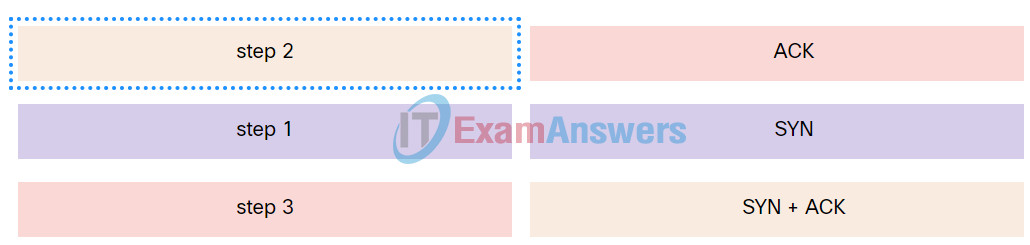
Explanation: Topic 26.5.2
Place the options in the following order:
| step 3 |
ACK |
| step 1 |
SYN |
| step 2 |
SYN + ACK |
78. What is the difference between the terms keyword and argument in the IOS command structure?
- A keyword is entered with a predefined length. An argument can be any length.
- A keyword always appears directly after a command. An argument does not.
- A keyword is required to complete a command. An argument is not.
- A keyword is a specific parameter. An argument is not a predefined variable.
Explanation: Topic 27.2.1
Keywords are specific parameters that are defined in IOS. Arguments are not predefined; they are the variables defined by the user when completing a command. Although most keywords appear directly after commands, they can appear in other locations, depending on a command structure. A keyword can be entered in its whole length or in a shortened format.
79. Which three commands are used to set up secure access to a router through a connection to the console interface? (Choose three.)
- line vty 0 4
- password cisco
- interface fastethernet 0/0
- line console 0
- enable secret cisco
- login
Explanation: Topic 28.2.1
The three commands needed to password protect the console port are as follows:
- line console 0
- password cisco
- login
The interface fastethernet 0/0 command is commonly used to access the configuration mode used to apply specific parameters such as the IP address to the Fa0/0 port. The line vty 0 4 command is used to access the configuration mode for Telnet. The0and 4 parameters specify ports 0 through 4, or a maximum of five simultaneous Telnet connections. The enable secret command is used to apply a password used on the router to access the privileged mode.
80. What three configuration steps must be performed to implement SSH access to a router? (Choose three.)
- a unique hostname
- a password on the console line
- an IP domain name
- a user account
- an enable mode password
- an encrypted password
Explanation: Topic 28.3.3
To implement SSH on a router the following steps need to be performed:
- Configure a unique hostname.
- Configure the domain name of the network.
- Configure a user account to use AAA or local database for authentication.
- Generate RSA keys.
- Enable VTY SSH sessions.
81. Refer to the exhibit. What is the maximum TTL value that is used to reach the destination www.cisco.com?
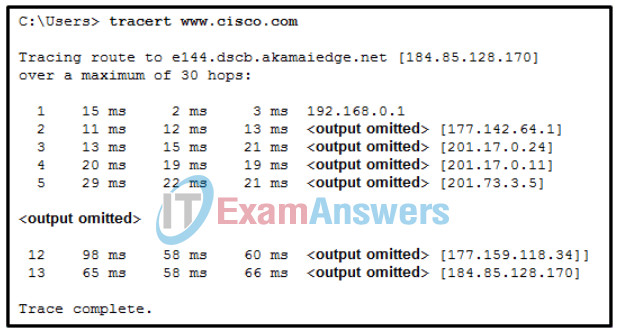
Networking Devices and Initial Configuration Course Final Exam 26
Explanation: Topic 29.2.5
Traceroute (in this case the command tracert) sets the TTL field to a value of 1 and sends the packet. At each router hop, this value is decreased by one and a "TTL expired" message is sent back to the source host. This message has a source address which is used by the host to build the trace. The host then progressively increments the TTL field (2, 3, 4...) for each sequence of messages until the destination is reached or it is incremented to a predefined maximum. Because the executed command reached the destination in the 13th line, the TTL was increased up to the value of 13.
82. Refer to the exhibit. A ping to PC2 is issued from PC0, PC1, and PC3 in this exact order. Which MAC addresses will be contained in the S1 MAC address table that is associated with the Fa0/1 port?
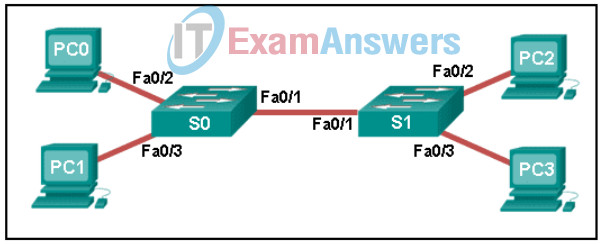
Networking Devices and Initial Configuration Course Final Exam 12
- just the PC1 MAC address
- just PC0 and PC1 MAC addresses
- just the PC0 MAC address
- PC0, PC1, and PC2 MAC addresses
- just the PC2 MAC address
Explanation: Topic 21.4.2
Switch S1 builds a MAC address table based on the source MAC address in the frame and the port upon which the frame enters the switch. The PC2 MAC address will be associated with port FA0/2. Because port FA0/1 of switch S1 connects with another switch, port FA0/1 will receive frames from multiple different devices. The MAC address table on switch S1 will therefore contain MAC addresses associated with each of the sending PCs.
83. Match field names to the IP header where they would be found.
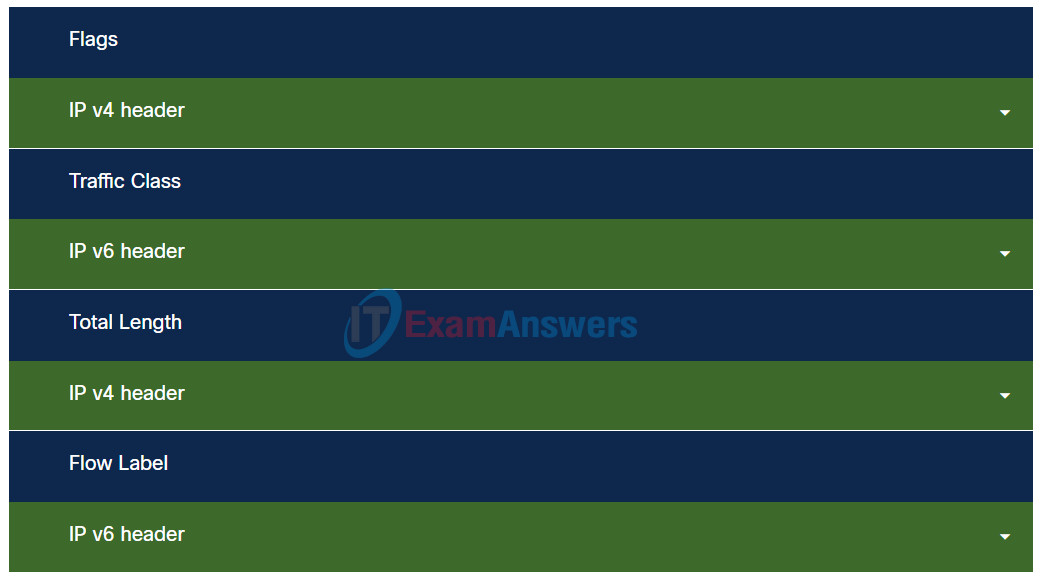
Explanation: Topic 22.3.4
Options matched to the correct selection.
| IP v4 header |
IP v6 header |
| Flags |
Traffic Class |
| Total Length |
Flow Label |
84. What is the dotted decimal representation of the IPv4 address
11001011.00000000.01110001.11010011?
- 203.0.113.211
- 209.165.201.223
- 198.51.100.201
- 192.0.2.199
Explanation: Topic 20.1.3
Each section (octet) contains eight binary digits. Each digit represents a specific value (128, 64, 32, 16, 8, 4, 2, and 1). Everywhere there is a 1, the specific value is relevant. Add all relevant values in a particular octet to obtain the decimal value. For example binary 11001011 equals 203 in decimal.
85. Which protocol is used by IPv4 and IPv6 to provide error messaging?
Explanation: Topic 29.1.1
ICMP is used by IPv4 and IPv6 to provide for messages to be sent in the event of certain errors and for informational purposes.
86. The global configuration command ip default-gateway 172.16.100.1 is applied to a switch. What is the effect of this command?
- The switch can communicate with other hosts on the 172.16.100.0 network.
- The switch can be remotely managed from a host on another network.
- The switch will have a management interface with the address 172.16.100.1.
- The switch is limited to sending and receiving frames to and from the gateway 172.16.100.1.
Explanation: Topic 28.4.2
A default gateway address is typically configured on all devices to allow them to communicate beyond just their local network.In a switch this is achieved using the command ip default-gateway <ip address>.
87. Match the router prompt to the configuration task.
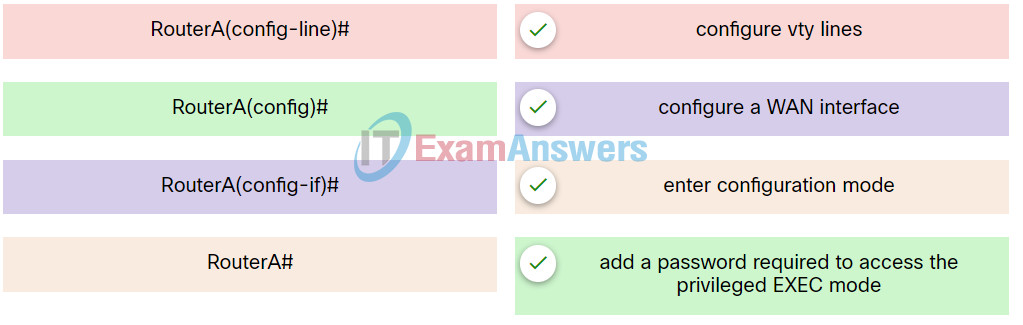
Networking Devices and Initial Configuration Course Final Exam 29
Explanation: Topic 27.1.2
Place the options in the following order:
| RouterA(config-line)# |
configure vty lines |
| RouterA(config-if)# |
configure a WAN interface |
| RouterA# |
enter configuration mode |
| RouterA(config)# |
add a password required to access the privileged EXEC mode |
88. While troubleshooting a network problem, a network administrator issues the show version command on a router. What information can be found by using this command?
- the amount of NVRAM, DRAM, and flash memory installed on the router
- the bandwidth, encapsulation, and I/O statistics on the interfaces
- differences between the backup configuration and the current running configuration
- the version of the routing protocol that is running on the router
Explanation: Topic 27.3.2
The show version command displays much information about the device, including the amount of memory (flash, NVRAM, and DRAM) that is installed on the device.
89. Refer to the exhibit. PC1 sends a frame with the destination MAC address 3c97.0e07.a1b2. Switch S1 looks up the destination MAC address in its CAM table but the address is not there. What will the switch do?
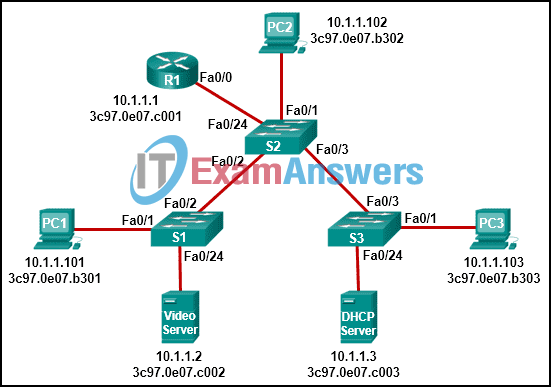
- It willl add the destination MAC address to the CAM table.
- It will forward the frame out all ports except Fa0/1.
- It will send a destination unreachable message back to PC1.
- The switch will drop the frame.
- It will forward the frame out port Fa0/2 towards the router.
Explanation: Topic 21.4.2
When a switch receives a frame with a destination that it does not already have in its CAM table, it will forward the frame out all ports except the one on which the frame was received. This is called unknown unicast flooding.
90. Which forwarding action does a switch take when the destination MAC address of an Ethernet frame is an unknown unicast?
- The switch forwards the frame to the default gateway.
- The switch forwards the frame the same way it does for broadcast and multicast MAC addresses.
- The switch drops the frame.
- The switch forwards the frame out a specified port for this type of address.
Explanation: Topic 21.4.2
If the destination MAC address is a unicast address, the switch will look for a match between the destination MAC address of the frame and an entry in its MAC address table:
- If the destination MAC address is in the table, it will forward the frame out of the specified port.
- If the destination MAC address is not in the table (unknown unicast), the switch will forward the frame out all ports except the incoming port. If the destination MAC address is a broadcast or a multicast, the frame is also flooded out all ports except the incoming port.
91. Refer to the exhibit. An administrator is troubleshooting connectivity on the office network. PC1 is able to send print jobs to Printer1, but is unable to access File Server1. Which action would correct the problem?
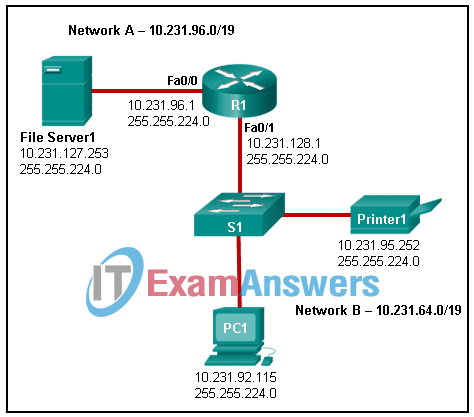
- Change the R1 Fa0/1 interface IP address to 10.231.64.1.
- Change the R1 Fa0/0 interface subnet mask to 255.255.0.0.
- Change the File Server1 IP address to 10.231.96.253.
- Change the PC1 IP address to 10.231.64.115.
Explanation: Topic 14.2.5
To correct the problem the Fa0/1 interface must be put into the 10.231.64.0 /19 network, so that it is in the same logical network as PC1. Currently the interface is in the 10.231.128.0 network.
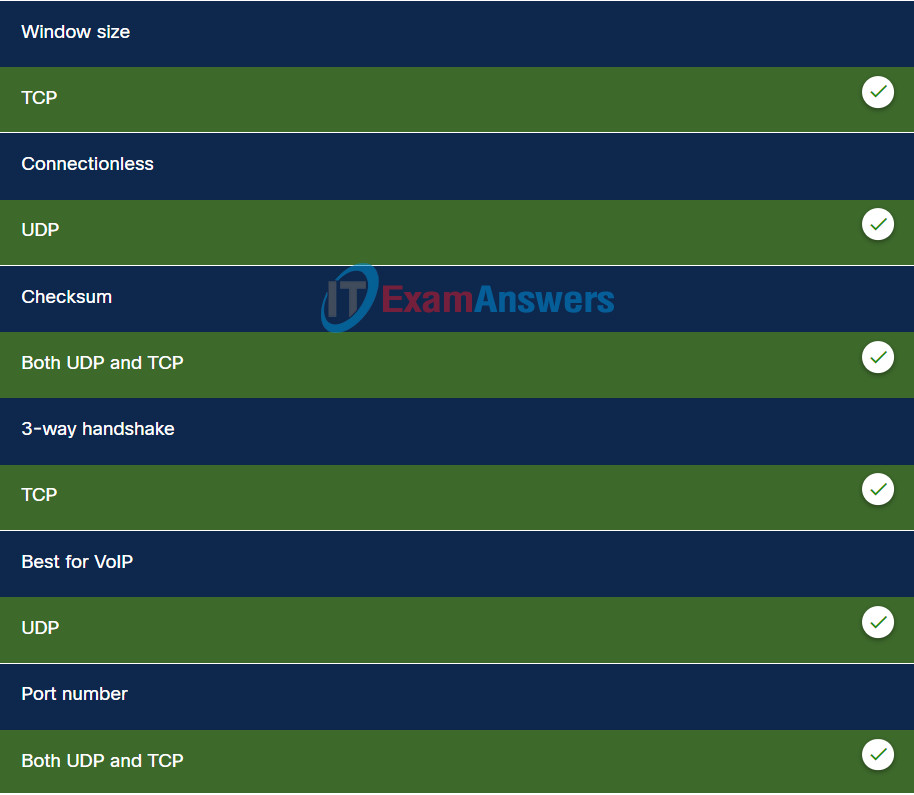
92. Match the characteristic to the protocol category.
Explanation: Topic 26.8.2
Options matched to the correct selection.
| TCP |
UDP |
Both UDP and TCP |
| window size |
connectionless |
checksum |
| 3-way handshake |
best for VoIP |
port number |
93. The ARP table in a switch maps which two types of address together?
- Layer 3 address to a Layer 4 address
- Layer 4 address to a Layer 2 address
- Layer 2 address to a Layer 4 address
- Layer 3 address to a Layer 2 address
Explanation: Topic 24.1.2
The switch ARP table keeps a mapping of Layer 2 MAC addresses to Layer 3 IP addresses. These mappings can be learned by the switch dynamically through ARP or statically through manual configuration.
94. A network administrator issues the Switch# show running-config command on a Cisco switch. Which term is used to describe the part "running-config" in the command?
- command
- argument
- hot key
- keyword
Explanation: Topic 27.2.1
The running-config is a keyword of the show command.
95. The global configuration command ip default-gateway 172.16.100.1 is applied to a switch. What is the effect of this command?
- The switch can be remotely managed from a host on another network.
- The switch can communicate with other hosts on the 172.16.100.0 network.
- The switch will have a management interface with the address 172.16.100.1.
- The switch is limited to sending and receiving frames to and from the gateway 172.16.100.1.
Explanation: Topic 28.4.2
A default gateway address is typically configured on all devices to allow them to communicate beyond just their local network.In a switch this is achieved using the command ip default-gateway <ip address>.
96. What is the purpose of the MAC address which is added to an e-mail message that is sent from a teacher to a student?
- It identifies the network to which the sending computer belongs.
- It identifies the computer on the Internet.
- It identifies the TCP/IP network application to which the reply can be sent.
- It identifies the computer on the LAN.
Explanation: Topic 13.1.1
A Media Access Control (MAC) address is unique on every device. An Internet Protocol (IP) address is used to communicate with devices on another LAN or on the Internet.
97. What is the purpose of assigning an IP address to the VLAN1 interface on a Cisco Layer 2 switch?
- to enable remote access to the switch to manage it
- to permit IP packets to be forwarded by the switch
- to create a new IP local network on the switch
- to enable the switch to route packets between networks
Explanation: Topic 28.1.2
The VLAN 1 on a Cisco Layer 2 switch is a virtual interface. By default, VLAN 1 is assigned as the management interface for remote access (Telnet or SSH) to the device for management tasks. In order to allow remote access through the network, a valid IP address configuration is needed on VLAN 1.
98. Which command should be used to test connectivity to the loopback interface?
- ping 255.255.255.255
- ping 0.0.0.0
- ping 127.0.0.1
- ping loopback
Explanation: Topic 29.2.2
The ping 127.0.0.1 command tests the TCP/IP stack through the loopback interface.
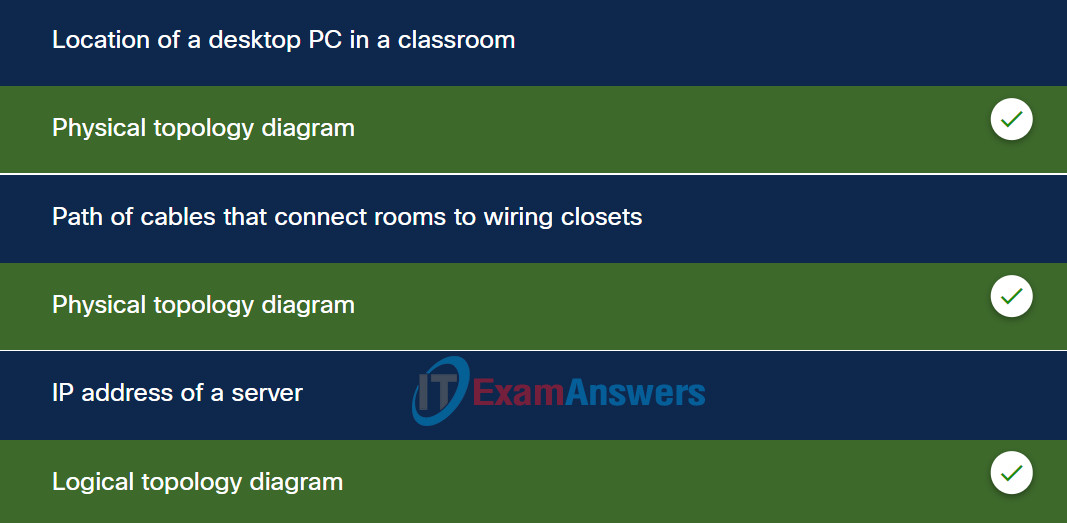
99. Match each item to the type of topology diagram on which it is typically identified.
Explanation: Topic 31.1.1
Place the options in the following order:
| location of a desktop PC in a classroom |
physical topology diagram |
| path of cables that connect rooms to wiring closets |
physical topology diagram |
| IP address of a server |
logical topology diagram |
100. Refer to the exhibit. The IP address of which device interface should be used as the default gateway setting of host H1?
- R1: G0/0
- R2: S0/0/1
- R2: S0/0/0
- R1: S0/0/0
Explanation: Topic 14.2.5
The default gateway for host H1 is the router interface that is attached to the LAN that H1 is a member of. In this case, that is the G0/0 interface of R1. H1 should be configured with the IP address of that interface in its addressing settings. R1 will provide routing services to packets from H1 that need to be forwarded to remote networks.
101. What are two advantages of using fiber-optic cabling to interconnect devices? (Choose two.)
- Fiber-optic cables can extend several miles.
- Fiber-optic cable is immune from EMI and RFI.
- Fiber-optic cables are easy to install..
- Fiber-optic cables are commonly found in both homes and small businesses.
- Fiber-optic cables use extra shielding to protect copper wires.
Explanation: Topic 30.5.6
Fiber-optic cables provide immunity to both EMI and RFI and a single cable can extend for several miles before regeneration is needed.
102. Which statement is true about the CSMA/CD access method that is used in Ethernet?
- When a device hears a carrier signal and transmits, a collision cannot occur.
- All network devices must listen before transmitting.
- A jamming signal causes only devices that caused the collision to execute a backoff algorithm.
- Devices involved in a collision get priority to transmit after the backoff period.
Explanation: Topic 31.2.3
Legacy bus-topology Ethernet LAN uses CSMA/CD as network media access control protocol. It works by detecting a collision in the medium and backing off (after transmitting a jam signal) as necessary. When one host wants to transmit a frame, it listens on the medium to check if the medium is busy. After it senses that no one else is transmitting, the host starts transmitting the frame, it also monitors the current level to detect a collision. If it detects a collision, it transmits a special jam signal so that all other hosts can know there was a collision. The other host will receive this jam signal and stop transmitting. After this, both hosts enter an exponential backoff phase and retry transmission.
103. Which two characteristics describe the use of a logical topology? (Choose two.)
- showing the physical connections of end devices
- identifying the interconnection of routers and switches
- describing the infrastructure
- identifying the virtual connections between devices
- identifying the type of media access control used
- identifying cable length requirements
Explanation: Topic 31.1.1
Physical topology refers to the physical connection and how hosts, switches, and routers are physically connected. Logical topology refers to how nodes transfer frames through virtual connections and how the upper layers perceive the network.
104. Which command can be used on a Windows host to display the routing table?
- show ip route
- tracert
- netstat –r
- netstat –s
Explanation: Topic 32.1.4
On a Windows host, either the route print or netstat -r commands can be used to display the host routing table. The show ip route command is used on a router to display its routing table. The netstat –s command is used to display per-protocol statistics. The tracert command is used to display the path that a packet travels to its destination.
105. Refer to the exhibit. Consider the IP address configuration shown from PC1. What is a description of the default gateway address?
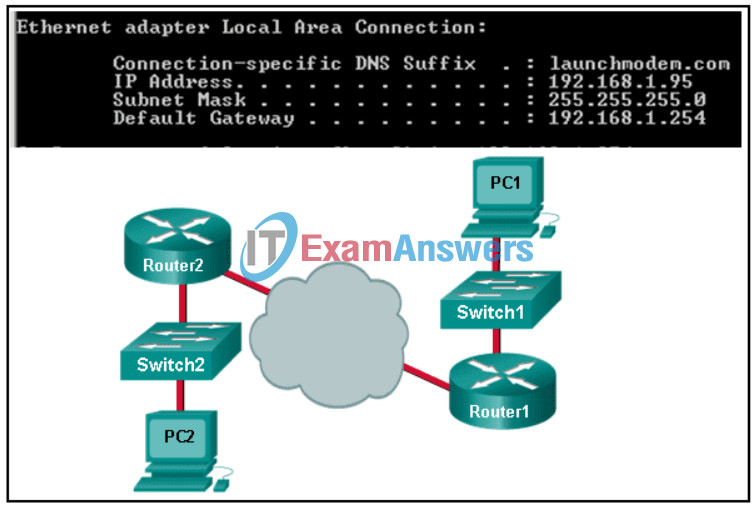
- It is the IP address of the Router1 interface that connects the PC1 LAN to Router1.
- It is the IP address of the Router1 interface that connects the company to the Internet.
- It is the IP address of Switch1 that connects PC1 to other devices on the same LAN.
- It is the IP address of the ISP network device located in the cloud.
Explanation: Topic 32.1.2
The default gateway is used to route packets destined for remote networks. The default gateway IP address is the address of the first Layer 3 device (the router interface) that connects to the same network.
106. Match the characteristics to the correct type of fiber.
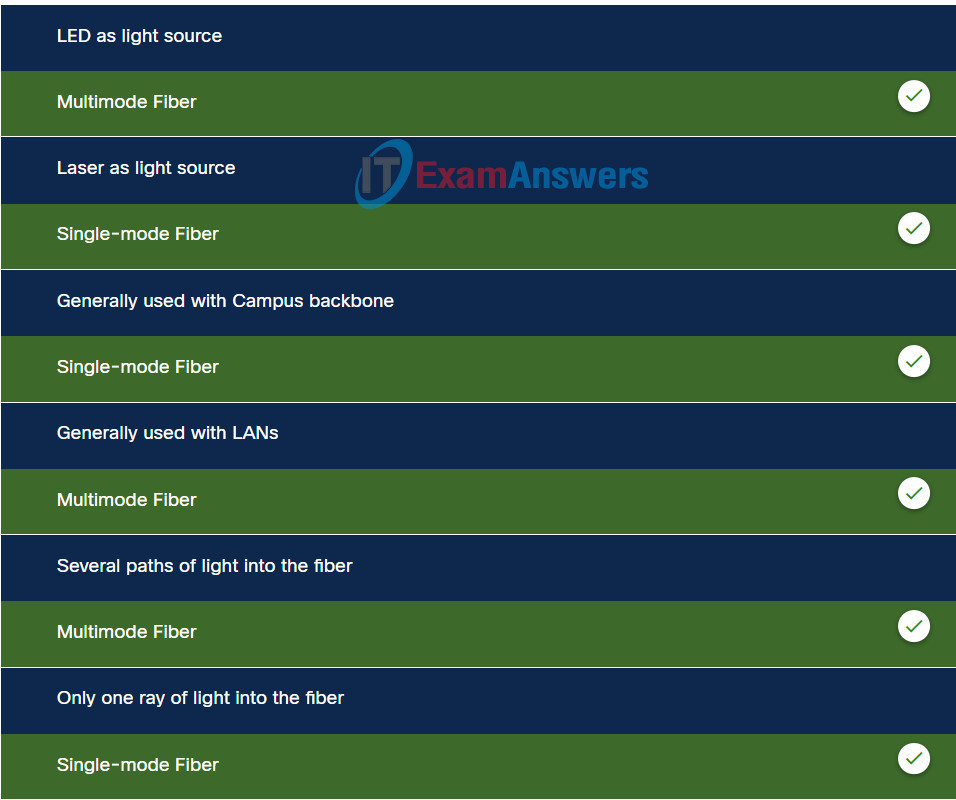
Explanation: Topic 30.5.2
Options matched to the correct selection.
| Multimode Fiber |
Single-mode Fiber |
| LED as light source |
only one ray of light into the fiber |
| several paths of light into the fiber |
generally used with Campus backbone |
| generally used with LANs |
laser as light source |
107. A user can access a file share resource on a server located in the same office but cannot access the internet. What is the possible cause?
- The IPv4 address and subnet mask are misconfigured on the PC.
- The default gateway address is misconfigured on the PC.
- The switch is malfunctioning.
- The DHCP server is disconnected.
Explanation: Topic 14.2.5
The fact that the user can access a file share resource but not the internet indicates the issue might be caused by default gateway misconfiguration. If no default gateway is configured in the host TCP/IP settings, or if the wrong default gateway is specified, messages addressed to hosts on the internet cannot be delivered.
108. Which statement describes the operation of devices accessing an Ethernet network?
- Each device monitors the media and sends a notification for its intention to send data first.
- To send data, each device waits for a token to be available.
- Each device monitors the media and sends data when the media is free.
- Each device in turn receives a frame. If the frame is not intended for the device, the device passes it along.
Explanation: Topic 31.2.3
Ethernet uses CSMA/CD as the access control method. With CSMA/CD, each end device monitors the media for the presence of a data signal. If the media is free, the device can transmit data immediately. The other options are operations with CSMA/CA and Token passing.
109. A PC has sent an RS message to an IPv6 router attached to the same network. Which two pieces of information will the router send to the client? (Choose two.)
- subnet mask in dotted decimal notation
- administrative distance
- domain name
- prefix length
- DNS server IP address
- prefix
Explanation: Topic 33.3.2
A router interface that has been configured with IPv6 addressing information responds to a router solicitation (RS) message with a router advertisement (RA) message. The RA message is used in the IPv6 stateless address autoconfiguration (SLAAC) process and the message contains the local prefix and prefix length of the local segment such as 2001:db8:acad:1::/64.
110. Which two types of messages are used in place of ARP for address resolution in IPv6? (Choose two.)
- echo reply
- neighbor solicitation
- broadcast
- neighbor advertisement
- anycast
- echo request
Explanation: Topic 34.1.3
IPv6 does not use ARP. Instead, ICMPv6 neighbor discovery is used by sending neighbor solicitation and neighbor advertisement messages.
111. A site administrator has been told that a particular network at the site must accommodate 126 hosts. Which subnet mask would be used that contains the required number of host bits?
- 255.255.255.240
- 255.255.255.0
- 255.255.255.224
- 255.255.255.128
Explanation: Topic 23.1.2
The subnet mask of 255.255.255.0 has 8 host bits. The mask of 255.255.255.128 results in 7 host bits. The mask of 255.255.255.224 has 5 host bits. Finally, 255.255.255.240 represents 4 host bits.
112. An IPv6 enabled device sends a data packet with the destination address of FF02::1. What is the target of this packet?
- only IPv6 configured routers
- only IPv6 DHCP servers
- all IPv6 enabled devices on the local link or network
- the one IPv6 device on the link that has been uniquely configured with this address
Explanation: Topic 33.5.1
This address is one of the assigned IPv6 multicast addresses. Packets addressed to FF02::1 are for all IPv6 enabled devices on the link or network. FF02::2 is for all IPv6 routers that exist on the network.
113. What are two services provided by IPv6 neighbor discovery protocol? (Choose two.)
- maximum IPv6 packet size for end-to-end transmission
- IPv6 dynamic routing
- domain name resolving
- router discovery
- address resolution
Explanation: Topic 31.1.2
IPv6 Neighbor Discovery protocol, also referred to as ND or NDP, provides address resolution, router discovery, and redirection services for IPv6 using ICMPv6.
114. A secretary receives a phone call from someone claiming that their manager is about to give an important presentation but the presentation files are corrupted.
The caller sternly asks that the secretary email the presentation right away to a personal email address. The caller also states that the secretary is being held personally responsible for the success of this presentation.
What type of social engineering tactic is the caller using?
- intimidation
- familiarity
- urgency
- trusted partners
Explanation: Topic 38.2.2
Intimidation is a tactic that cybercriminals will often use to bully a victim into taking an action that compromises security.
115. The awareness and identification of vulnerabilities is a critical function of a cybersecurity specialist. Which of the following resources can they use to identify specific details about vulnerabilities?
- ISO/IEC 27000 model
- Infragard
- NIST/NICE framework
- CVE national database
Explanation: Topic 38.1.14
The United States Computer Emergency Readiness Team (US-CERT) and the U.S. Department of Homeland Security sponsor a dictionary of common vulnerabilities and exposures (CVE).
Each CVE entry contains a standard identifier number, a brief description of the security vulnerability and any important references to related vulnerability reports. The CVE list is maintained by a not-for-profit, the MITRE Corporation, on its public website.
116. Which three security services are part of the concept of administrative access controls?
- data in transit, data at rest, and data in process
- confidentiality, integrity, and availability
- technology, policy and practices, and people
- authentication, authorization, and accounting
Explanation: Topic 39.2.4
Administrative access controls involve three security services: authentication, authorization, and accounting (AAA).
117. Which statement describes the use of powerline networking technology?
- A device connects to an existing home LAN using an adapter and an existing electrical outlet.
- New "smart" electrical cabling is used to extend an existing home LAN.
- Wireless access points use powerline adapters to distribute data through the home LAN.
- A home LAN is installed without the use of physical cabling.
Explanation: Topic 4.2.2
Powerline networking adds the ability to connect a device to the network using an adapter wherever there is an electrical outlet. The network uses existing electrical wiring to send data. It is not a replacement for physical cabling, but it can add functionality in places where wireless access points cannot be used or cannot reach devices.
118. A user is configuring a wireless access point and wants to prevent any neighbors from discovering the network. What action does the user need to take?
- Configure DMZ settings.
- Disable SSID broadcast.
- Configure a DNS server.
- Enable WPA encryption.
Explanation: Topic 39.6.8
Disabling SSID broadcast prevents the access point from announcing the name of the network. Enabling WPA encryption, configuring DMZ settings, and configuring a DNS server will accomplish different tasks, but the name of the network will still be announced.
119. A tourist is traveling through the countryside and needs to connect to the internet from a laptop. However, the laptop only has Wi-Fi and Ethernet connections. The tourist has a smartphone with 3G/4G connectivity. What can the tourist do to allow the laptop to connect to the internet?
- Enable tethering and create a hotspot.
- Use the smartphone to access web pages and then pass the web pages to the laptop.
- Use the smartphone to access the internet through a satellite connection and then share that connection with the laptop.
- Use an Ethernet cable to connect the smartphone to the laptop.
Explanation: Topic 3.2.6
Many cell phones have the ability to connect to other devices through a feature called tethering. The connection can be made using Wi-Fi, Bluetooth, or a USB cable. Once a device is connected, it is able to use the cellular connection of the phone to access the internet. When a cellular phone allows Wi-Fi devices to connect and use the mobile data network, this is called a hotspot.
120. Match the ICMPv6 messages to the description.
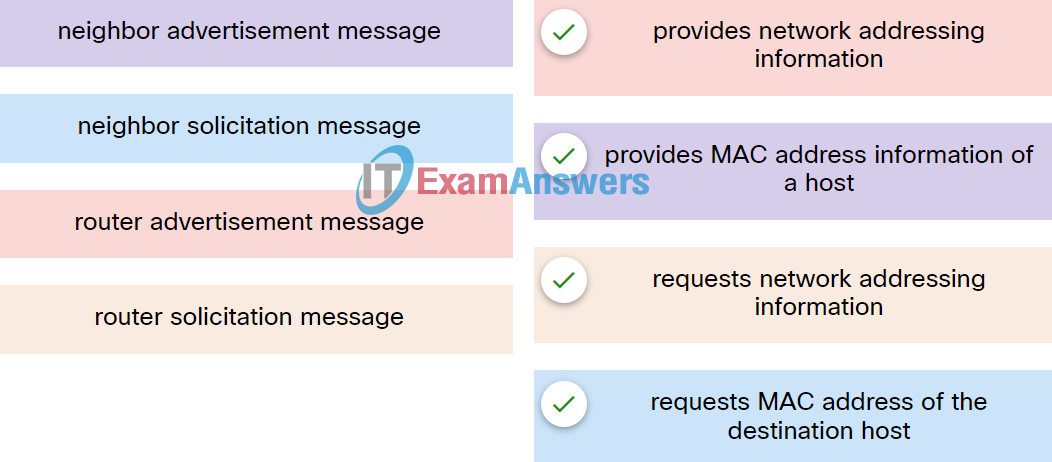
Explanation: Topic 29.1.5
Place the options in the following order:
| router advertisement message |
provides network addressing information |
| neighbor advertisement message |
provides MAC address information of a host |
| router solicitation message |
requests network addressing information |
| neighbor solicitation message |
requests MAC address of the destination host |
121. A network administrator is assigned the 172.16.0.0/24 block of addresses to use in designing an IP addressing scheme. The administrator submits this design for approval:
- 172.16.0.0/26
- 172.16.0.64/27
- 172.16.0.96/26
- 172.16.0.128/27
What should be the response from the senior network engineer regarding this design?
- This design is flawed because the 172.16.0.96/26 network is not a valid block of addresses.
- This design is flawed because the 172.16.0.96/26 network overlaps with other addresses.
- This design is flawed because no design could have two networks that use a /26 mask and are not consecutive blocks of addresses.
- This design is flawed because the 172.16.0.128/27 network number is invalid.
- This design will work for the branch office.
Explanation: Topic 23.1.2
The valid numbers that can be used with a /26 mask include 172.16.0.0/26, 172.16.0.64/26, 172.16.0.128/26, and 172.16.0.192/26.
122. What is the prefix for the host address 2001:DB8:BC15:A:12AB::1/64?
- 2001:DB8:BC15:A
- 2001:DB8:BC15:A:1
- 2001:DB8:BC15:A:12
- 2001:DB8:BC15
Explanation: Topic 33.1.2
The network portion, or prefix, of an IPv6 address is identified through the prefix length. A /64 prefix length indicates that the first 64 bits of the IPv6 address is the network portion. Hence the prefix is 2001:DB8:BC15:A.
123. How are port numbers used in the TCP/IP encapsulation process?
- Source port and destination port numbers are randomly generated.
- Source port numbers and destination port numbers are not necessary when UDP is the transport layer protocol being used for the communication.
- If multiple conversations occur that are using the same service, the source port number is used to track the separate conversations.
- Destination port numbers are assigned automatically and cannot be changed.
Explanation: Topic 26.4.1
Both UDP and TCP use port numbers to provide a unique identifier for each conversation. Source port numbers are randomly generated and are used to track different conversations. Destination port numbers identify specific services by using either a default port number for the service or a port number that is assigned manually by a system administrator.
124. What is the shortest valid representation of the IPv6 address 2001:0DB8:0000:1470:0000:0000:0000:0200?
- 2001:DB8::1470::200
- 2001:0DB8:0:147::02
- 2001:0DB8::1470:0:0:0:2
- 2001:DB8:0:1470::200
Explanation: Topic 10.2.5
A double colon (::) can replace any single, contiguous string of one or more 16-bit segments (hextets) consisting of all 0s, and can only be used once per IPv6 address. Any leading 0s (zeros) in any 16-bit section or hextet can be omitted.
125. A college has five campuses. Each campus has IP phones installed. Each campus has an assigned IP address range. For example, one campus has IP addresses that start with 10.1.x.x. On another campus the address range is 10.2.x.x. The college has standardized that IP phones are assigned IP addresses that have the number 4X in the third octet. For example, at one campus the address ranges used with phones include 10.1.40.x, 10.1.41.x, 10.1.42.x, etc. Which two groupings were used to create this IP addressing scheme? (Choose two.)
- personnel type
- device type
- geographic location
- department
- support model
Explanation: Topic 9.3.4
The IP address design being used is by geographic location (for example, one campus is 10.1, another campus 10.2, another campus 10.3). The other design criterion is that the next octet number designates IP phones, or a specific device type, with numbers starting with 4, but which can include other numbers. Other devices that might get a designation inside this octet could be printers, PCs, and access points.
126. Refer to the exhibit. If all devices are using a subnet mask of 255.255.255.0, which laptop would have an IP address with the same network number as the server?
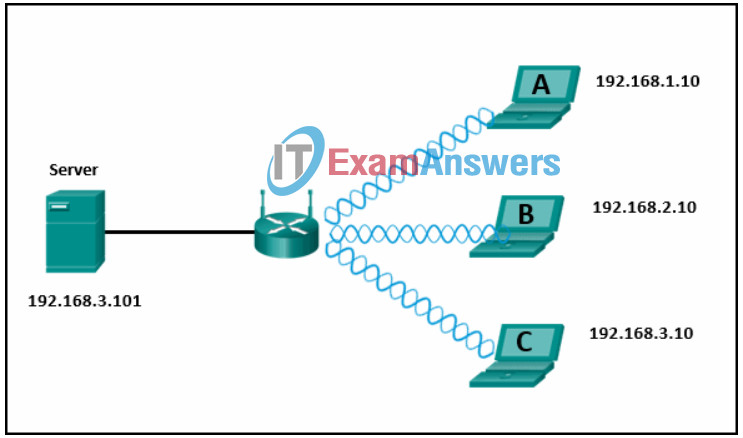
Explanation: Topic 23.1.2
The subnet mask shows which part of the IP address is the network number. Because all the devices have a subnet mask of 255.255.255.0, the first three sets of numbers in each IP address indicate the network number. The server and laptop C both have network numbers of 192.168.3.0.
127. For what purpose are IPv4 addresses utilized?
- An IPv4 address is burned into the network card to uniquely identify a device.
- An IPv4 address is used to identify the number of IP networks available.
- An IPv4 address is used to uniquely identify a device on an IP network.
- An IPv4 address is used to uniquely identify the application that requested the information from a remote device.
Explanation: Topic 8.1.1
A MAC address is burned into a NIC to uniquely identify a device. A port number is used to uniquely identify the application that requested information. The subnet mask identifies how many hosts can be on a network and the network number. There is not really any parameter that identifies the number of free IP networks.
128. A user is setting up a home wireless network. A global address is to be used in NAT translations for traffic flowing through the wireless router. How is this global address assigned?
- The wireless router will act as a DHCP client in order to receive global addressing from the ISP.
- The default gateway IP address of the LAN device is used as the global address for NAT translations through the wireless router.
- The network administrator will choose an available IP address from the LAN and configure the global addressing of the wireless router.
- The host devices will select an unused IP address on the LAN for performing NAT through the wireless router.
Explanation: Topic 12.1.3
The public (global) address used in NAT is commonly the public IP address that resides on the external facing interface of the wireless router.This IP address is commonly provided via DHCP from the ISP.
129. Match the protocol function to the description while taking into consideration that a network client is visiting a web site.
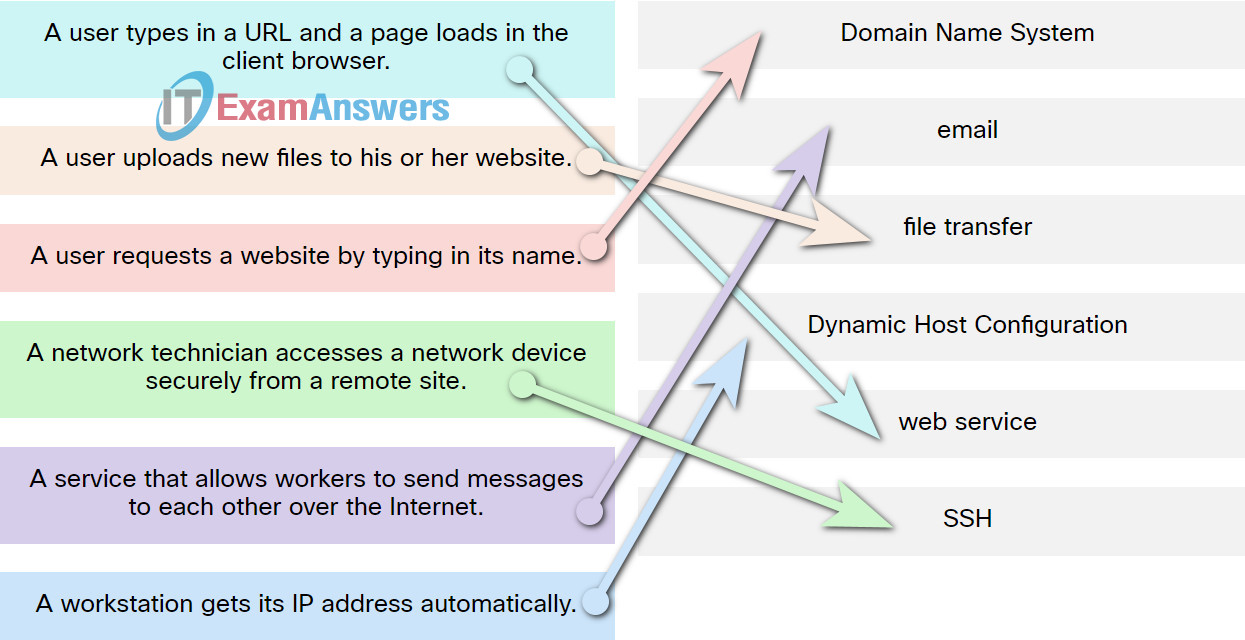
Explanation: Topic 16.2.1
Place the options in the following order:
| A user requests a website by typing in its name. |
Domain Name System |
| A service that allows workers to send messages to each other over the Internet. |
email |
| A user uploads new files to his or her website. |
file transfer |
| A workstation gets its IP address automatically. |
Dynamic Host Configuration |
| A user types in a URL and a page loads in the client browser. |
web service |
| A network technician accesses a network device securely from a remote site. |
SSH |
130. Refer to the exhibit. PC1 needs to resolve the host name of the web server into an IP address by using DNS. What destination IP address and destination port number will PC1 assign to the DNS query packet?
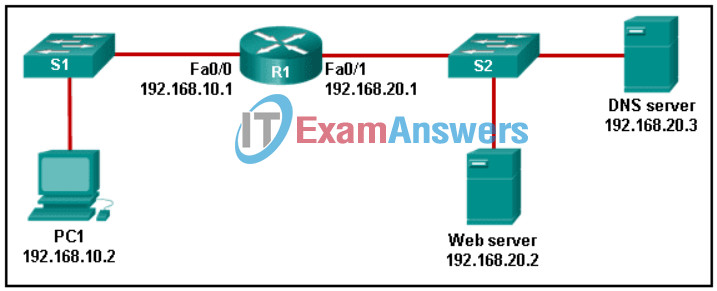
Networking Basics: Course Completion Assessment & Survey Q61
- 192.168.20.3 port 53
- 192.168.10.1 port 53
- 192.168.20.3 port 80
- 192.168.20.2 port 80
- 192.168.20.2 port 53
Explanation: Topic 25.1.2
To resolve the host name to an IP address a host can send a query to a DNS server. The transport layer port number for DNS is port 53.
131. How many bits are in an IPv4 address?
Explanation: Topic 23.1.1
An IPv4 address is comprised of 4 octets of binary digits, each containing 8 bits, resulting in a 32-bit address.
132. A company is contemplating whether to use a client/server or a peer-to-peer network. What are three characteristics of a peer-to-peer network? (Choose three.)
- better security
- scalable
- easy to create
- better device performance when acting as both client and server
- less cost to implement
- lacks centralized administration
Explanation: Topic 2.1.3
Because network devices and dedicated servers are not required, peer-to-peer networks are easy to create, less complex, and have lower costs. Peer-to-peer networks also have no centralized administration. They are less secure, not scalable, and those devices acting as both client and server may perform slower.
133. A production switch is reloaded and finishes with a Switch> prompt. What two facts can be determined? (Choose two.)
- The switch did not locate the Cisco IOS in flash, so it defaulted to ROM.
- The boot process was interrupted.
- A full version of the Cisco IOS was located and loaded.
- There is not enough RAM or flash on this router.
- POST occurred normally.
Explanation: Topic 35.3.1
A switch booting to the Switch> prompt indicates that the switch booted normally. This means a the switch successfully completed POST full version of the Cisco IOS was loaded.
134. A user is complaining that an external web page is taking longer than normal to load.The web page does eventually load on the user machine. Which tool should the technician use with administrator privileges in order to locate where the issue is in the network?
- tracert
- nslookup
- ipconfig /displaydns
- ping
Explanation: Topic 29.2.5
The Command Prompt command tracert will map the path from the PC to the web server and measure transit delays of packets across the network.
135. When a host sends a packet, how does it determine if the destination of the packet is on the same local network or on a remote network?
- It compares the source and destination MAC addresses.
- It queries the DNS server with the destination IP address.
- It checks to see if the default gateway is configured.
- It uses the subnet mask to compare the source and destination IP address.
Explanation: Topic 32.1.1
When a host sends a packet, it uses the subnet mask to compare the source IPv4 address and the destination IPv4 address. If the network bits match, both the source and destination host are on the same local network. Otherwise, the destination host is on a remote network.
136. Match the network with the correct IP address and prefix that will satisfy the usable host addressing requirements for each network.
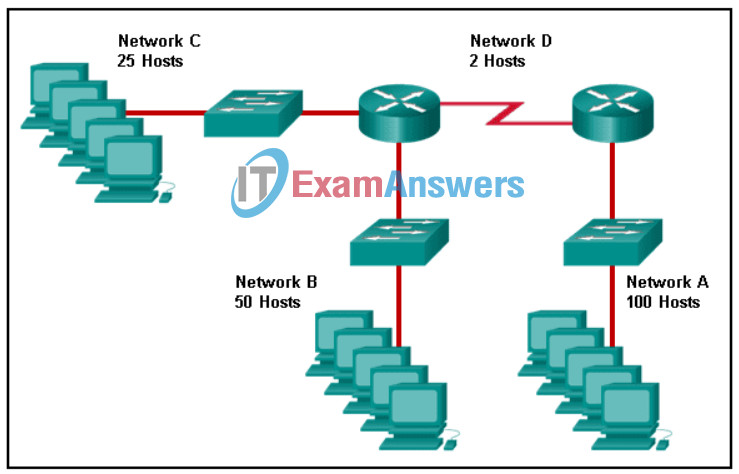
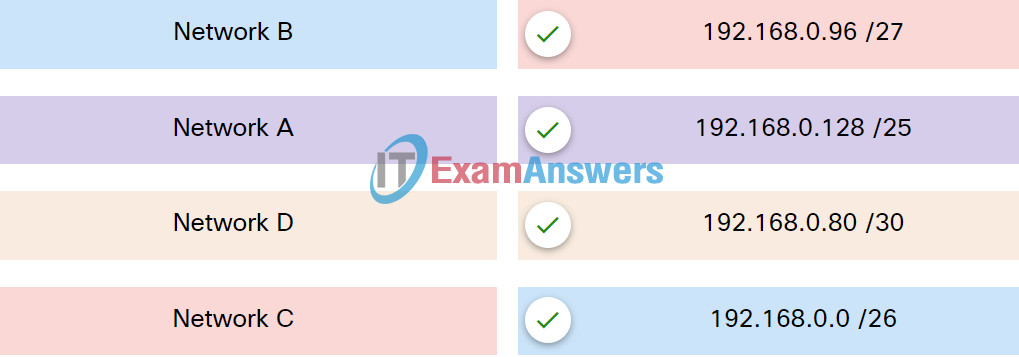
Explanation: Topic 9.3.3
Place the options in the following order:
| Network C |
192.168.0.96 /27 |
| Network A |
192.168.0.128 /25 |
| Network D |
192.168.0.80 /30 |
| Network B |
192.168.0.0 /26 |
137. Which wireless RF band do IEEE 802.11b/g devices use?
- 60 GHz
- 2.4 GHz
- 900 MHz
- 5 GHz
Explanation: Topic 37.2.6
900 MHz is an FCC wireless technology that was used before development of the 802.11 standards. 900 MHz devices have a larger coverage range than the higher frequencies have and do not require line of sight between devices. 802.11b/g/n/ad devices all operate at 2.4 GHz. 802.11a/n/ac/ad devices operate at 5 GHz, and 802.11ad devices operate at 60 GHz.
138. Refer to the exhibit. Which term correctly identifies the device type that is included in the area B?
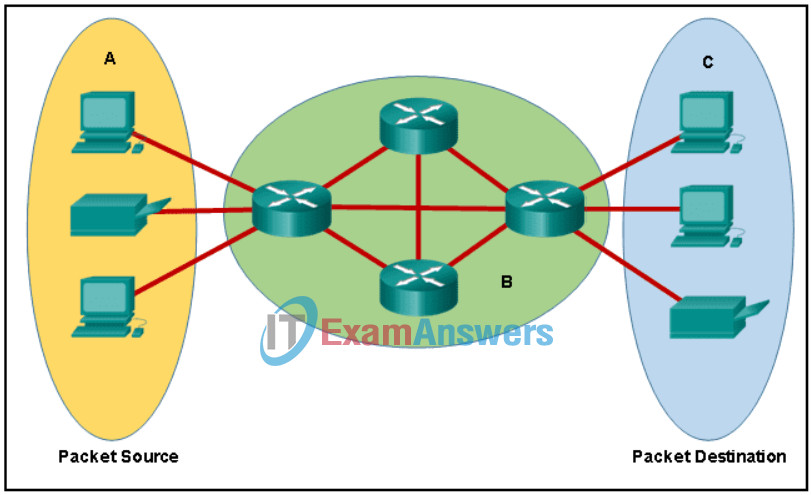
Networking Basics Course Final Exam 3
- end
- transfer
- source
- intermediary
Explanation: Topic 2.2.2
Routers and switches are intermediary devices. End devices consist of PCs, laptops, and servers. They also include printers, VoIP phones, security cameras, and hand-held devices.
139. What is a disadvantage of deploying a peer-to-peer network model?
- lack of centralized administration
- high cost
- difficulty of setup
- high degree of complexity
Explanation: Topic 2.1.3
The simplest peer-to-peer network consists of two computers that are directly connected to each other through the use of a wired or wireless connection. The primary disadvantages of a peer-to-peer network are its lack of central administration, minimal security, and its lack of scalability.
140. Match the phases to the functions during the boot up process of a Cisco router.
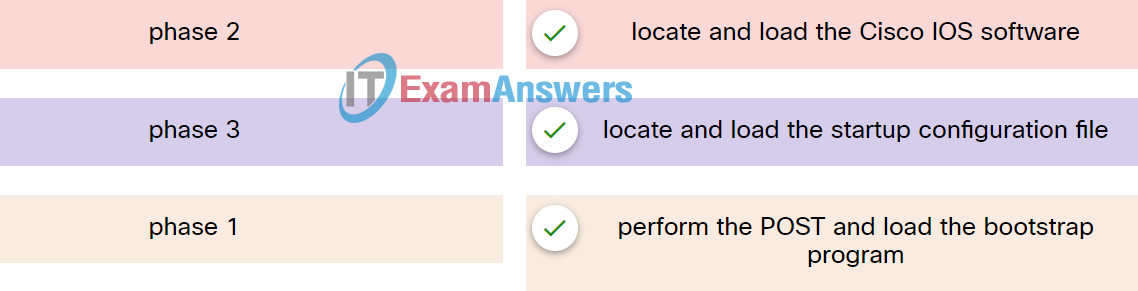
Explanation: Topic 35.3.3
Place the options in the following order:
| phase 2 |
locate and load the Cisco IOS software |
| phase 3 |
locate and load the startup configuration file |
| phase 1 |
perform the POST and load the bootstrap program |
141. Which troubleshooting tool can be used to determine the current TCP open connections on a PC?
- tracrt
- nslookup
- netstat
- ping
- ipconfig
Explanation: Topic 15.2.4
The netstat command displays active TCP connections that are open and running on a networked host. The netstat command lists the protocol in use, the local address and port number, the foreign address and port number, and the state of the connection.
142. A group of Windows PCs in a new subnet has been added to an Ethernet network. When testing the connectivity, a technician finds that these PCs can access local network resources but not the Internet resources. To troubleshoot the problem, the technician wants to initially confirm the IP address and DNS configurations on the PCs, and also verify connectivity to the local router. Which three Windows CLI commands and utilities will provide the necessary information? (Choose three.)
- netsh interface ipv6 show neighbor
- tracert
- nslookup
- ping
- arp -a
- ipconfig
- telnet
Explanation: Topic 17.1.1
The ipconfig and nslookup commands will provide initial IP address and DNS configuration information to the technicians and determine if DHCP is assigning correct information to the PCs. The ping utility would be used to verify, or not, connectivity to the default gateway (router) using the configured default gateway address, or using the known correct default gateway address if these are found to be different. The arp -a or netsh interface ipv6 show neighbor commands could be used if the problem is then suspected to be an IP address to MAC address mapping issue. The telnet and tracert utilities could be used to determine where the problem was located in the network if the default gateway configuration was found to be correct.
143. Refer to the exhibit. PC1 is unable to access PC2. To troubleshoot this problem, the technician needs to confirm that the next hop interface is operational. Which default gateway address should the technician ping from PC1 to confirm this?
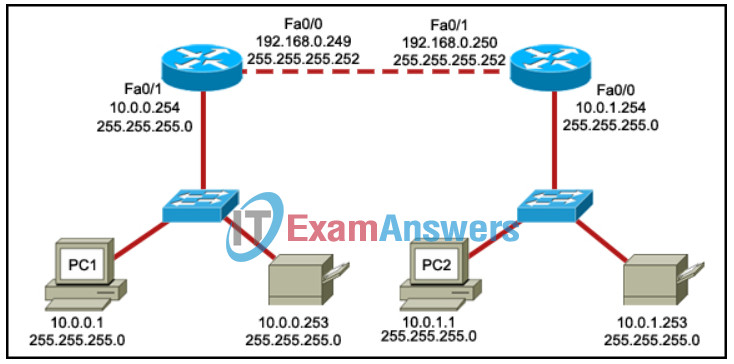
- 10.0.0.254
- 10.0.1.254
- 192.168.0.250
- 192.168.0.249
Explanation: Topic 29.2.3
A successful ping to the default gateway assigned to a PC is an indicator that the PC can communicate across the network. The default gateway must be on the same IP network as the PC, and is usually the IP address of the router interface connected to the same physical network as the PC.
144. Refer to the exhibit. An IT consulting firm is helping a mid-sized marketing and advertising company for updating the campus network. Which three network design features are covered in the diagram? (Choose three.)
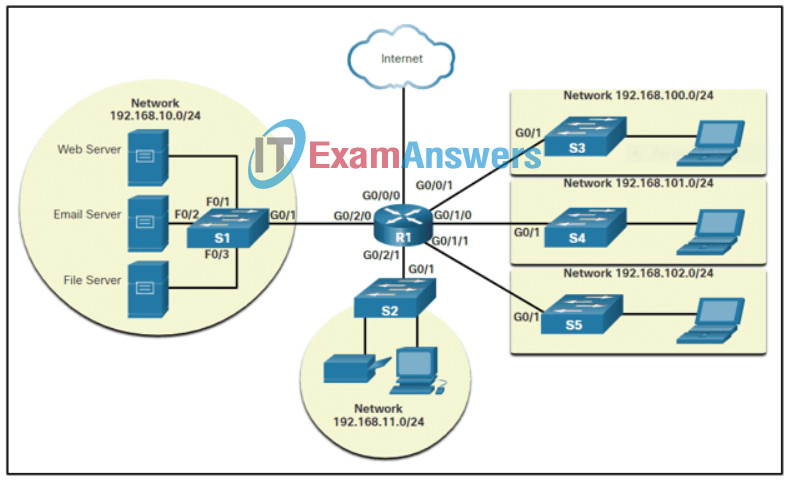
- flow of information in the network including addressing
- network devices that might be needed
- network segmentation
- data packet routing and protocol needs
- IP network subnetting consideration
- locations of network devices in the company
Explanation: Topic 31.1.1
The exhibit shows a logical topology diagram for the network design. The network design features shown in this diagram includes flow of information in the network including addressing, network devices that might be needed, and network segmentation provisioned through a router. The suggested IP address blocks are with the default subnet mask, no subnetting is required. While network devices are grouped logically in the diagram, the locations are not determined or indicated. Routing will be required, but there is no indication of which routing protocol should be used.
145. Refer to the exhibit. Using VLSM, what is the largest and smallest subnet mask required on this network, including the links between routers, in order to minimize address waste?
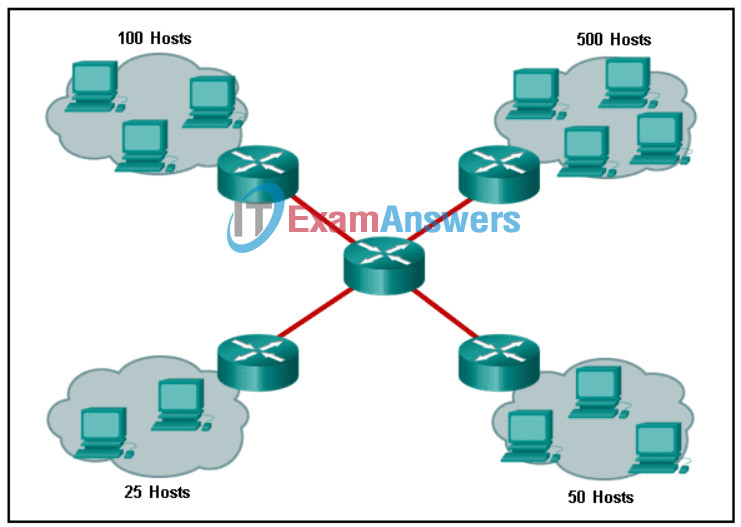
- 255.255.255.0 and 255.255.255.252
- 255.255.254.0 and 255.255.255.252
- 255.255.255.128 and 255.255.255.224
- 255.255.254.0 and 255.255.255.224
Explanation: Topic 9.3.3
The largest subnet requires 500 hosts addresses, so the most efficient subnet would be a /23 with the mask 255.255.254.0. The smallest subnet, the links between the routers, requires two addresses each, so a /30 subnet with the mask 255.255.255.252 is required.
146. IPv6 host A is sending a neighbor solicitation message to IPv6 host B on the same Ethernet network. Which statement describes the destination MAC address host A uses to build the Ethernet frame of the neighbor solicitation message?
- It maps the special braodcast address reserved for neighbor discovery protocol.
- It maps the special solicited-node multicast address of the destination IPv6 address.
- It maps the special IPv6 unicast address reserved for neighbor discovery protocol.
- It maps the special address from the router advertisement message.
Explanation: Topic 34.1.3
When an IPv6 host sends a neighbor solicitation message to another IPv6 host on the same Ethernet network, the sending host creates an Ethernet frame and add a multicast MAC address in the Destination MAC address field. This multicast MAC address maps the special solicited-node multicast address derived from the destination IPv6 address.
147. Which three steps must be completed to manually connect an Android or IOS device to a secured wireless network? (Choose three.)
- Change the MAC address.
- Set the IP address.
- Enter the network SSID.
- Activate the Bluetooth antenna.
- Input the authentication password.
- Choose the correct security type.
Explanation: Topic 3.2.3
In order to connect an Android or IOS device to a Wi-Fi network manually, perform these steps:
Enter the network SSID of the wireless network.
Choose the security type used by the wireless network.
Input the password to authenticate successfully.
148. What are two characteristics of RAM on a Cisco device? (Choose two.)
- RAM is able to store multiple versions of IOS and configuration files.
- The configuration that is actively running on the device is stored in RAM.
- The contents of RAM are lost during a power cycle.
- RAM provides nonvolatile storage.
- RAM is a component in Cisco switches but not in Cisco routers.
Explanation: Topic 35.3.3
RAM stores data that is used by the device to support network operations. The running configuration is stored in RAM. This type of memory is considered volatile memory because data is lost during a power cycle. Flash memory stores the IOS and delivers a copy of the IOS into RAM when a device is powered on. Flash memory is nonvolatile since it retains stored contents during a loss of power.
149. Which type of device provides an Internet connection through the use of a phone jack?
- satellite modem
- Wi-Fi AP
- DSL modem
- cable modem
Explanation: Topic 4.4.1
SL technology uses the existing telephone network. For that reason, a DSL modem commonly has an RJ-11 phone
150. A traveling sales representative uses a cell phone to interact with the home office and customers, track samples, make sales calls, log mileage, and upload/download data while at a hotel. Which internet connectivity method would be a preferred method to use on the mobile device due to the low cost?
Explanation: Topic 3.2.1
Mobile devices typically use either the cellular network or a Wi-Fi network to connect to the internet. The Wi-Fi connection is preferred because it uses less battery power and is free in many places.
151. IPv6 host A is communicating with a remote IPv6 host B. Which device would send ICMPv6 redirect messages to inform that a better next-hop device should be used?
- Host A
- a router in the traffic path
- the switch connected to Host A
- Host B
- the switch connected to Host B
Explanation: Topic 34.1.2
When a router receives a data packet, it may analyze the best gateway device that the host should use. When there are multiple gateway devices available on a network, an IPv6 router will send ICMPv6 redirect messages to the sending host if it determines that there is a more efficient path for the transmissions.
152. Refer to the exhibit. The PC is connected to the console port of the switch. All the other connections are made through FastEthernet links. Which types of UTP cables can be used to connect the devices?
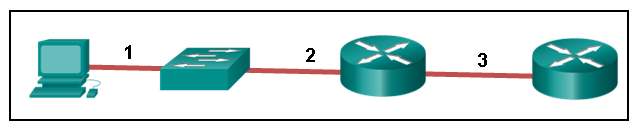
1 - rollover, 2 - crossover, 3 - straight-through
1 - rollover, 2 - straight-through, 3 - crossover
1 - crossover, 2 - rollover, 3 - straight-through
1 - crossover, 2 - straight-through, 3 - rollover
Explanation: Topic 30.4.3
A straight-through cable is commonly used to interconnect a host to a switch and a switch to a router. A crossover cable is used to interconnect similar devices together like switch to a switch, a host to a host, or a router to a router. If a switch has the MDIX capability, a crossover could be used to connect the switch to the router; however, that option is not available. A rollover cable is used to connect to a router or switch console port.
153. A workstation connected to an Ethernet switch port is experiencing connectivity problems. The network technician chooses to use the bottom-up troubleshooting method to identify the issue. What are two possible causes of physical layer network problems that the technician should check? (Choose two.)
- logical addressing issues
- incorrect MAC address assigned
- cables plugged into wrong ports
- incorrect subnet mask on an interface
- improperly terminated cables
- packets received out of sequence
Explanation: Topic 36.2.1
Physical problems are concerned mainly with the hardware aspects of computers and networking devices, and the cables that interconnect them. Physical problems do not include the logical (software) configuration of devices.
154. An ISP help desk technician receives a call from a customer who reports that no one at their business can reach any websites or get their e-mail. After testing the communication line and finding everything fine, the technician instructs the customer to run nslookup from the command prompt. What does the technician suspect is causing the customer's problem?
- improper IP address configuration on the host
- failure of DNS to resolve names to IP addresses
- hardware failure of the ISR used to connect the customer to the ISP
- bad cables or connections at the customer site
Explanation: Topic 25.1.5
The nslookup command can be used to troubleshoot name resolution issues and to verify the current status of the name servers. The nslookup output identifies the default DNS server that is configured on the host. The utility has many options available for testing and verification of the DNS process.
155. Which information does the show startup-config command display?
- the contents of the current running configuration file in the RAM
- the IOS image copied into RAM
- the bootstrap program in the ROM
- the contents of the saved configuration file in the NVRAM
Explanation: Topic 35.3.3
The show startup-config command displays the saved configuration located in NVRAM. The show running-config command displays the contents of the currently running configuration file located in RAM.
156. What is true concerning physical and logical topologies?
- Physical topologies are concerned with how a network transfers frames.
- The logical topology is always the same as the physical topology.
- Physical topologies display the IP addressing scheme of each network.
- Logical topologies refer to how a network transfers data between devices.
Explanation: Topic 31.1.1
Physical topologies show the physical interconnection of devices. Logical topologies show the way the network will transfer data between connected nodes.
157. After making configuration changes on a Cisco switch, a network administrator issues a copy running-config startup-config command. What is the result of issuing this command?
- The configuration changes will be removed and the original configuration will be restored.
- The new configuration will be stored in flash memory.
- The current IOS file will be replaced with the newly configured file.
- The new configuration will be loaded if the switch is restarted.
Explanation: Topic 35.3.3
With the copy running-config startup-config command, the content of the current operating configuration replaces the startup configuration file stored in NVRAM. The configuration file saved in NVRAM will be loaded when the device is restarted.
158. In the OSI model, what three functional areas are addressed by physical layer standards? (Choose three.)
- frame encapsulation
- error detection and retransmission
- encoding
- physical components
- signaling
- media access control
Explanation: Topic 30.2.2
The physical layer standards address three functional areas: physical components, encoding, and signaling. Frame encapsulation, media access control, and error detection and retransmission are services provided by the data link layer.
159. Which two types of signal interference are reduced more by STP than by UTP? (Choose two.)
- dispersion
- MDF
- RFI
- EMI
- white noise
Explanation: Topic 30.3.4
RFI, EMI, and crosstalk cause interference to the electrical signals that are transmitted through copper cables. Both UTP and STP use twisted pairs of wires that help protect against crosstalk. However, STP provides greater protection against RFI and EMI than UTP provides.
160. An IPv6 host receives an ICMPv6 message requesting MAC address resolution. Which message should the host return to provide the MAC address?
- neighbor solicitation message
- neighbor advertisement message
- router advertisement message
- router solicitation message
Explanation: Topic 34.1.3
When an IPv6 host receives an ICMPv6 neighbor solicitation message for MAC address resolution, the host would return a neighbor advertisement message to provide the MAC address.
161. A technician must accommodate at least 500 subnets from address 172.16.0.0/16. What is an appropriate subnet mask and corresponding number of available host IP addresses per subnet to meet the requirement?
- 255.255.255.192 and 126 hosts
- 255.255.255.0 and 128 hosts
- 255.255.255.128 and 126 hosts
- 255.255.255.224 and 128 hosts
Explanation: Topic 9.3.3
The network address 172.16.0.0 has a default mask of 255.255.0.0 (/16). This address has 16 bits in the network portion and 16 bits in the host portion. To have at least 500 subnets, you need to borrow 9 bits (subnets) from the host portion (2^9 = 512 subnets), leaving 7 bits to create hosts. Thus the resulting netmask is 255.255.255.128, and the number of hosts per subnet is 2^7 = 128 - 2 = 126 hosts.
162. Which two statements correctly describe the components of a router? (Choose two.)
- ROM contains diagnostics executed on hardware modules.
- NVRAM stores a backup copy of the IOS used during the boot sequence.
- Flash memory does not lose its contents during a reboot.
- RAM permanently stores the configuration file used during the boot sequence.
- ROM contains the most current and most complete version of the IOS.
- Flash contains boot system commands to identify the location of the IOS.
Explanation: Topic 35.4.2
A router contains four types of memory:
RAM - volatile memory used to store the running IOS, running configuration file, routing table, ARP table, as well as serve as a packet buffer
ROM - nonvolatile memory used to hold a limited version of the IOS, bootup instructions, and basic diagnostic software
NVRAM - nonvolatile memory used to hold the startup configuration file
Flash - nonvolatile memory used to hold the IOS and other system files
163. Refer to the exhibit. Considering the addresses already used and having to remain within the 10.16.10.0/24 network range, which subnet address could be assigned to the network containing 25 hosts?
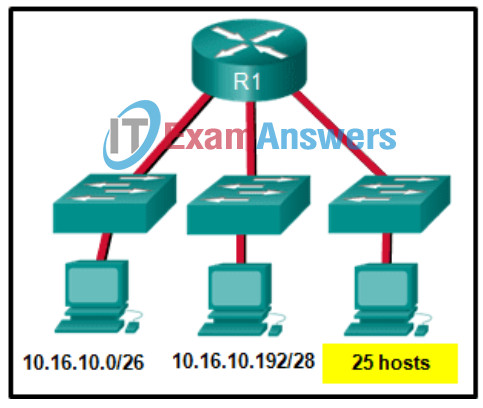
- 10.16.10.240/28
- 10.16.10.240/27
- 10.16.10.160/26
- 10.16.10.64/27
- 10.16.10.128/28
- 10.16.10.224/26
Explanation: Topic 23.1.3
Addresses 10.16.10.0 through 10.16.10.63 are taken for the leftmost network. Addresses 10.16.10.192 through 10.16.10.207 are used by the center network.The address space from 208-255 assumes a /28 mask, which does not allow enough host bits to accommodate 25 host addresses.The address ranges that are available include 10.16.10.64/26 and10.16.10.128/26. To accommodate 25 hosts, 5 host bits are needed, so a /27 mask is necessary. Four possible /27 subnets could be created from the available addresses between 10.16.10.64 and 10.16.10.191:
10.16.10.64/27
10.16.10.96/27
10.16.10.128/27
10.16.10.160/27
164. Which IPv6 prefix is reserved for communication between devices on the same link?
- FE80::/10
- 2001::/32
- FDFF::/7
- FC00::/7
Explanation: Topic 33.1.7
IPv6 link-local unicast addresses are in the FE80::/10 prefix range and are not routable. They are used only for communications between devices on the same link.
165. Refer to the exhibit. A user has configured a NIC on the PC as shown but finds that the PC is unable to access the Internet. What is the problem?
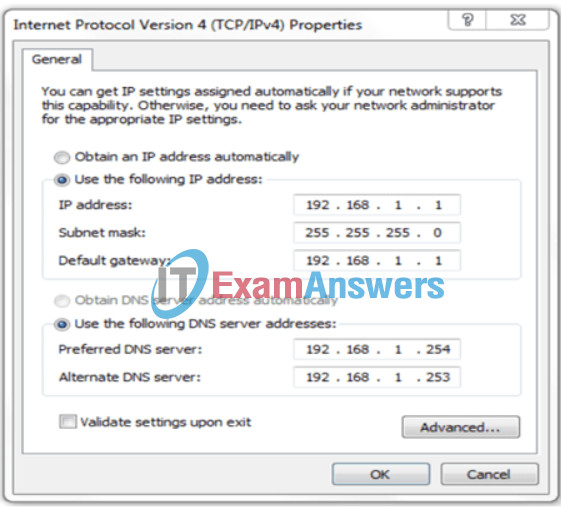
- There should not be an alternate DNS server.
- The preferred DNS address is incorrect.
- The default gateway address is incorrect.
- The settings were not validated upon exit.
Explanation: Topic 32.1.2
In order for a computer to communicate outside its network, it must have a valid default gateway configured.This address cannot be the same as the IP address of the computer.
166. What type of communication rule would best describe CSMA/CD?
- message encoding
- flow control
- access method
- message encapsulation
Explanation: Topic 31.2.3
Carrier sense multiple access collision detection (CSMA/CD) is the access method used with Ethernet. The access method rule of communication dictates how a network device is able to place a signal on the carrier. CSMA/CD dictates those rules on an Ethernet network and CSMA/CA dictates those rules on an 802.11 wireless LAN.
167. What are three parts of an IPv6 global unicast address? (Choose three.)
- a global routing prefix that is used to identify the network portion of the address that has been provided by an ISP
- an interface ID that is used to identify the local network for a particular host
- a global routing prefix that is used to identify the portion of the network address provided by a local administrator
- a subnet ID that is used to identify networks inside of the local enterprise site
- an interface ID that is used to identify the local host on the network
Explanation: Topic 33.1.6
There are three elements that make up an IPv6 global unicast address. A global routing prefix which is provided by an ISP, a subnet ID which is determined by the organization, and an interface ID which uniquely identifies the interface interface of a host.
168. Which attack takes control over a user's mobile device and instructs the device to exfiltrate user-sensitive information and send it to threat actors?
- MitMo
- SMiShing
- Bluejacking
- Grayware
Explanation: 38.3.8
Man-in-the-Mobile (MitMo) is a variation of a man-in-the-middle attack. It is used to take control over the mobile device of a user. When infected, the mobile device is instructed to exfiltrate user-sensitive information and send it to the attackers.
169. What do you call an impersonation attack that takes advantage of a trusted relationship between two systems?
- man-in-the-middle
- sniffing
- spoofing
- spamming
Explanation: Topic 38.3.6
In spoofing attacks, hackers can disguise their devices by using a valid address from the network and therefore bypass authentication processes. MAC addresses and IP addresses can be spoofed and can also be used to spoof ARP relationships.
170. Match the type of firewall to the description.
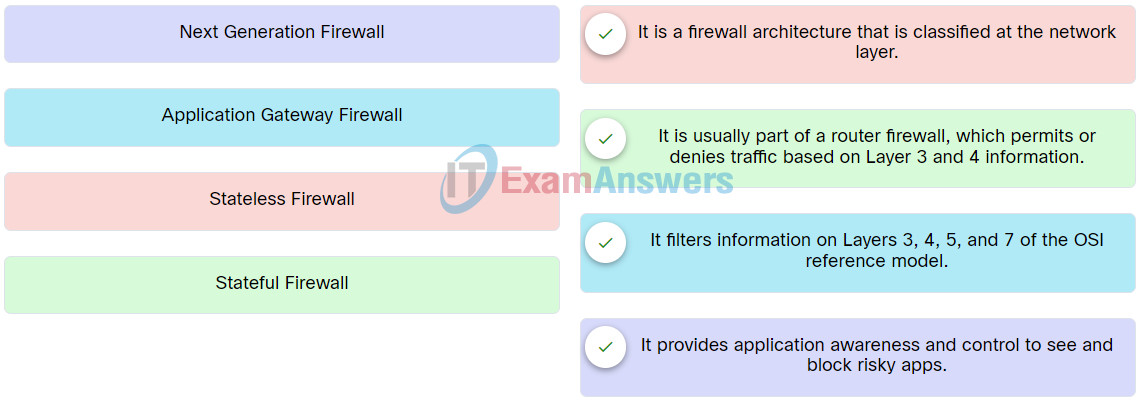
Network Support and Security Course Final Exam Q21
Explanation: Topic 39.5.2
Place the options in the following order:
| Stateless Firewall |
It is a firewall architecture that is classified at the network layer. |
| Stateful Firewall |
It is usually part of a router firewall, which permits or denies traffic based on Layer 3 and 4 information. |
| Application Gateway Firewall |
It filters information on Layers 3, 4, 5, and 7 of the OSI reference model. |
| Next Generation Firewall |
It provides application awareness and control to see and block risky apps. |
171. What is one of the safeguards according to the third dimension of the cybersecurity cube?
- accountability
- confidentiality
- integrity
- technology
Explanation: Topic 39.1.1
The third dimension of the cybersecurity cube defines the pillars on which we need to base our cybersecurity defenses to protect data and infrastructure in the digital realm. These are technology , policy, and practices , and improving people's education, training, and awareness.
172. Which type of static route creates a gateway of last resort?
- standard static route
- floating static route
- summary static route
- default static route
Explanation: Topic 32.2.2
There are four basic types of static routes. Floating static routes are backup routes that are placed into the routing table if a primary route is lost. A summary static route aggregates several routes into one, reducing the size of the routing table. Standard static routes are entered manually into the routing table. Default static routes create a gateway of last resort.
173. What is the interface ID of the IPv6 address 2001:DB8::1000:A9CD:47FF:FE57:FE94/64?
- 47FF:FE57:FE94
- FE57:FE94
- A9CD:47FF:FE57:FE94
- 1000:A9CD:47FF:FE57:FE94
- FE94
Explanation: 33.1.6
The interface ID of an IPv6 address is the rightmost 64 bits, or last four hextets, of the address if no interface ID bits have been used for subnets.
174. Refer to the exhibit. A technician is attempting to map the local network using CDP. According to the output shown, which two statements are true about router Branch01? (Choose two.)
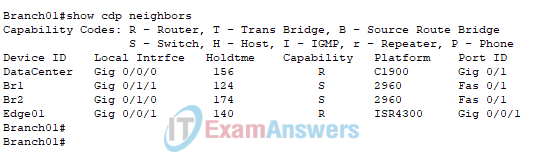
- Router Branch01 is directly connected to port Gi0/1/0 on device BR2.
- Router Branch01 is directly connected to three Cisco switches.
- Router Branch01 is directly connected to another router named DataCenter.
- Router Branch01 port Gi0/0/0 is directly connected to a Layer 2 switch.
- Router Branch01 is directly connected to port Fa0/1 on device BR1.
Explanation: Topic 37.2.11
The output of the show CDP neighbors command on Branch01 indicates that DataCenter is connected to the Gi0/0/0 port on router Branch01 and that the Fa0/1 port on switch BR1 is connected to the Gi0/1/1 port on router Branch01. Two Cisco switches are attached to router Branch01, as indicated by the two S capability codes in the Capability column. The Local Interface column displays the port on Branch01 connected to the device, and the PortID column indicates the port on the connected device.
175. A technician receives a trouble ticket from a user reporting that a website is no longer accessible. What two questions would the technician ask to narrow down the potential problem? (Choose two.)
- Could you access this web site previously from this device?
- What model computer are you using to access this site?
- What operating system is installed on your computer?
- Do you remember your password to this web site?
- Can you access other web sites from this computer browser?
Explanation: Topic 37.3.4
To narrow down the problem, the technician asks if the computer was previously able to access the website and if other websites are accessible. If the answer is yes to both questions, the technician has narrowed the issue to problems with the single website on this day.
176. Which type of cloud service is a user accessing when using Google Sheets to create a financial report?
Explanation: Topic 37.2.5
Google Sheets is an example of SaaS, or software as a service. The software that powers Google Sheet functionality is located on cloud servers managed by Google. PaaS is a platform and service used primarily by software developers to develop and test new applications. IaaS is an infrastructure service in which servers and other network devices, such as firewalls, are deployed in the cloud. FaaS functions as a service that provides dynamically allocated servers when a request is made for specific application services, such as providing a web service when a web page is requested.
177. What would be the interface ID of an IPv6 enabled interface with a MAC address of 1C-6F-65-C2-BD-F8 when the interface ID is generated by using the EUI-64 process?
- 1E6F:65FF:FEC2:BDF8
- C16F:65FF:FEC2:BDF8
- 0C6F:65FF:FEC2:BDF8
- 106F:65FF:FEC2:BDF8
Explanation: Topic 33.3.7
To derive the EUI-64 interface ID by using the MAC address 1C-6F-65-C2-BD-F8, three steps are taken.
- Change the seventh bit of the MAC address from a binary 0 to a binary 1 which changes the hex C, into a hex E.
- Insert hex digits FFFE into the middle of the address.
- Rewrite the address in IPv6 format.
The three steps, when complete, give the interface ID of 1E6F:65FF:FEC2:BDF8.
178. Consider the following command:
ip route 192.168.10.0 255.255.255.0 10.10.10.2 5
Which route would have to go down in order for this static route to appear in the routing table?
- a default route
- a static route to the 192.168.10.0/24 network
- an EIGRP-learned route to the 192.168.10.0/24 network
- an OSPF-learned route to the 192.168.10.0/24 network
Explanation: Topic 32.2.3
The administrative distance of 5 added to the end of the static route creates a floating static situation for a static route that goes down. Static routes have a default administrative distance of 1. This route that has an administrative distance of 5 will not be placed into the routing table unless the previously entered static route to the 192.168.10.0/24 goes down or was never entered. The administrative distance of 5 added to the end of the static route configuration creates a floating static route that will be placed in the routing table when the primary route to the same destination network goes down. By default, a static route to the 192.168.10.0/24 network has an administrative distance of 1. Therefore, the floating route with an administrative distance of 5 will not be placed into the routing table unless the previously entered static route to the 192.168.10.0/24 goes down or was never entered. Because the floating route has an administrative distance of 5, the route is preferred to an OSPF-learned route (with the administrative distance of 110) or an EIGRP-learned route (with the administrative distance of 110) to the same destination network.
179. A technician has been asked to develop a physical topology for a network that provides a high level of availability. Which physical topology requires that every node is attached to every other node on the network?
- hierarchical
- bus
- ring
- mesh
- star
Explanation: Topic 31.1.3
The mesh topology provides high availability because every node is connected to all other nodes. Mesh topologies can be found in WANs. A partial mesh topology can also be used where some, but not all, end points connect to one another.
180. Refer to the exhibit. The image shows a firewall filtering network traffic based on information at highlighted OSI model Layers. Which type of firewall is represented?
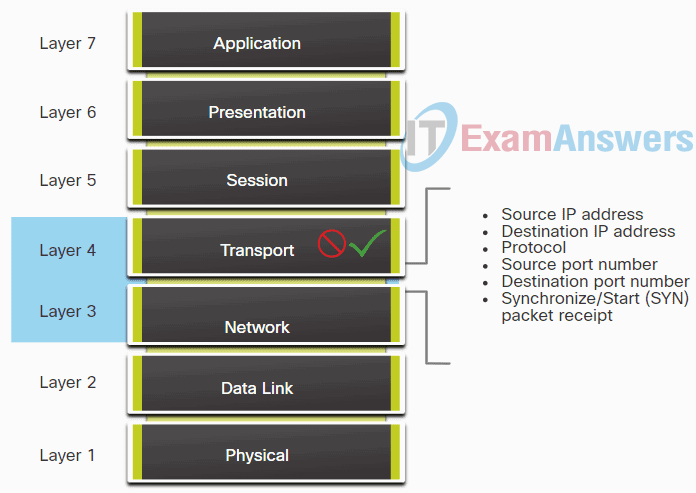
Network Support and Security Course Final Exam Q23
- Next Generation
- Application Gateway
- Stateful
- Packet filtering (stateless)
Explanation: Topic 39.5.2
Packet filtering firewalls are usually part of a router firewall, which permits or denies traffic based on Layer 3 and 4 information. Stateless firewalls use a simple policy table look-up that filters traffic based on specific criteria.
181. Match the characteristic with the appropriate copper media.
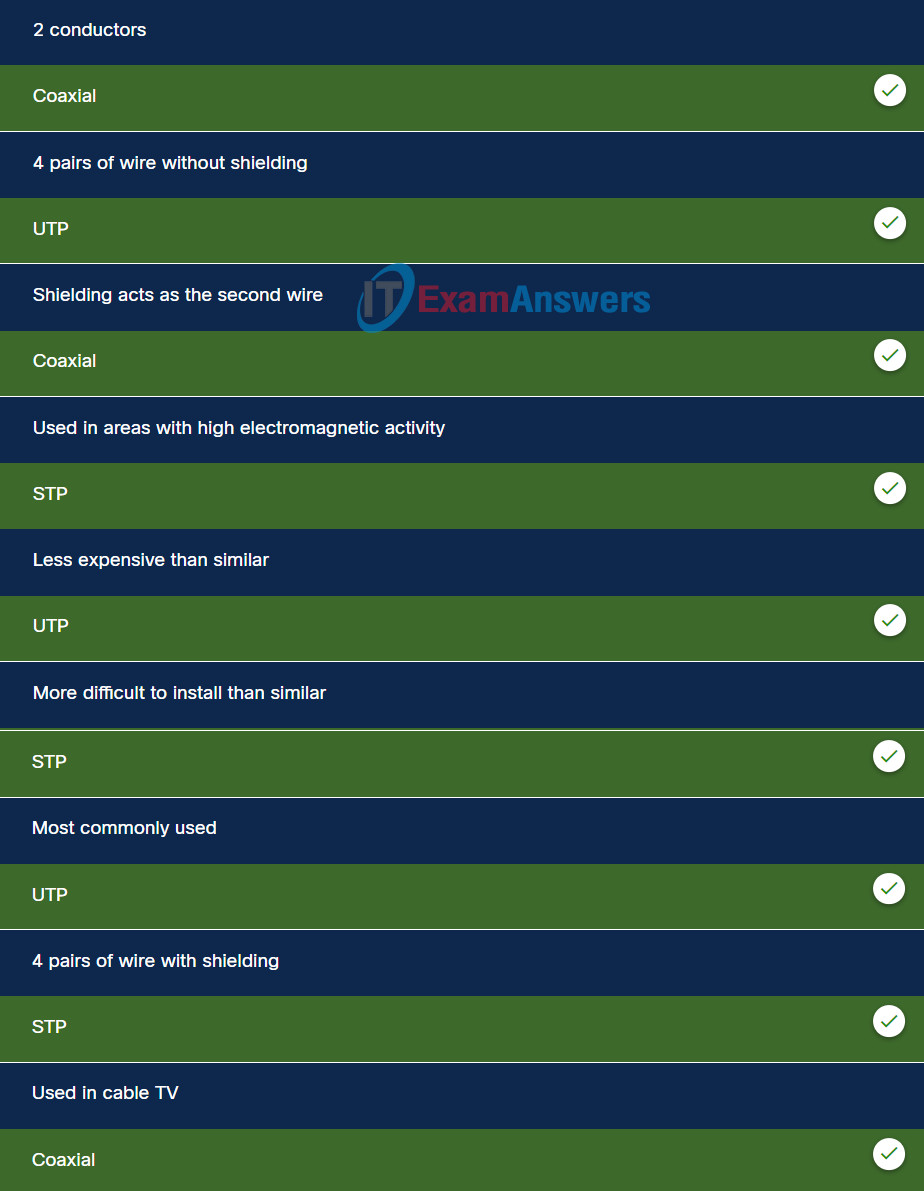
Explanation: Topic 30.3.2
Options matched to the correct selection.
| coaxial |
UTP |
STP |
| 2 conductors |
4 pairs of wire without shielding |
4 pairs of wire with shielding |
| used in cable TV |
less expensive than similar |
used in areas with high electromagnetic activity |
| shielding acts as the second wire |
most commonly used |
more difficult to install than similar |
182. What security benefit is provided by SSH?
- protection from threat actors deciphering remote access session data.
- protection from viruses and malware for endpoints.
- protection from malicious data reaching servers and clients.
- protection from DoS attacks against routers and Layer 3 switches.
Explanation: Topic 37.6.2
Internet Protocol Security (IPsec) protects sensitive data and secures VPNs. IPsec tunneling encrypts all data sent between tunnel endpoints. IPsec also can be used to authenticate data originating from an authorized sender.
183. What information can a technician obtain by running the tracert command on a Windows PC?
- the available routes in the PC routing table to reach a destination.
- the available bandwidth between the PC and a destination.
- the verification of Layer 2 connectivity between the PC and a destination.
- layer 3 hops a packet crosses as it travels to a destination.
Explanation: Topic 29.2.5
The tracert command in Windows can help a technician locate Layer 3 problems by returning a list of hops a packet takes as it is routed through a network. This helps verify Layer 3 connectivity and identify the point along the path where a problem can be found if there is no end-to-end connectivity.
184. What are the two characteristics of a site-to-site VPN? (Choose two.)
- The client initiates the VPN connection.
- Traffic between clients and the VPN gateway is automatically encrypted.
- A VPN gateway device is needed at both ends of the tunnel.
- The VPN is established between the client PC and a VPN gateway.
- Clients have no awareness of the VPN.
Explanation: Topic 37.6.4
A site-to-site VPN is created between two VPN gateways to establish a secure tunnel. The VPN traffic is only encrypted between the two gateway devices and not between the client and the gateway. The client host will have no knowledge that a VPN is being used.
185. What type of connection is used when a teleworker must have secure access to devices and services located on an enterprise network?
Explanation: Topic 37.6.4
A VPN connection between the teleworker and the enterprise provides a secure connection to the enterprise network. All communications between the entities are encrypted. HTTP and FTP are not secure protocols. RDP provides remote access to a single Windows computer.
186. The IT department of a high school is developing cybersecurity policies. One policy item regulates the blocking of obtaining movies and sounds through peer-to-peer networks on school computers. Which two user threats does this policy address? (Choose two.)
- data theft
- unauthorized downloads and media
- no awareness of security
- poorly enforced security policies
- unauthorized websites
Explanation: Topic 38.1.5
Network and device infections and attacks can be traced back to users who have downloaded unauthorized emails, photos, music, games, apps, or videos to their computers, networks, or storage devices. Most movies and music recordings downloaded from peer-to-peer networks are distributed illegally.
187. A penetration test carried out by an organization identified a backdoor on the network. What action should the organization take to find out if their systems have been compromised?
- Look for policy changes in Event Viewer.
- Look for unauthorized accounts.
- Scan the systems for viruses.
- Look for usernames that do not have passwords.
Explanation: Topic 38.1.13
If a penetration test is successful, the corporation should check to locate vulnerabilities in the network and also check to see if there are new unauthorized accounts.
188. What non-technical method could a cybercriminal use to gather sensitive information from an organization?
- ransomware
- pharming
- social engineering
- man-in-the-middle
Explanation: Topic 38.2.1
Social engineering is a very effective way to get personal or sensitive corpoate information from an employee. Cybercriminals may try to get to know an employee and then use trust or familiarity to gather the needed information.
189. What type of attack occurs when data goes beyond the memory areas allocated to an application?
- SQL injection
- RAM spoofing
- Buffer overflow
- RAM injection
Explanation: Topic 38.5.3
A buffer overflow occurs when data is written beyond the limits of a buffer. By changing data beyond the boundaries of a buffer, the application can access memory allocated to other processes. This can lead to a system crash or data compromise, or provide escalation of privileges.
190. A network administrator needs to segment the local area network to isolate traffic from different departments so that network permissions unique to each department can be implemented. Which network topology provides a solution to achieve the objective?
Explanation: Topic 37.2.2
Implementing VLANs on a local area network allows an administrator to segment and isolate traffic for administrative purposes. Ports on a switch can be grouped in VLANs, and traffic in each VLANs is kept separate from other VLANs by the switch. This allows the administrator to apply different network permissions to the isolated traffic on the VLANs.
191. Which output of a ping command can determine two important pieces of information? (Choose two.)
- the round-trip time for the request to reach the destination and the response to return
- the IP address of the gateway router that connects the source device to the internet
- the number of domains that the packet travels through from the source to the destination
- which network device is causing delays in delivering the packet to the destination IP address
- whether or not the destination IP address is reachable through the network
Explanation: Topic 29.2.1
A successful ping command confirms that the destination IP address is reachable through the network. The ping command output also displays the average round-trip time for the ping request to reach the destination and the ping response to return.
192. Which protocol is used by network management systems to collect data from network devices?
Explanation: Topic 37.6.5
Many network management systems use SNMP to collect data from networking devices. SMTP is used to send emails between email servers. RDP is the protocol used to access desktop computers remotely. TFTP is an insecure protocol used to transfer files between devices.
Networking Essentials 2.0: Course Final Exam
1. Using default settings, what is the next step in the switch boot sequence after the IOS loads from flash?
- Search for a backup IOS in ROM.
- Load the bootstrap program from ROM.
- Load the running-config file from RAM.
- Perform the POST routine.
- Locate and load the startup-config file from NVRAM.
4. What is an inherent security vulnerability of SSID broadcasting?
- It sends traffic unencrypted between the wireless access point and the client.
- It broadcasts the identity of the network.
- It allows unauthenticated access to the wireless network.
- It allows any host to join the wireless network.
Explanation: By default, wireless routers and access points broadcast SSIDs in plain text to all computers within the wireless range.This represents a security risk because an attacker can easily intercept the wireless signals and read plain text messages.
5. A network administrator installs a network device that focuses on interconnecting independent local networks. At which layer of devices does this technology reside?
- access
- internet
- distribution
- core
Explanation: The distribution layer connects local networks and controls the traffic flowing between them. Networking devices that make up the distribution layer are designed to interconnect networks, not individual hosts.
6. What are three characteristics of multicast transmission? (Choose three.)
- Multicast transmission can be used by routers to exchange routing information.
- The range of 224.0.0.0 to 224.0.0.255 is reserved to reach multicast groups on a local network.
- The source address of a multicast transmission is in the range of 224.0.0.0 to 224.0.0.255.
- Multicast messages map lower layer addresses to upper layer addresses.
- Computers use multicast transmission to request IPv4 addresses.
- A single packet can be sent to a group of hosts.
Explanation: Broadcast messages consist of single packets that are sent to all hosts on a network segment. These types of messages are used to request IPv4 addresses, and map upper layer addresses to lower layer addresses. A multicast transmission is a single packet sent to a group of hosts and is used by routing protocols, such as OSPF and RIPv2, to exchange routes. The address range 224.0.0.0 to 224.0.0.255 is reserved for link-local addresses to reach multicast groups on a local network.
7. What are two common media used in networks? (Choose two.)
- fiber
- wood
- nylon
- water
- copper
Explanation: Common media used in networks include copper, glass or plastic optical fiber, and wireless.
8. Refer to the exhibit. Which router port connects to the modem provided by the service provider?
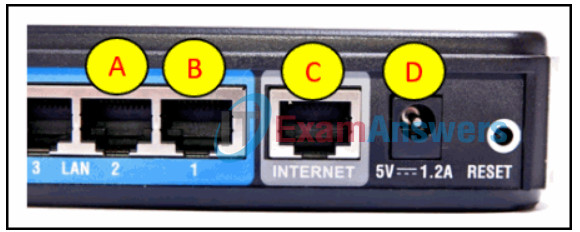
Explanation: The ports shown in the diagram are used as follows: The LAN ports, A and B, are used to connect wired devices on the home network. The Internet port, C, is connected to the modem. The port, labeled D, is the 5V DC power port that supplies power to the router.
9. A consumer places a smartphone close to a pay terminal at a store and the shopping charge is successfully paid. Which type of wireless technology was used?
Explanation: NFC is a wireless technology that allows data to be exchanged between devices that are in very close proximity to each other.
11. What type of technology converts analog voice signals into digital data?
Explanation: Voice over IP (VoIP) is a technology that is used with making telephone calls across a network or internet and it converts analog voice signals into digital data.
12. What are two wiring schemes defined by the TIA/EIA organization for Ethernet installation in homes and businesses? (Choose two.)
- T568B
- RJ-45
- STP
- UTP
- T568A
Explanation: The TIA/EIA organization defines the wiring schemes T568A and T568B for typical Ethernet installations. Each wiring scheme defines a specific order of wire connections on the end of the cable.
14. What is the effect of setting the security mode to WEP on a small wireless router?
- It translates an internal address or group of addresses into an outside, public address.
- It encrypts data between the wireless client and the access point.
- It allows the access point to inform clients of its presence.
- It translates IP addresses into easy-to-remember domain names.
- It identifies the wireless LAN.
Explanation: WEP is used to encrypt data between the wireless client and the access point. DNS translates IP addresses into easy-to-remember domain names. NAT translates an internal address or group of addresses into an outside, public address. An SSID allows the access point to inform clients of its presence.
15. A network administrator issues the Switch(config)# Interface FastEthernet 0/1 command on a Cisco switch. Which term is used to describe the "0/1" part in the command?
- command
- hot key
- keyword
- argument
Explanation: In this command structure, the Interface part is the command, the FastEthernet part is a keyword, and the 0/1 part is an argument.
16. What is the purpose of the subnet mask in conjunction with an IP address?
- to identify whether the address is public or private
- to mask the IP address to outsiders
- to uniquely identify a host on a network
- to determine the subnet to which the host belongs
Explanation: With the IPv4 address, a subnet mask is also necessary. A subnet mask is a special type of IPv4 address that coupled with the IP address determines the subnet of which the device is a member.
17. If the default gateway is configured incorrectly on a host, what is the impact on communications?
- The host is unable to communicate on the local network.
- The host is unable to communicate with hosts on remote networks.
- The host is unable to communicate with hosts on both the local and remote networks.
- The host cannot get an IP address from the DHCP server.
Explanation: In data communication, the default gateway device is involved only when a host needs to communicate with other hosts on another network. The default gateway address identifies a network device that a host device uses to communicate with devices on other networks. The default gateway device is not used when a host communicates with other hosts on the same network.
18. What is a characteristic of a peer-to-peer application?
- The resources required for the application are centralized.
- Both devices initiate a three-way handshake to determine who is initiating the communication.
- Each device using the application provides a user interface and runs a background service.
- Each device can act both as a client and a server, but not simultaneously.
Explanation: Peer-to-peer networks exist directly between client devices, with no centralized resources or authentication. Hybrid peer-to-peer systems also exist that decentralize resource sharing but can use centralized indexes to point to the resource locations.
19. In software defined network architecture, what function is removed from network devices and performed by an SDN controller?
- application policies
- data plane
- security
- control plane
Explanation: In network virtualization, the control plane function of each network device is removed and is performed by a centralized controller. The controller then can communicate control plane functions to each of the network devices. This allows the network devices to focus all resources on forwarding plane functions.
21. Which network migration technique encapsulates IPv6 packets inside IPv4 packets to carry them over IPv4 network infrastructures?
- translation
- dual-stack
- tunneling
- encapsulation
Explanation: The tunneling migration technique encapsulates an IPv6 packet inside an IPv4 packet. Encapsulation assembles a message and adds information to each layer in order to transmit the data over the network. Translation is a migration technique that allows IPv6-enabled devices to communicate with IPv4-enabled devices using a translation technique similar to NAT for IPv4. The dual-stack migration technique allows IPv4 and IPv6 protocol stacks to coexist on the same network simultaneously.
22. Which two types of interference may affect the data throughput on UTP cables? (Choose two.)
- moisture
- EMI
- crosstalk
- temperature
- noise
Explanation: Unshielded twisted-pair (UTP) cabling is sensitive to the interference introduced by electromagnetic interference (EMI) and crosstalk.
24. Match the type of malware with the definition.
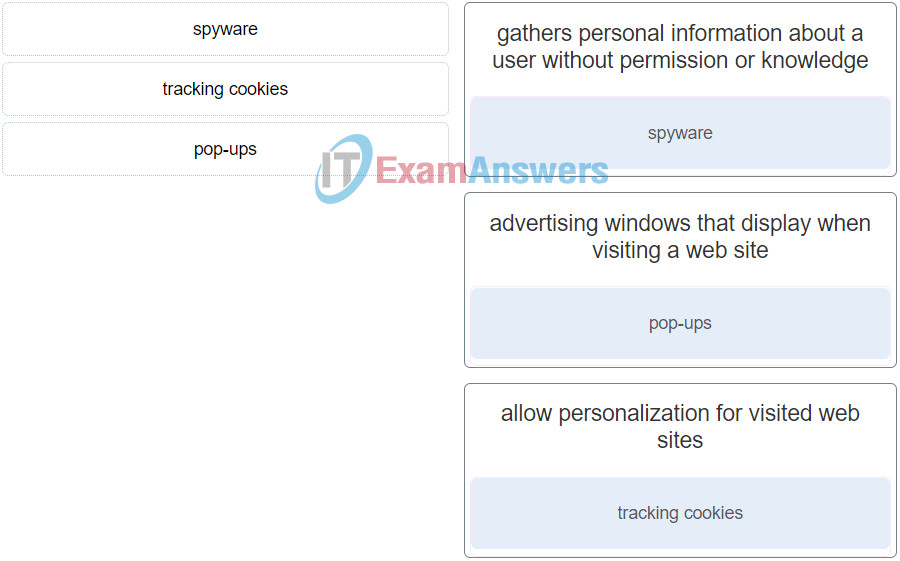
25. Which statement correctly describes data transmission at the transport layer?
- Segmentation is provided by the window size field when the TCP protocol is used.
- Segmentation is provided by sequence numbers when UDP is used.
- Retransmission of lost packets is provided by both TCP and UDP.
- A single datagram can include both a TCP and a UDP header.
- Both UDP and TCP use port numbers.
Explanation: Segmentation is handled at Layer 4 by TCP sequence numbers. UDP does not have sequence numbers in the header, but instead, lets the application handle reordering if it is necessary. Only TCP provides reliable deliver and retransmits data. Each segment has either a TCP header or a UDP header; it cannot contain both.
26. What are two benefits of using a layered network model? (Choose two.)
- It speeds up packet delivery.
- It prevents technology in one layer from affecting other layers.
- It ensures a device at one layer can function at the next higher layer.
- It assists in protocol design.
- It prevents designers from creating their own model.
Explanation: Some vendors have developed their own reference models and protocols. Today, if a device is to communicate on the Internet, the device must use the TCP/IP model. The benefits of using a layered model are as follows:assists in protocol design
fosters competition between vendors
prevents a technology that functions at one layer from affecting any other layer
provides a common language for describing network functionality
helps in visualizing the interaction between each layer and protocols between each layer
27. Which two devices are considered end devices? (Choose two.)
- switch
- hub
- laptop
- printer
- router
Explanation: A device that forms the interface between users and the underlying communication network is known as an end device. End devices are either the source or destination of a message.
28. Which three attacks exploit human behavior? (Choose three.)
- pretexting
- brute force
- phishing
- zombies
- vishing
- malware
Explanation: Attacks aimed at exploiting human behavior such as pretexting, phishing, and vishing are commonly used by hackers to obtain information directly from authorized users.
29. A user is setting up a home wireless network. Which type of device must the user have in order to establish the wireless network and provide access to the internet for multiple home devices?
- hub
- wireless router
- switch
- patch panel
Explanation: A wireless router connects multiple wireless devices to the network. It will then aggregate the internet access requests from home devices to the internet.
30. Match the protocol with the function.
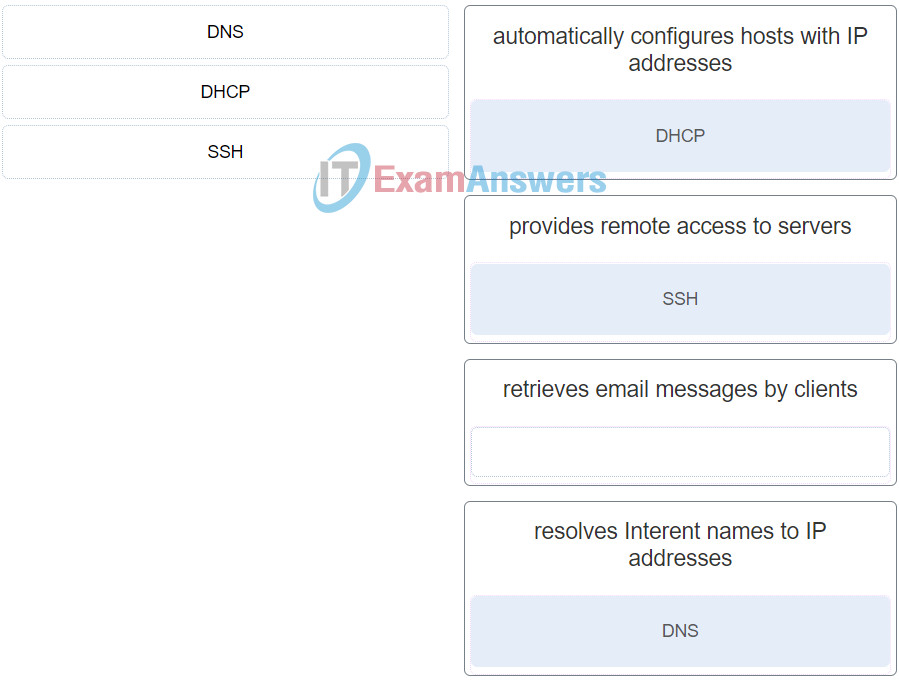
31. What are two features of protocols used within the TCP/IP protocol stack? (Choose two.)
- The Internet Layer IP protocol has built in mechanisms for ensuring the reliable transmission and receipt of data.
- The same Transport Layer source port is used for all of the tabs opened at the same time within a web browser.
- UDP is used when an application must be delivered as quickly as possible and some loss of data can be tolerated.
- TCP and UDP destination port numbers are dynamically generated by the sending device in order to track the responses to requests.
- TCP mechanisms retransmit data when an acknowledgment is not received from the destination system within a set period of time.
Explanation: Application programmers make decisions about which protocols to use to transport the data to and from their applications based on whether the application can tolerate any lost data. Live streaming and voice transmissions can use UDP because if a few data packets are lost, the quality of the video and audio is not seriously impacted. TCP is used when all data must be complete and accurate.
33. Which command can an administrator execute to determine what interface a router will use to reach remote networks?
- show protocols
- show interfaces
- show ip route
- show arp
Explanation: The show ip route command is used to display the IP routing table of the router. The IP routing table will show a list of known local and remote networks and the interfaces that the router will use to reach those networks.
34. While a network security product is being deployed, a customizable list of allowable protocols is shown. Which three protocols should be allowed to provide for the use of email on a network? (Choose three.)
- POP3
- Telnet
- IMAP4
- TFTP
- SMTP
- HTTP
- DNS
Explanation: The email protocols used on a network are SMTP, POP3, and IMAP4. SMTP is used to send messages to a local email server, whereas POP and IMAP are used to receive email.
36. A client device on an Ethernet segment needs an IP address in order to communicate on the network. A DHCP server with IP address 192.168.1.1 has been configured and enabled on the network. How will a client device obtain a usable IP address for this network?
- Send a DHCPACK packet to the default gateway address.
- Use a statically configured IP address from the pool of IP addresses that is offered by the DHCP server.
- Send a DHCPDISCOVER message to physical address FF-FF-FF-FF-FF-FF.
- Send a DHCPREQUEST packet to IP address 255.255.255.255.
Explanation: Like IP addressing, there is also a special MAC address for broadcast purposes: FF-FF-FF-FF-FF-FF. When a DHCP client needs to send a DHCP Discover message in order to seek DHCP servers, the client will use this MAC address as the destination MAC address in the Ethernet frame. It does this because it has no knowledge of the IP and MAC addresses of DHCP servers.
37. Which two files, if found, are copied into RAM as a router with the default configuration register setting boots up? (Choose two.)
- IOS image file
- running configuration
- POST diagnostics
- startup configuration
Explanation: The two primary files needed for bootup are the IOS image file and startup configuration, which are copied into RAM to maximize performance. If a router configuration register is set to 0x2102, the router will attempt to load the IOS image from flash memory and the startup configuration file from NVRAM.
39. A network administrator establishes a connection to a switch via SSH. What characteristic uniquely describes the SSH connection?
- on-site access to a switch through the use of a directly connected PC and a console cable
- remote access to the switch through the use of a telephone dialup connection
- direct access to the switch through the use of a terminal emulation program
- remote access to a switch where data is encrypted during the session
- out-of-band access to a switch through the use of a virtual terminal with password authentication
Explanation: SSH provides a secure remote login through a virtual interface. SSH provides a stronger password authentication than Telnet. SSH also encrypts the data during the session.
40. Using a systematic troubleshooting approach, a help desk technician suspects a problem at Layer 3 of the OSI model. In gathering information, which two questions are associated with Layer 3? (Choose two.)
- Does a browser connection to www.cisco.com work?
- Is there a link light on the network card?
- Is the PC configured for DHCP?
- Is the network cable plugged in?
- From the PC, is the default gateway reachable using the ping command?
Explanation: IP address configuration and the ping command are associated with Layer 3 protocols. Visiting a web server is associated with the application layer. An Ethernet cable connection and NIC are associated with Layer 1 functions.
41. During a move, employee workstations were disconnected from the network and reconnected in new offices. However, after the move a few workstations cannot get a valid IP address. What should be checked first to identify the root cause of the problem?
- Install all software updates.
- Check the operation status of the DHCP server.
- Make sure the cables are functional and properly plugged.
- Test if these workstations can ping the default gateway.
Explanation: Because the workstations have just been moved from one location to another, the internal OS and applications have not changed. The first thing to check should be the Ethernet cable, including the type of cable used and whether the cables are properly plugged into both the workstation and the jack on the wall.
42. Which solution allows external users to access only an internal FTP server on a private network?
- dynamic NAT
- port forwarding
- NAT with overload
- static NAT
Explanation: Port forwarding can be used to permit other users to reach devices on an internal network through the Internet. The firewall in the router determines if the traffic should be forwarded to an internal device based on the port number. Port numbers are associated with specific services, such as FTP, HTTP, HTTPS, and POP3.
43. Which type of address does a switch use to build the MAC address table?
- destination MAC address
- source MAC address
- source IP address
- destination IP address
Explanation: When a switch receives a frame with a source MAC address that is not in the MAC address table, the switch will add that MAC address to the table and map that address to a specific port. Switches do not use IP addressing in the MAC address table.
45. Which factor does not influence throughput?
- the amount of data that is being sent and received on the connection
- the type of data that is being transmitted
- the operating system that is used by end devices
- the latency that is created by the number of network devices encountered between source and destination
Explanation: Throughput is the amount of data that has successfully moved from one place to another in a given time period. Several factors could influence throughput, including the amount and type of data being transmitted and latency.
46. A DHCP server is used to assign IP addresses dynamically to the hosts on a network. The address pool is configured with 192.168.10.0/24. There are 3 printers on this network that need to use reserved static IP addresses from the pool. How many IP addresses in the pool are left to be assigned to other hosts?
Explanation: If the block of addresses allocated to the pool is 192.168.10.0/24, there are 254 IP addresses to be assigned to hosts on the network. As there are 3 printers which need to have their addresses assigned statically, then there are 251 IP addresses left for assignment.
47. What is an advantage of using standards to develop and implement protocols?
- Different manufacturers are free to apply different requirements when implementing a protocol.
- A particular protocol can only be implemented by one manufacturer.
- Standards provide flexibility for manufacturers to create devices that comply with unique requirements.
- Products from different manufacturers can interoperate successfully.
Explanation: Standards-based protocols enable products from different manufacturers to interoperate successfully. Standards-based protocols enable many manufacturers to implement that protocol. If different manufacturers implement different requirements within the same protocol, then their products will not be interoperable.
48. An intruder tries a large number of possibilities in rapid succession to guess a password. As a result, other users on the network are locked out. What type of attack has occurred?
- brute force
- DDoS
- SYN flooding
- ping of death
Explanation: In a brute force attack, an unauthorized person will try to gain access to a system by sending as many passwords as possible as rapidly as possible.
49. Match the commands to the correct actions.
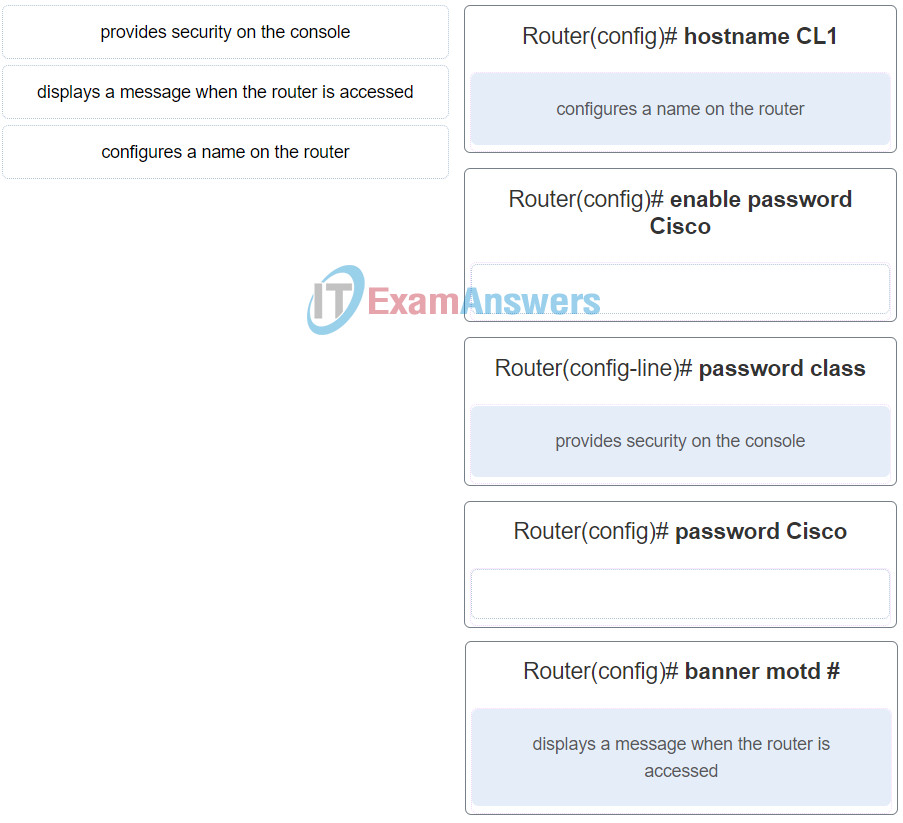
50. Which type of access is secured on a Cisco router or switch with the enable secret command?
- console line
- virtual terminal
- AUX port
- privileged EXEC
Explanation: The enable secret command secures access to the privileged EXEC mode of a Cisco router or switch.
51. Which type of device filtering can be enabled on some wireless access points or wireless routers?
- IP address
- user ID
- authentication
- MAC address
Explanation: On wireless access points, MAC addresses can be manually entered to filter which devices are allowed on the wireless network.
52. A host needs to reach another host on a remote network, but the ARP cache has no mapping entries. To what destination address will the host send an ARP request?
- the broadcast MAC address
- the subnet broadcast IP address
- the unicast IP address of the remote host
- the unicast MAC address of the remote host
Explanation: ARP requests are sent when a host does not have an IP to MAC mapping for a destination in the ARP cache. ARP requests are sent to the Ethernet broadcast of FF:FF:FF:FF:FF:FF. In this example because the address of the remote host is unknown, an ARP request is sent to the Ethernet broadcast to resolve the MAC address of the default gateway that is used to reach the remote host.
53. When configuring SSH on a router to implement secure network management, a network engineer has issued the login local and transport input ssh line vty commands. What three additional configuration actions have to be performed to complete the SSH configuration? (Choose three.)
- Configure the correct IP domain name.
- Manually enable SSH after the RSA keys are generated.
- Generate the asymmetric RSA keys.
- Create a valid local username and password database.
- Configure role-based CLI access.
- Set the user privilege levels.
Explanation: SSH is automatically enabled after the RSA keys are generated. Setting user privilege levels and configuring role-based CLI access are good security practices but are not a requirement of implementing SSH.
54. A computer has to send a packet to a destination host in the same LAN. How will the packet be sent?
- The packet will be sent to the default gateway first, and then, depending on the response from the gateway, it may be sent to the destination host.
- The packet will be sent directly to the destination host.
- The packet will first be sent to the default gateway, and then from the default gateway it will be sent directly to the destination host.
- The packet will be sent only to the default gateway.
Explanation: If the destination host is in the same LAN as the source host, there is no need for a default gateway. A default gateway is needed if a packet needs to be sent outside the LAN.
55. Refer to the exhibit. What three facts can be determined from the viewable output of the show ip interface brief command? (Choose three.)
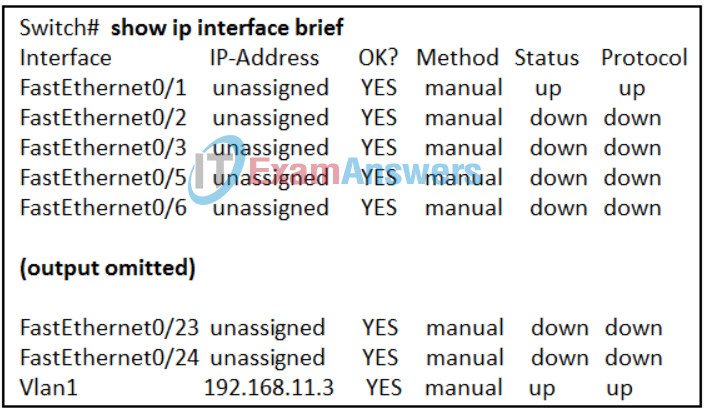
- Two devices are attached to the switch.
- The switch can be remotely managed.
- One device is attached to a physical interface.
- The default SVI has been configured.
- Two physical interfaces have been configured.
- Passwords have been configured on the switch.
Explanation: Vlan1 is the default SVI. Because an SVI has been configured, the switch can be configured and managed remotely. FastEthernet0/0 is showing up and up, so a device is connected.
56. Which two statements describe characteristics of network addresses? (Choose two.)
- DHCP is used to dynamically assign both MAC and IP addresses to devices connected to the network.
- The MAC address of a device will change when that device moves from one Ethernet network to another.
- A MAC address is also referred to as a physical address because it is permanently embedded on the NIC.
- A statically assigned IP address will be valid on any network to which the device connects.
- A valid public IPv4 or IPv6 address is needed in order for devices to communicate over the internet.
Explanation: Knowing how network addressing works can speed configuration and troubleshooting tasks. MAC addresses are assigned by the NIC manufacturer and remain the same as long as the NIC is not replaced. MAC addresses are used to communicate between devices connected to the same local Ethernet network. Valid IPv4 and IPv6 addresses are necessary for communications to be routed over the internet. All IP addresses are valid only on a network that has the same network prefix bits and the same subnet mask.
57. When troubleshooting network problems, where would a network administrator find the configuration information, such as the computer names and the IP addresses that are used?
- DNS server
- physical topology diagram
- DHCP server
- logical topology diagram
Explanation: A logical topology usually contains relevant network configuration information, such as the following:
Device names
Device IP addressing
Network designations
Configuration information
58. A student is uploading files from a phone to a server on another network. Which layer of the TCP/IP model is responsible for providing an addressing scheme to transmit the data between the devices?
- network access
- internet
- transport
- application
Explanation: The internet layer provides addresses for the purpose of connecting end devices on different networks.
59. If the default gateway is configured incorrectly on the host, what is the impact on communications?
- The host can communicate with other hosts on the local network, but is unable to communicate with hosts on remote networks.
- The host can communicate with other hosts on remote networks, but is unable to communicate with hosts on the local network.
- The host is unable to communicate on the local network.
- There is no impact on communications.
Explanation: A default gateway is only required to communicate with devices on another network. The absence of a default gateway does not affect connectivity between devices on the same local network.
60. A customer calls the help line to report a computer problem. The help line technician responds and works with the customer for some time. However, the technician cannot identify the root cause of the problem. What should the technician do to help the customer?
- Suggest that the customer visit the support website for more detailed information.
- Tell the customer that a replacement computer will be shipped immediately.
- Ask for the email address of the customer in order to send all the support documents for the computer.
- Tell the customer that a ticket is created and another technician will contact the user soon.
Explanation: When the first line technician cannot identify the cause of the problem, the technician should create a ticket and initiate the escalation process. Because the cause of the problem is not identified, the technician should not authorize the replacement process. The customer should not be sent to explore further troubleshooting.
An attacker is sitting in front of a store and wirelessly copies emails and contact lists from nearby unsuspecting user devices. What type of attack is this?
- RF jamming
- bluesnarfing
- smishing
- bluejacking
Explanation: Blusnarfing is the copying of user information through unauthorized Bluetooth transmissions.