
4.4.8 Packet Tracer - Troubleshoot Inter-VLAN Routing Answers
Topology
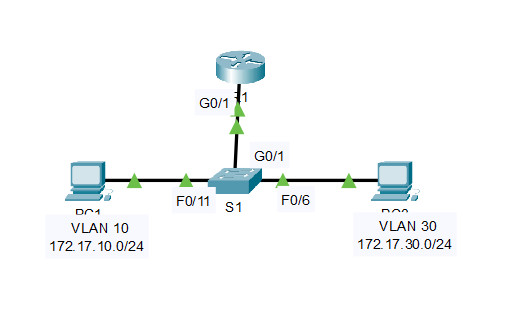
Addressing Table
| Device | Interface | IP Address | Subnet Mask | Default Gateway | VLAN |
|---|---|---|---|---|---|
| R1 | G0/1.10 | 172.17.10.1 | 255.255.255.0 | N/A | VLAN 10 |
| G0/1.30 | 172.17.30.1 | 255.255.255.0 | N/A | VLAN 30 | |
| PC1 | NIC | 172.17.10.10 | 255.255.255.0 | 172.17.10.1 | VLAN 10 |
| PC3 | NIC | 172.17.30.10 | 255.255.255.0 | 172.17.30.1 | VLAN 30 |
Objectives
- Part 1: Locate Network Problems
- Part 2: Implement the Solution
- Part 3: Verify Network Connectivity
Scenario
In this activity, you will troubleshoot connectivity problems caused by improper configurations related to VLANs and inter-VLAN routing.
Instructions
Part 1: Locate the Network Problems
Examine the network and locate the source of any connectivity issues.
Commands you may find useful include:
R1# show ip interface brief
Interface              IP-Address      OK? Method Status                Protocol
GigabitEthernet0/0     unassigned      YES unset  administratively down down
GigabitEthernet0/1     unassigned      YES unset  up                    up
GigabitEthernet0/1.10  172.17.10.1     YES manual administratively down down
GigabitEthernet0/1.30  172.17.30.1     YES manual up                    up
Vlan1 unassigned YES unset administratively down downR1# show interfaces gigabitethernet 0/1.10 GigabitEthernet0/1.10 is administratively down, line protocol is down (disabled) Hardware is PQUICC_FEC, address is 000d.bde7.0c02 (bia 000d.bde7.0c02) Internet address is 172.17.10.1/24 MTU 1500 bytes, BW 100000 Kbit, DLY 100 usec, reliability 255/255, txload 1/255, rxload 1/255 Encapsulation 802.1Q Virtual LAN, Vlan ID 30 ARP type: ARPA, ARP Timeout 04:00:00, Last clearing of "show interface" counters never
R1# show interfaces gigabitethernet 0/1.30
GigabitEthernet0/1.30 is up, line protocol is up (connected)
  Hardware is PQUICC_FEC, address is 000d.bde7.0c02 (bia 000d.bde7.0c02)
  Internet address is 172.17.30.1/24
  MTU 1500 bytes, BW 100000 Kbit, DLY 100 usec,
     reliability 255/255, txload 1/255, rxload 1/255
  Encapsulation 802.1Q Virtual LAN, Vlan ID 10
  ARP type: ARPA, ARP Timeout 04:00:00,
  Last clearing of "show interface" counters never
S1# show interfaces trunk

S1#
- Test connectivity and use the necessary show commands to verify configurations.
- Verify that all configured settings match the requirements shown in the Addressing Table.
- List all of the problems and possible solutions in the Documentation Table.
Documentation Table
| Problems | Solutions |
|---|---|
| The G0/1 physical interface is up but G0/1.10 subinterface is administratively down. | Implement the no shutdown command to enable the G0/1.10 subinterface. |
| PC3 is configured with the wrong default gateway address. | Change the default gateway on PC3 from 172.17.10.1 to 172.17.30.1. |
| Interface G0/1 on S1 is configured as an access port instead of trunk port. | Use the command switchport mode trunk to change the interface from access mode to trunk mode. |
| Subinterface VLAN assignments are switched on R1. The configured assignments do not match the ones shown in the Addressing Table. | Issue the no encapsulation dot1q command to remove the incorrect configuration. Then configure the subinterfaces with the correct encapsulation dot1q vlan_number command. Re-enter the correct IP address information. |
Part 2: Implement the Solutions
Implement your recommended solutions.
Problem 1: Enable the G0/1.10 subinterface on R1.
R1(config)# interface gigabitethernet 0/1.10
R1(config-subif)# no shutdown
Problem 2: Change the default gateway on PC3 from 172.17.10.1 to 172.17.30.1.
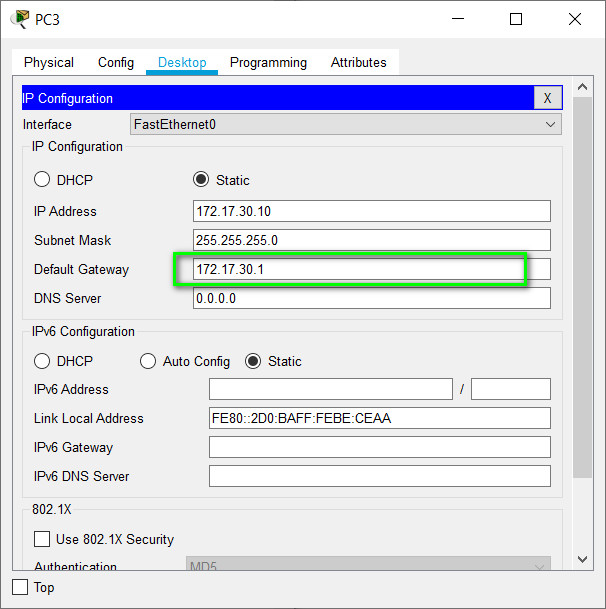
Problem 3: Configure G0/1 on S1 as a trunk port.
S1(config)# interface gigabitethernet 0/1
S1(config-if)# switchport mode trunk
Problem 4: Correct the swapped subinterface VLAN assignments on R1. Remove the encapsulation from both subinterfaces first; otherwise IOS rejects the new VLAN ID because it is still in use on the other subinterface.
R1(config)# interface gigabitethernet 0/1.10
R1(config-subif)# no encapsulation dot1Q
R1(config-subif)# interface gigabitethernet 0/1.30
R1(config-subif)# no encapsulation dot1Q
R1(config-subif)# interface gigabitethernet 0/1.10
R1(config-subif)# encapsulation dot1Q 10
R1(config-subif)# ip address 172.17.10.1 255.255.255.0
R1(config-subif)# interface gigabitethernet 0/1.30
R1(config-subif)# encapsulation dot1Q 30
R1(config-subif)# ip address 172.17.30.1 255.255.255.0
Part 3: Verify Network Connectivity
Verify the PCs can ping each other and R1. If not, continue to troubleshoot until the pings are successful.
C:\> ping 172.17.10.1
C:\> ping 172.17.30.10
C:\> ping 172.17.30.1
C:\> ping 172.17.10.10
Device Configs - Final
ROUTER R1
! ==============================================================
!--- 4.4.8 Packet Tracer - Troubleshoot Inter-VLAN Routing
!--- FIX SCRIPT FOR ROUTER R1
!--- Usage: copy this whole file and paste it into the R1 terminal (start at the R1> prompt). Every line beginning with "!" is a comment; IOS ignores it, so pasting a comment by accident is harmless.
!--- Troubleshooting lab: only the corrective commands from the Documentation Table.
! ==============================================================

enable
configure terminal

! --------------------------------------------------------------
!--- Problem 4: subinterface VLAN assignments are swapped.
! --------------------------------------------------------------

!--- Remove the wrong 802.1Q tag from BOTH subinterfaces first - a VLAN ID cannot be applied while the other subinterface still uses it.
interface gigabitethernet 0/1.10
 no encapsulation dot1Q
 exit
interface gigabitethernet 0/1.30
 no encapsulation dot1Q
 exit

!--- Apply the correct VLAN and re-enter the IP address (removing the encapsulation also removes the address).
interface gigabitethernet 0/1.10
 encapsulation dot1Q 10
 ip address 172.17.10.1 255.255.255.0
 exit
interface gigabitethernet 0/1.30
 encapsulation dot1Q 30
 ip address 172.17.30.1 255.255.255.0
 exit

! --------------------------------------------------------------
!--- Problem 1: G0/1.10 is administratively down.
! --------------------------------------------------------------

interface gigabitethernet 0/1.10
 no shutdown
 exit

end

! --------------------------------------------------------------
!--- Save the configuration to NVRAM. (Press Enter when prompted for the destination filename.)
! --------------------------------------------------------------
copy running-config startup-config


! ==============================================================
!--- Verification:
!---   show ip interface brief                    -> G0/1, G0/1.10, G0/1.30 up/up
!---   show interfaces gigabitethernet 0/1.10     -> 802.1Q VLAN ID 10
!---   show interfaces gigabitethernet 0/1.30     -> 802.1Q VLAN ID 30
! ==============================================================
SWITCH S1
! ==============================================================
!--- 4.4.8 Packet Tracer - Troubleshoot Inter-VLAN Routing
!--- FIX SCRIPT FOR SWITCH S1
!--- Usage: copy this whole file and paste it into the S1 terminal (start at the S1> prompt). Every line beginning with "!" is a comment; IOS ignores it, so pasting a comment by accident is harmless.
!--- Troubleshooting lab: only the corrective commands from the Documentation Table.
! ==============================================================

enable
configure terminal

! --------------------------------------------------------------
!--- Problem 3: G0/1 (to R1) is an access port instead of a trunk.
! --------------------------------------------------------------

interface gigabitethernet 0/1
 switchport mode trunk
 exit

end

! --------------------------------------------------------------
!--- Save the configuration to NVRAM. (Press Enter when prompted for the destination filename.)
! --------------------------------------------------------------
copy running-config startup-config


! ==============================================================
!--- Verification:
!---   show interfaces trunk  -> Gig0/1 on, trunking, VLANs 10 and 30 active
!--- From PC1: ping 172.17.30.10 (PC3) -> successful
! ==============================================================


