
Lab - Troubleshoot Inter-VLAN Routing (Instructor Version)
Topology
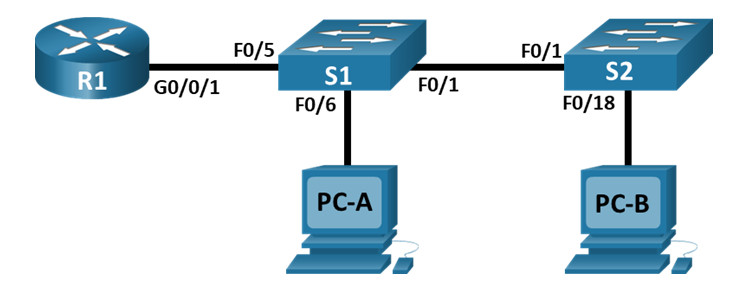
Addressing Table
| Device | Interface | IP Address | Subnet Mask | Default Gateway |
|---|---|---|---|---|
| R1 | G0/0/1.3 | 10.3.0.1 | 255.255.255.0 | N/A |
| G0/0/1.4 | 10.4.0.1 | 255.255.255.0 | ||
| G0/0/1.13 | 10.13.0.1 | 255.255.255.0 | ||
| S1 | VLAN 3 | 10.3.0.11 | 255.255.255.0 | 10.3.0.1 |
| S2 | VLAN 3 | 10.3.0.12 | 255.255.255.0 | 10.3.0.1 |
| PC-A | NIC | 10.4.0.50 | 255.255.255.0 | 10.4.0.1 |
| PC-B | NIC | 10.13.0.50 | 255.255.255.0 | 10.13.0.1 |
VLAN Table
| VLAN | Name | Interface Assigned |
|---|---|---|
| 3 | Management | S1: VLAN 3
S2: VLAN 3 |
| 4 | Operations | S1: F0/6 |
| 7 | ParkingLot | S1: F0/2-4, F0/7-24, G0/1-2
S2: F0/2-17, F0/19-24, G0/1-2 |
| 8 | Native | N/A |
| 13 | Maintenance | S2: F0/18 |
Objectives
- Part 1: Evaluate Network Operation
- Part 2: Gather information, create an action plan, and implement corrections
Background / Scenario
Instructor Note: Preconfiguration scripts for all the devices are documented below. Cut and paste or otherwise use these to pre-configure the equipment for the student.
Router R1
enable
configure terminal
hostname R1
no ip domain lookup
enable secret class
line con 0
 password cisco
 login
 logging synch
line vty 0 4
 password cisco
 login
service password-encryption
banner motd $ Authorized Users Only! $
interface g0/0/1
 no shut
interface g0/0/1.3
 encap dot1q 3
 ip add 10.3.0.1 255.255.255.0
interface g0/0/1.4
 encap dot1q 4 native
 ip address 10.4.0.1 255.255.255.0
interface g0/0/1.8
! encap dot1q 8 native
 encap dot1q 8
interface g0/0/1.13
 encap dot1q 13
 ip address 10.13.0.1 255.255.255.0
end
Switch S1
enable
config terminal
hostname S1
no ip domain-lookup
enable secret class
line con 0
 password cisco
 login
 logging synch
line vty 0 15
 password cisco
 login
service password-encryption
banner motd $ Authorized Users Only! $
vlan 3
 name Management
vlan 4
 name Operations
vlan 7
 name ParkingLot
vlan 8
 name Native
!vlan 13
! name Maintenance
interface vlan 3
 ip address 10.3.0.11 255.255.255.0
 no shut
exit
ip default-gateway 10.3.0.1
interface range f0/2-4, f0/7-24, G0/1-2
 switchport mode access
 switchport access vlan 7
 shutdown
interface f0/1
 switchport mode trunk
! switchport trunk native vlan 8
! switchport trunk allowed vlan add 3
 switchport trunk allowed vlan 4,8,13
 no shutdown
interface f0/6
 switchport mode access
 switchport access vlan 4
 no shutdown
interface f0/5
 switchport mode access
! default interface fa0/5
! switchport mode trunk
 switchport trunk native vlan 8
! switchport trunk allowed vlan 3,4,8,13
 switchport access vlan 3
 no shut
end
Switch S2
enable
config terminal
hostname S2
no ip domain-lookup
enable secret class
line con 0
 password cisco
 login
 logging synch
line vty 0 15
 password cisco
 login
service password-encryption
banner motd $ Authorized Users Only! $
vlan 3
 name Management
vlan 4
 name Operations
vlan 7
 name ParkingLot
vlan 8
 name Native
vlan 13
 name Maintenance
interface vlan 3
 ip address 10.3.0.12 255.255.255.0
 no shut
interface range f0/2-17, f0/19-24, G0/1-2
 switchport mode access
 switchport access vlan 7
 shutdown
interface f0/18
 switchport mode access
 switchport access vlan 13
interface f0/1
 switchport mode trunk
 switchport trunk native vlan 8
 switchport trunk allowed vlan 4,8
! switchport trunk allowed vlan add 3,13
ip default-gateway 10.3.0.1
end
Your instructor has preconfigured all the network equipment and has included intentional errors that are keeping the inter-VLAN routing from working. Your task is to evaluate the network and identify and correct the configuration errors to restore full connectivity. You may find errors with the configurations which are not directly related to inter-VLAN routing that impact the ability of the network devices to perform this function.
Note: The design approach used in this lab is to assess your ability to configure and troubleshoot inter-VLAN routing only. This design may not reflect networking best practices.
Note: The router used with CCNA hands-on labs it the Cisco 4221 with Cisco IOS XE Release 16.9.4 (universalk9 image). The switches used in the labs are Cisco Catalyst 2960s with Cisco IOS Release 15.2(2) (lanbasek9 image). Other routers, switches, and Cisco IOS versions can be used. Depending on the model and Cisco IOS version, the commands available and the output produced might vary from what is shown in the labs. Refer to the Router Interface Summary Table at the end of the lab for the correct interface identifiers.
Note: Ensure that the routers and switches have been erased and have no startup configurations. If you are unsure contact your instructor.
Instructor Note: Refer to the Instructor Lab Manual for the procedures to initialize and reload devices
Required Resources
- 1 Router (Cisco 4221 with Cisco IOS XE Release 16.9.4 universal image or comparable)
- 2 Switches (Cisco 2960 with Cisco IOS Release 15.2(2) lanbasek9 image or comparable)
- 2 PCs (Windows with a terminal emulation program, such as Tera Term)
- Console cables to configure the Cisco IOS devices via the console ports
- Ethernet cables as shown in the topology
Instructions
Part 1: Evaluate Network Operation.
Note: You may need to disable the Windows Firewall on PC–A and PC–B.
Requirement:
- No VLAN 7 trunk traffic because there is no devices in VLAN 7.
- VLAN 8 is the native VLAN.
- All trunks are static.
- End to end connectivity
Use Ping to test the following criteria and record the results in the table below.
| From | To | Ping Results |
|---|---|---|
| R1 | S1 VLAN 3 (10.3.0.11) | Unsuccessful |
| S2 VLAN 3 (10.3.0.12) | Unsuccessful | |
| PC-A (10.4.0.50) | Unsuccessful | |
| PC-B (10.13.0.50) | Unsuccessful | |
| S1 | S2 VLAN 3 (10.3.0.12) | Unsuccessful |
| PC-A (10.4.0.50) | Unsuccessful | |
| PC-B (10.13.0.50) | Unsuccessful | |
| S2 | PC-A (10.4.0.50) | Unsuccessful |
| PC-B (10.13.0.50) | Unsuccessful |
Part 2: Gather information, create an action plan, and implement corrections.
a. For each criterion that is not met, gather information by examining the running configuration and routing tables and develop a hypothesis for what is causing the malfunction.
b. Create an action plan that you think will fix the issue. Develop a list of all the commands you intend to issue to fix the issue, and a list of all the commands you need to revert the configuration, should your action plan fail to correct the issue.
Hint: If you need to reset a switchport to default configuration, use the command default interface interface name.
As an example for F0/10:
S1(config)# default interface f0/10
c. Execute your action plans one at a time for each criterion that fails and record the fix actions.
Router R1:
configure terminal
interface g0/0/1.8
 encapsulation dot1q 8 native
 exit
Switch S1:
configure terminal
default interface f0/5
interface f0/5
 switchport mode trunk
 switchport trunk native vlan 8
 switchport trunk allowed vlan 3,4,8,13
interface f0/1
 switchport trunk allowed vlan add 3,13
 switchport trunk native vlan 8
vlan 13
 name Maintenance
 exit
Switch S2:
configure terminal
interface f0/1
 switchport trunk allowed vlan add 3,13
exit
Documentation Table: Confirmed Configuration Errors
| # | Device | Problem | Direct Evidence from the Preconfiguration Script |
|---|---|---|---|
| 1 | R1 | Native VLAN assigned to the wrong subinterface - .4 instead of .8 |
encapsulation dot1q 4 native is active on G0/0/1.4; the correct line, encapsulation dot1q 8 native, sits commented out on G0/0/1.8 |
| 2 | S1 | F0/5 (the link to R1) stuck in access mode | switchport mode access is active; the correct switchport mode trunk line is commented out |
| 3 | S1 | F0/1 (the link to S2) missing its native VLAN and missing VLAN 3 from the allowed list | Both switchport trunk native vlan 8 and switchport trunk allowed vlan add 3 are commented out |
| 4 | S1 | VLAN 13 never created | vlan 13 and name Maintenance are both commented out entirely |
| 5 | S2 | F0/1 (the link to S1) missing VLAN 3 and VLAN 13 from the allowed list | Active list is only 4,8; the correct switchport trunk allowed vlan add 3,13 line is commented out |


