
10.6.12 Packet Tracer - Use TFTP and Flash to Manage Configuration Files - Physical Mode Answers
Topology

Addressing Table
| Device | Interface | IP Address | Subnet Mask | Default Gateway |
|---|---|---|---|---|
| R1 | G0/0/1 | 192.168.1.1 | 255.255.255.0 | N/A |
| S1 | VLAN 1 | 192.168.1.11 | 255.255.255.0 | 192.168.1.1 |
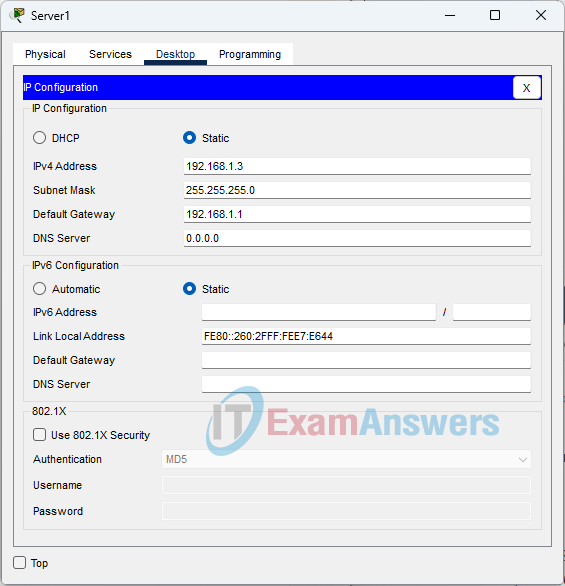
| Server1 | F0 | 192.168.1.3 | 255.255.255.0 | 192.168.1.1 |
Objectives
- Part 1: Cable the Network and Configure Basic Device Settings
- Part 2: Use TFTP to Back Up and Restore the Switch Running Configuration
- Part 3: Use TFTP to Back Up and Restore the Router Running Configuration
- Part 4: Back Up and Restore Running Configurations Using Router Flash Memory
Background / Scenario
Cisco networking devices are often upgraded or replaced for a number of reasons. It is important to maintain backups of the latest device configurations, as well as a history of configuration changes. A TFTP server is often used to back up configuration files and IOS images in production networks. A TFTP server is a centralized and secure method used to store file backups and restore them as necessary. Using a centralized TFTP server, you can back up files from many different Cisco devices.
In addition to a TFTP server, most of the current Cisco routers can back up and restore files locally from CompactFlash (CF) memory or a USB flash drive. The CF is a removable memory module that has replaced the limited internal flash memory of earlier router models. The IOS image for the router resides in the CF memory, and the router uses this IOS Image for the boot process. With the larger size of the CF memory, additional files can be stored for back up purposes. A removable USB flash drive can also be used for back up purposes.
In this Packet Tracer Physical Mode (PTPM) activity, you will use TFTP server software to back up the running configuration of Cisco devices to the TFTP server. You will also back up the running configuration to Flash.
Instructions
Part 1: Build the Network and Configure Basic Device Settings
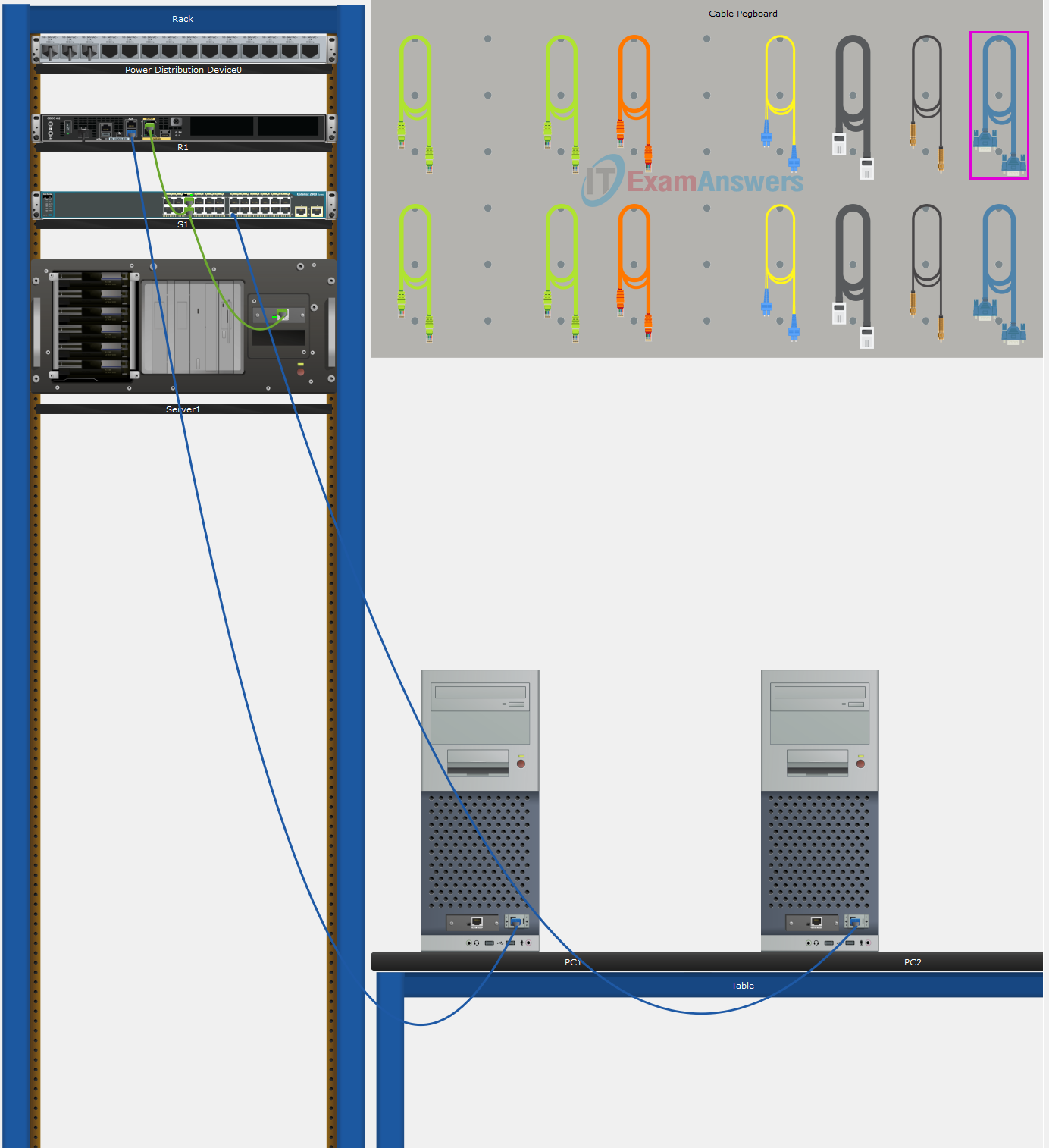
In Part 1, you will cable the network topology and configure basic settings, such as the interface IP addresses for R1, S1, and Server1.
Note: There are two PCs available so that you can establish a console connection from one PC to the router and the other PC to the switch. That way, you will not have to change the cables during the activity.
Step 1: Cable the network.
Cable the devices as shown in the topology. Connect a console cable from PC1 to R1. Connect a console cable from PC2 to S1.
Step 2: Use the CLI tab on the router to configure basic settings for the router.
a. Open a terminal to R1 from PC1. Click PC1 > Desktop tab > Terminal, and then click OK.
b. Assign a device name to the router.
Router(config)# hostname R1
c. Disable DNS lookup to prevent the router from attempting to translate incorrectly entered commands as though they were host names.
R1(config)# no ip domain-lookup
d. Assign class as the privileged EXEC encrypted password.
R1(config)# enable secret class
e. Assign cisco as the console password and enable login.
R1(config)# line console 0
R1(config-line)# password cisco
R1(config-line)# login
f. Assign cisco as the vty password and enable login.
R1(config)# line vty 0 4
R1(config-line)# password cisco
R1(config-line)# login
g. Encrypt the plaintext passwords.
R1(config)# service password-encryption
h. Create a banner that warns anyone accessing the device that Authorized Users Only are permitted.
R1(config)# banner motd $Authorized Users Only!$
i. Configure interfaces as listed in the Addressing Table.
R1(config)# interface gigabitethernet 0/0/1
R1(config-if)# ip address 192.168.1.1 255.255.255.0
R1(config-if)# no shutdown
j. Save the running configuration to the startup configuration file.
R1# copy running-config startup-config
Destination filename [startup-config]?
Building configuration...
[OK]
Note: Use the question mark (?) to help with the correct sequence of parameters needed to execute this command.
Step 3: Use the CLI tab on the switch to configure basic settings for the switch.
a. Open a terminal to S1 from PC2. Click PC2 > Desktop tab > Terminal, and then click OK.
b. Assign a device name to the switch.
Switch(config)# hostname S1
c. Disable DNS lookup to prevent the switch from attempting to translate incorrectly entered commands as though they were host names.
S1(config)# no ip domain-lookup
d. Assign class as the privileged EXEC encrypted password.
S1(config)# enable secret class
e. Assign cisco as the console password and enable login.
S1(config)# line console 0
S1(config-line)# password cisco
S1(config-line)# login
f. Assign cisco as the vty password and enable login.
S1(config)# line vty 0 15
S1(config-line)# password cisco
S1(config-line)# login
g. Encrypt the plaintext passwords.
S1(config)# service password-encryption
h. Shut down all unused interfaces.
S1(config)# interface range fastethernet 0/1 - 4, fastethernet 0/7 - 24, gigabitethernet 0/1 - 2
S1(config-if-range)# shutdown
i. Configure interface VLAN 1 as specified in the Addressing Table.
S1(config)# interface vlan 1
S1(config-if)# ip address 192.168.1.11 255.255.255.0
S1(config-if)# no shutdown
S1(config-if)# exit
S1(config)# ip default-gateway 192.168.1.1
j. Save the running configuration to the startup configuration file.
S1# copy running-config startup-config
Destination filename [startup-config]?
Building configuration...
[OK]
Note: Use the question mark (?) to help with the correct sequence of parameters needed to execute this command.
Step 4: Using the Desktop tab, configure the IP addressing information for Server1 and verify connectivity with S1 and R1.
a. Ping from Server1 to S1.
C:\> ping 192.168.1.11

Pinging 192.168.1.11 with 32 bytes of data:

Request timed out.
Reply from 192.168.1.11: bytes=32 time<1ms TTL=255
Reply from 192.168.1.11: bytes=32 time<1ms TTL=255
Reply from 192.168.1.11: bytes=32 time<1ms TTL=255

Ping statistics for 192.168.1.11:
    Packets: Sent = 4, Received = 3, Lost = 1 (25% loss),
Approximate round trip times in milli-seconds:
    Minimum = 0ms, Maximum = 0ms, Average = 0ms
b. Ping from Server1 to R1.
C:\> ping 192.168.1.1

Pinging 192.168.1.1 with 32 bytes of data:

Reply from 192.168.1.1: bytes=32 time<1ms TTL=255
Reply from 192.168.1.1: bytes=32 time<1ms TTL=255
Reply from 192.168.1.1: bytes=32 time<1ms TTL=255
Reply from 192.168.1.1: bytes=32 time<1ms TTL=255

Ping statistics for 192.168.1.1:
    Packets: Sent = 4, Received = 4, Lost = 0 (0% loss),
Approximate round trip times in milli-seconds:
    Minimum = 0ms, Maximum = 0ms, Average = 0ms
If the pings are not successful, troubleshoot the basic device configurations before continuing.
Part 2: Use TFTP to Back Up and Restore the Switch Running Configuration
In this part, you will back up and restore the configuration for S1 to and from a TFTP server.
Step 1: Start the TFTP server application on Server1.
From the Services tab of Server1, turn on the TFTP application.
The TFTP application uses the UDP Layer 4 transport protocol, which is encapsulated in an IP packet. For TFTP file transfers to function, there must be Layer 1 and 2 (Ethernet, in this case) and Layer 3 (IP) connectivity between the TFTP client and the TFTP server. The LAN topology in this activity uses only Ethernet at Layers 1 and 2. However, TFTP transfers can also be accomplished over WAN links that use other Layer 1 physical links and Layer 2 protocols. As long as there is IP connectivity between the client and server, as demonstrated by the output of the ping command, the TFTP transfer can take place. If the pings are not successful, troubleshoot the basic device configurations before continuing.
Note: A common misconception is that you can TFTP a file over the console connection. This is not the case because the console connection does not use IP. The TFTP transfer can be initiated from the client device (router or switch) using the console connection, but there must be IP connectivity between the client and server for the file transfer to take place.
Step 2: Explore the copy command on a Cisco device.
a. From the privileged EXEC mode prompt of S1, enter copy ? to display the options for source or “from” location and other available copy options. You can specify flash: or flash0: as the source. However, if you simply provide a filename as the source, flash0: is assumed and is the default. Note that running-config is also an option for the source location.
S1# copy ?
 flash:          Copy from flash: file system
 ftp:            Copy from ftp: file system
 running-config  Copy from current system configuration
 scp:            Copy from scp: file system
 startup-config  Copy from startup configuration
 tftp:           Copy from tftp: file system
S1# copy
b. Use the ? to display the destination options after a source file location is chosen. The flash: file system for S1 is the source file system in this example.
S1# copy flash: ?
 ftp:            Copy to ftp: file system
 running-config  Update (merge with) current system configuration
 scp:            Copy to scp: file system
 startup-config  Copy to startup configuration
 tftp:           Copy to tftp: file system
S1# copy flash:
Step 3: Transfer the running-config file from S1 to the TFTP server on Server1.
a. From the privileged EXEC mode of S1, enter the copy running-config tftp: command. Provide the remote host address of the TFTP server, 192.168.1.3. Press Enter to accept the default destination filename (S1-confg) or provide your own filename. The exclamation marks (!!) indicate the transfer process is in progress and is successful.
S1# copy running-config tftp:
Address or name of remote host []? 192.168.1.3
Destination filename [S1-confg]?

Writing running-config...!!
[OK - 1549 bytes]

1549 bytes copied in 0 secs
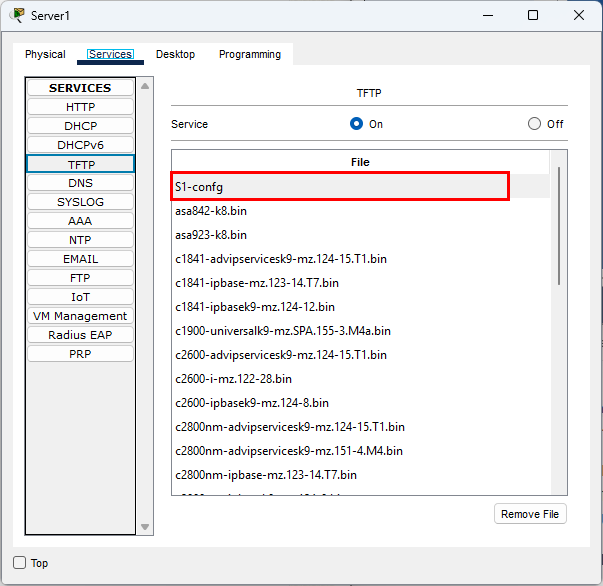
b. Check the directory in the TFTP application on Server1 to verify that the file was transferred successfully. Click Server1 > Services tab > TFTP. You should see the S1-confg file listed at the top of the File list.
Step 4: Modify the running configuration on the switch and copy the running configuration file from the TFTP server to the switch.
a. On S1, create a banner that warns anyone accessing the device that unauthorized access is prohibited.
S1(config)# banner motd $Unauthorized access is prohibited!$
b. From the privileged EXEC mode on S1, enter the copy tftp running-config command. Provide the remote host address of the TFTP server, 192.168.1.3. Enter the filename, S1-confg. The exclamation mark (!) indicates the transfer process is in progress and is successful.
S1# copy tftp: running-config
Address or name of remote host []? 192.168.1.3
Source filename []? S1-confg
Destination filename [running-config]?

Accessing tftp://192.168.1.3/S1-confg...
Loading S1-confg from 192.168.1.3: !
[OK - 1525 bytes]

1525 bytes copied in 0 secs
S1#
%SYS-5-CONFIG_I: Configured from console by console

S1#
c. Enter the show running-config command to examine running configuration file.
S1# show running-config
<output omitted>
interface Vlan1
 ip address 192.168.1.11 255.255.255.0
!
ip default-gateway 192.168.1.1
!
banner motd ^CUnauthorized access is prohibited!^C
!
!
!
line con 0
 password 7 0822455D0A16
 login
!
<output omitted>Note: Notice that the banner motd command was added after the running configuration was copied to the TFTP server. It is still present after the running configuration was copied back from the TFTP server.
If you do not erase the startup configuration, the procedure merges the running-config from the TFTP server with the current running-config in the switch or router. If changes were made to the current running-config, the commands in the TFTP copy are added. Alternatively, if the same command is issued, it updates the corresponding command in the current running-config of the switch or router.
Part 3: Use TFTP to Back Up and Restore the Router Running Configuration
The backup and restore procedure from Part 2 can also be performed with a router. In Part 3, the running configuration file will be backed up and restored using a TFTP server.
Step 1: Transfer the running configuration from R1 to the TFTP server.
a. Open the Terminal program on PC1 for R1.
b. From the privileged EXEC mode on R1, enter the copy running-config tftp command. Provide the remote host address of the TFTP server, 192.168.1.3, and accept R1-confg as the default filename.
R1# copy running-config tftp:
Address or name of remote host []? 192.168.1.3
Destination filename [R1-confg]?

Writing running-config...!!
[OK - 765 bytes]

765 bytes copied in 0 secs
c. Verify that the file has been transferred to the TFTP server.
Step 2: Restore the running configuration file to the router.
Note: If you want to completely replace the current running-config with the one from the TFTP server, you must erase the router startup-config and reload the device. You will then need to configure the G0/0/1 interface address, so there is IP connectivity between the TFTP server and the router.
a. Erase the startup-config file on the router.
R1# erase startup-config
Erasing the nvram filesystem will remove all configuration files! Continue? [confirm]
[OK]
Erase of nvram: complete
%SYS-7-NV_BLOCK_INIT: Initialized the geometry of nvram
b. Reload the router.
R1# reload
Proceed with reload? [confirm]
<output omitted>
         --- System Configuration Dialog ---

Would you like to enter the initial configuration dialog? [yes/no]: no


Press RETURN to get started!

Router>
Note: Your completion percentage will temporarily be lower until you restore the configuration.
c. Configure the G0/0/1 interface on the router with an IP address 192.168.1.1. Wait until the Spanning Tree Protocol (STP) converges on S1.
Router(config)# interface gigabitethernet 0/0/1
Router(config-if)# ip address 192.168.1.1 255.255.255.0
Router(config-if)# no shutdown
d. Verify connectivity between the router and Server1. You may need to ping a few times before connectivity is re-established.
Router# ping 192.168.1.3

Type escape sequence to abort.
Sending 5, 100-byte ICMP Echos to 192.168.1.3, timeout is 2 seconds:
.!!!!
Success rate is 80 percent (4/5), round-trip min/avg/max = 0/0/1 ms
e. Use the copy command to transfer the R1-confg file from the TFTP server to the router. Use running-config as the destination.
Router# copy tftp: running-config
Address or name of remote host []? 192.168.1.3
Source filename []? R1-confg
Destination filename [running-config]?

Accessing tftp://192.168.1.3/R1-confg...
Loading R1-confg from 192.168.1.3: !
[OK - 765 bytes]

765 bytes copied in 0 secs
R1#
%LINK-5-CHANGED: Interface Vlan1, changed state to up

%LINK-5-CHANGED: Interface Vlan1, changed state to administratively down

%SYS-5-CONFIG_I: Configured from console by console
f. Verify that the router has updated the running configuration. The router prompt should be changed back to R1# and your completion percentage should reflect that all your configurations are now restored.
R1# show running-config
Part 4: Back Up and Restore Configurations Using Router Flash Memory
Current generation Cisco routers do not have internal flash memory. The flash memory for these routers uses CompactFlash (CF) memory. The use of CF memory allows for more available flash memory and easier upgrades without the need to open the router case. Besides storing the necessary files, such as IOS images, the CF memory can store other files, such as a copy of the running configuration.
Note: If the router does not use CF, the router may not have enough flash memory for storing the backup copy of running configuration file. You should still read through the instructions and become familiar with the commands.
Step 1: Display the router file systems.
The show file systems command displays the available file systems on the router. The flash0: file system is the default file system on this router as indicated by the asterisk (*) symbol (at the beginning of the line). The flash0: file system can also be referenced using the name flash:. The total size of the flash0: is approximately 3GB with about 2.5GB available. Currently flash0: and nvram: are the only available file systems.
Note: Verify that there is at least 1 MB (1,048,576 bytes) of free space. You can determine the size of flash memory and space available using the show flash or dir flash: command at the privileged EXEC prompt.
R1# show file systems
File Systems:

       Size(b)       Free(b)      Type  Flags  Prefixes
*   3249049600    2761893909     flash     rw  flash:
         29688         23590     nvram     rw  nvram:
Where is the startup-config file located?
Step 2: Copy the router running configuration to flash.
A file can be copied to flash by using the copy command at the privileged EXEC prompt. In this example, the file is copied into flash0: because there is only one flash drive available as displayed in the previous step, and it is also the default file system. The R1-running-config-backup file is used as the filename for the backup running configuration file.
Note: Remember that filenames are case-sensitive in the IOS file system.
a. Copy the running configuration to flash memory.
R1# copy running-config flash:
Destination filename [running-config]? R1-running-config-backup
Building configuration...
[OK]
b. Use the dir command to verify that the running-config has been copied to flash.
R1# dir flash:
Directory of flash:/

    6  -rw-         765           <no date>  R1-running-config-backup
    3  -rw-   486899872           <no date>  isr4300-universalk9.03.16.05.S.155-3.S5-ext.SPA.bin
    2  -rw-       28282           <no date>  sigdef-category.xml
    1  -rw-      227537           <no date>  sigdef-default.xml

3249049600 bytes total (2761893144 bytes free)
c. Use the more command to view the running-config file in flash memory. Examine the file output and scroll to the Interface section. Notice the no shutdown command is not included with the GigabitEthernet0/0/1 interface. The interface is shut down when this file is used to update the running configuration on the router.
R1# more flash:R1-running-config-backup
<output omitted>
interface GigabitEthernet0/0/1
 ip address 192.168.1.1 255.255.255.0
 duplex auto
 speed auto
<output omitted>
Step 3: Erase the startup configuration and reload the router.
a. Erase the startup-config file on the router.
R1# erase startup-config
Erasing the nvram filesystem will remove all configuration files! Continue? [confirm]
[OK]
Erase of nvram: complete
%SYS-7-NV_BLOCK_INIT: Initialized the geometry of nvram
b. Reload the router.
R1# reload
System configuration has been modified. Save? [yes/no]: no
Proceed with reload? [confirm]
<output omitted>
         --- System Configuration Dialog ---

Would you like to enter the initial configuration dialog? [yes/no]: no


Press RETURN to get started!

Router>
Note: Your completion percentage will temporarily be lower until you restore the configuration.
c. Verify the router has the default initial configuration.
Router# show running-config
Step 4: Restore the running configuration from flash.
a. Copy the saved running-config file from flash to update the running-config.
Router# copy flash: running-config
Source filename []? R1-running-config-backup
Destination filename [running-config]?

765 bytes copied in 0.416 secs (1838 bytes/sec)
R1#
%LINK-5-CHANGED: Interface Vlan1, changed state to up

%LINK-5-CHANGED: Interface Vlan1, changed state to administratively down

%SYS-5-CONFIG_I: Configured from console by console
b. Use the show ip interface brief command to view the status of the interfaces.
R1# show ip interface brief
Interface              IP-Address      OK? Method Status                Protocol
GigabitEthernet0/0/0   unassigned      YES NVRAM  administratively down down
GigabitEthernet0/0/1   192.168.1.1     YES manual administratively down down
Vlan1                  unassigned      YES unset  administratively down down
c. In Packet Tracer, the G0/0/1 interface will be administratively down. Enter interface configuration mode and reactivate the interface. Your completion percentage should now be 100%.
R1(config)# interface gigabitethernet 0/0/1
R1(config-if)# no shutdown
Device Configs - Final
Server1
ROUTER R1
! ==============================================================
!--- 10.6.12 Packet Tracer - Use TFTP and Flash to Manage Configuration Files - Physical Mode
!--- ANSWER SCRIPT FOR ROUTER R1
!--- Usage: on PC1 open Desktop > Terminal (console to R1). Paste one section at a time at the prompt shown in the section. The copy, erase and reload commands ask questions, so type them by hand with the answers listed. Every line beginning with "!" is a comment; IOS ignores it.
! ==============================================================

! --------------------------------------------------------------
!--- Part 1, Step 2: Basic settings for the router  (paste at Router>)
! --------------------------------------------------------------

enable
configure terminal

!--- b. Device name.
hostname R1

!--- c. Disable DNS lookup.
no ip domain-lookup

!--- d. Privileged EXEC encrypted password.
enable secret class

!--- e. Console password and login.
line console 0
 password cisco
 login
 exit

!--- f. VTY password and login.
line vty 0 4
 password cisco
 login
 exit

!--- g. Encrypt the plaintext passwords.
service password-encryption

!--- h. MOTD banner.
banner motd $Authorized Users Only!$

!--- i. G0/0/1 addressing from the Addressing Table.
interface gigabitethernet 0/0/1
 ip address 192.168.1.1 255.255.255.0
 no shutdown
 exit

end

!--- j. Save the configuration. (Press Enter when prompted for the destination filename.)
copy running-config startup-config

! --------------------------------------------------------------
!--- Part 3: Use TFTP to Back Up and Restore the Router Running Configuration
! --------------------------------------------------------------

!--- Step 1b. Type by hand at R1#:  copy running-config tftp:
!---    Address or name of remote host []? 192.168.1.3
!---    Destination filename [R1-confg]? (press Enter)

!--- Step 2a-b. Type by hand at R1#:  erase startup-config  (press Enter to confirm), then  reload

!--- Step 2c. After the reload, paste at Router>:
enable
configure terminal
interface gigabitethernet 0/0/1
 ip address 192.168.1.1 255.255.255.0
 no shutdown
 exit
end

!--- Step 2d. Wait for STP on S1, then test connectivity to Server1.
ping 192.168.1.3

!--- Step 2e. Type by hand at Router#:  copy tftp: running-config
!---    Address or name of remote host []? 192.168.1.3
!---    Source filename []? R1-confg
!---    Destination filename [running-config]? (press Enter)
!---    The prompt changes back to R1#.

! --------------------------------------------------------------
!--- Part 4: Back Up and Restore Configurations Using Router Flash Memory
! --------------------------------------------------------------

!--- Step 1. Display the file systems (the startup-config is in nvram:).
show file systems

!--- Step 2a. Type by hand at R1#:  copy running-config flash:
!---    Destination filename [running-config]? R1-running-config-backup

!--- Step 2b-c. Verify the backup file in flash.
dir flash:
more flash:R1-running-config-backup

!--- Step 3a-b. Type by hand at R1#:  erase startup-config  (press Enter to confirm), then  reload

!--- Step 4a. Type by hand at Router#:  copy flash: running-config
!---    Source filename []? R1-running-config-backup
!---    Destination filename [running-config]? (press Enter)

!--- Step 4b. G0/0/1 is administratively down after the restore.
show ip interface brief

!--- Step 4c. Reactivate G0/0/1 (paste at R1#).
configure terminal
interface gigabitethernet 0/0/1
 no shutdown
 exit
end

! ==============================================================
!--- Verification:
!---   show ip interface brief   -> G0/0/1 192.168.1.1 up/up
!---   Completion percentage     -> 100%
! ==============================================================
SWITCH S1
! ==============================================================
!--- 10.6.12 Packet Tracer - Use TFTP and Flash to Manage Configuration Files - Physical Mode
!--- ANSWER SCRIPT FOR SWITCH S1
!--- Usage: on PC2 open Desktop > Terminal (console to S1). Paste one section at a time at the prompt shown in the section. The copy commands ask questions, so type them by hand with the answers listed. Every line beginning with "!" is a comment; IOS ignores it.
! ==============================================================

! --------------------------------------------------------------
!--- Part 1, Step 3: Basic settings for the switch  (paste at Switch>)
! --------------------------------------------------------------

enable
configure terminal

!--- b. Device name.
hostname S1

!--- c. Disable DNS lookup.
no ip domain-lookup

!--- d. Privileged EXEC encrypted password.
enable secret class

!--- e. Console password and login.
line console 0
 password cisco
 login
 exit

!--- f. VTY password and login.
line vty 0 15
 password cisco
 login
 exit

!--- g. Encrypt the plaintext passwords.
service password-encryption

!--- h. Shut down all unused interfaces (F0/5 to R1 and F0/6 to Server1 stay up).
interface range fastethernet 0/1 - 4, fastethernet 0/7 - 24, gigabitethernet 0/1 - 2
 shutdown
 exit

!--- i. VLAN 1 addressing and default gateway from the Addressing Table.
interface vlan 1
 ip address 192.168.1.11 255.255.255.0
 no shutdown
 exit
ip default-gateway 192.168.1.1

end

!--- j. Save the configuration. (Press Enter when prompted for the destination filename.)
copy running-config startup-config

! --------------------------------------------------------------
!--- Part 2: Use TFTP to Back Up and Restore the Switch Running Configuration
! --------------------------------------------------------------

!--- Step 3a. Type by hand at S1#:  copy running-config tftp:
!---    Address or name of remote host []? 192.168.1.3
!---    Destination filename [S1-confg]? (press Enter)

!--- Step 4a. MOTD banner (paste at S1#).
configure terminal
banner motd $Unauthorized access is prohibited!$
end

!--- Step 4b. Type by hand at S1#:  copy tftp: running-config
!---    Address or name of remote host []? 192.168.1.3
!---    Source filename []? S1-confg
!---    Destination filename [running-config]? (press Enter)

!--- Step 4c. The banner from Step 4a is still present (the TFTP copy merges with the running-config).
show running-config

! ==============================================================
!--- Verification:
!---   Server1: ping 192.168.1.11 and 192.168.1.1   -> replies
!---   Server1 > Services > TFTP                     -> S1-confg is listed
! ==============================================================


