
Lab - Configure and Verify Extended IPv4 ACLs (Instructor Version)
Topology
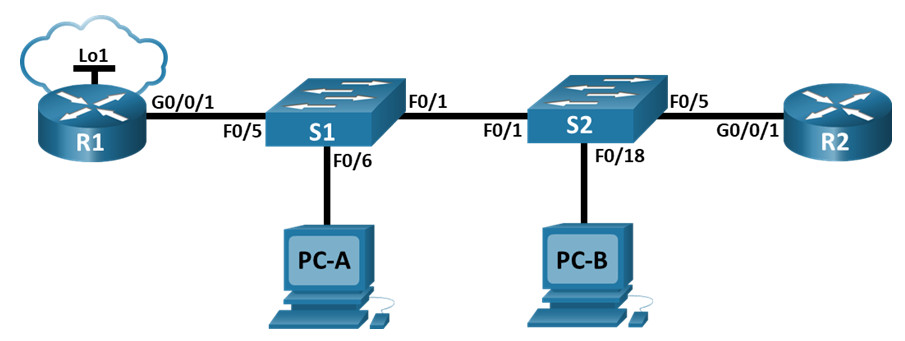
Addressing Table
| Device | Interface | IP Address | Subnet Mask | Default Gateway |
|---|---|---|---|---|
| R1 | G0/0/1 | N/A | N/A | N/A |
| G0/0/1.20 | 10.20.0.1 | 255.255.255.0 | ||
| G0/0/1.30 | 10.30.0.1 | 255.255.255.0 | ||
| G0/0/1.40 | 10.40.0.1 | 255.255.255.0 | ||
| G0/0/1.1000 | N/A | N/A | ||
| Loopback1 | 172.16.1.1 | 255.255.255.0 | ||
| R2 | G0/0/1 | 10.20.0.4 | 255.255.255.0 | N/A |
| S1 | VLAN 20 | 10.20.0.2 | 255.255.255.0 | 10.20.0.1 |
| S2 | VLAN 20 | 10.20.0.3 | 255.255.255.0 | 10.20.0.1 |
| PC-A | NIC | 10.30.0.10 | 255.255.255.0 | 10.30.0.1 |
| PC-B | NIC | 10.40.0.10 | 255.255.255.0 | 10.40.0.1 |
VLAN Table
| VLAN | Name | Interface Assigned |
|---|---|---|
| 20 | Management | S2: F0/5 |
| 30 | Operations | S1: F0/6 |
| 40 | Sales | S2: F0/18 |
| 999 | ParkingLot | S1: F0/2-4, F0/7-24, G0/1-2
S2: F0/2-4, F0/6-17, F0/19-24, G0/1-2 |
| 1000 | Native | N/A |
Objectives
- Part 1: Build the Network and Configure Basic Device Settings
- Part 2: Configure and Verify Extended Access Control Lists
Background / Scenario
You have been tasked with configuring access control lists on small company’s network. ACLs are one of the simplest and most direct means of controlling layer 3 traffic. R1 will be hosting an internet connection (simulated by interface Loopback 1) and sharing the default route information to R2. After initial configuration is complete, the company has some specific traffic security requirements that you are responsible for implementing.
Note: The routers used with CCNA hands-on labs are Cisco 4221 with Cisco IOS XE Release 16.9.4 (universalk9 image). The switches used in the labs are Cisco Catalyst 2960s with Cisco IOS Release 15.2(2) (lanbasek9 image). Other routers, switches, and Cisco IOS versions can be used. Depending on the model and Cisco IOS version, the commands available and the output produced might vary from what is shown in the labs. Refer to the Router Interface Summary Table at the end of the lab for the correct interface identifiers.
Note: Ensure that the routers and switches have been erased and have no startup configurations. If you are unsure contact your instructor.
Instructor Note: Refer to the Instructor Lab Manual for the procedures to initialize and reload devices.
Required Resources
- 2 Routers (Cisco 4221 with Cisco IOS XE Release 16.9.4 universal image or comparable)
- 2 Switches (Cisco 2960 with Cisco IOS Release 15.2(2) lanbasek9 image or comparable)
- 2 PCs (Windows with a terminal emulation program, such as Tera Term)
- Console cables to configure the Cisco IOS devices via the console ports
- Ethernet cables as shown in the topology
Instructions
Part 1: Build the Network and Configure Basic Device Settings.
Step 1: Cable the network as shown in the topology.
Attach the devices as shown in the topology diagram, and cable as necessary.
Step 2: Configure basic settings for each router.
a. Assign a device name to the router.
router(config)# hostname R1
b. Disable DNS lookup to prevent the router from attempting to translate incorrectly entered commands as though they were host names.
R1(config)# no ip domain lookup
c. Assign class as the privileged EXEC encrypted password.
R1(config)# enable secret class
d. Assign cisco as the console password and enable login.
R1(config)# line console 0
R1(config-line)# password cisco
R1(config-line)# login
e. Assign cisco as the VTY password and enable login.
R1(config)# line vty 0 4
R1(config-line)# password cisco
R1(config-line)# login
f. Encrypt the plaintext passwords.
R1(config)# service password-encryption
g. Create a banner that warns anyone accessing the device that unauthorized access is prohibited.
R1(config)# banner motd $ Authorized Users Only! $
h. Save the running configuration to the startup configuration file.
R1# copy running-config startup-config
Step 3: Configure basic settings for each switch.
a. Assign a device name to the switch.
switch(config)# hostname S1
b. Disable DNS lookup to prevent the router from attempting to translate incorrectly entered commands as though they were host names.
S1(config)# no ip domain-lookup
c. Assign class as the privileged EXEC encrypted password.
S1(config)# enable secret class
d. Assign cisco as the console password and enable login.
S1(config)# line console 0
S1(config-line)# password cisco
S1(config-line)# login
e. Assign cisco as the VTY password and enable login.
S1(config)# line vty 0 15
S1(config-line)# password cisco
S1(config-line)# login
f. Encrypt the plaintext passwords.
S1(config)# service password-encryption
g. Create a banner that warns anyone accessing the device that unauthorized access is prohibited.
S1(config)# banner motd $ Authorized Users Only! $
h. Save the running configuration to the startup configuration file.
S1(config)# exit
S1# copy running-config startup-config
Part 2: Configure VLANs on the Switches
Step 1: Create VLANs on both switches.
a. Create and name the required VLANs on each switch from the table above.
S1(config)# vlan 20
S1(config-vlan)# name Management
S1(config-vlan)# vlan 30
S1(config-vlan)# name Operations
S1(config-vlan)# vlan 40
S1(config-vlan)# name Sales
S1(config-vlan)# vlan 999
S1(config-vlan)# name ParkingLot
S1(config-vlan)# vlan 1000
S1(config-vlan)# name Native
S1(config-vlan)# exit

S2(config)# vlan 20
S2(config-vlan)# name Management
S2(config-vlan)# vlan 30
S2(config-vlan)# name Operations
S2(config-vlan)# vlan 40
S2(config-vlan)# name Sales
S2(config-vlan)# vlan 999
S2(config-vlan)# name ParkingLot
S2(config-vlan)# vlan 1000
S2(config-vlan)# name Native
S2(config-vlan)# exit
b. Configure the management interface and default gateway on each switch using the IP address information in the Addressing Table.
S1(config)# interface vlan 20
S1(config-if)# ip address 10.20.0.2 255.255.255.0
S1(config-if)# no shutdown
S1(config-if)# exit
S1(config)# ip default-gateway 10.20.0.1
S1(config)# end

S2(config)# interface vlan 20
S2(config-if)# ip address 10.20.0.3 255.255.255.0
S2(config-if)# no shutdown
S2(config-if)# exit
S2(config)# ip default-gateway 10.20.0.1
S2(config)# end
c. Assign all unused ports on the switch to the Parking Lot VLAN, configure them for static access mode, and administratively deactivate them.
Note: The interface range command is helpful to accomplish this task with as few commands as necessary.
S1(config)# interface range f0/2 - 4, f0/7 - 24, g0/1 - 2
S1(config-if-range)# switchport mode access
S1(config-if-range)# switchport access vlan 999
S1(config-if-range)# shutdown
S1(config-if-range)# end

S2(config)# interface range f0/2 - 17, f0/19 - 24, g0/1 - 2
S2(config-if-range)# switchport mode access
S2(config-if-range)# switchport access vlan 999
S2(config-if-range)# shutdown
S2(config-if-range)# end
Step 2: Assign VLANs to the correct switch interfaces.
a. Assign used ports to the appropriate VLAN (specified in the VLAN table above) and configure them for static access mode.
S1(config)# interface f0/6
S1(config-if)# switchport mode access
S1(config-if)# switchport access vlan 30

S2(config)# interface f0/18
S2(config-if)# switchport mode access
S2(config-if)# switchport access vlan 40
b. Issue the show vlan brief command and verify that the VLANs are assigned to the correct interfaces.
S1# show vlan brief

VLAN Name                             Status    Ports
---- -------------------------------- --------- -------------------------------
1    default                          active    Fa0/1, Fa0/5
10   Management                       active
20   Sales                            active    Fa0/6
30   Operations                       active
999  ParkingLot                       active    Fa0/2, Fa0/3, Fa0/4, Fa0/7
                                                Fa0/8, Fa0/9, Fa0/10, Fa0/11
                                                Fa0/12, Fa0/13, Fa0/14, Fa0/15
                                                Fa0/16, Fa0/17, Fa0/18, Fa0/19
                                                Fa0/20, Fa0/21, Fa0/22, Fa0/23
                                                Fa0/24, Gi0/1, Gi0/2
1000 Native                           active
1002 fddi-default                     act/unsup
1003 token-ring-default               act/unsup
1004 fddinet-default                  act/unsup
1005 trnet-default                    act/unsup
S2# show vlab brief

VLAN Name                             Status    Ports
---- -------------------------------- --------- -------------------------------
1    default                          active    Fa0/1
10   Management                       active
30   Operations                       active
40   Sales                            active    Fa0/18
999  ParkingLot                       active    Fa0/2, Fa0/3, Fa0/4, Fa0/5
                                                Fa0/6, Fa0/7, Fa0/8, Fa0/9
                                                Fa0/10, Fa0/11, Fa0/12, Fa0/13
                                                Fa0/14, Fa0/15, Fa0/16, Fa0/17
                                                Fa0/19, Fa0/20, Fa0/21, Fa0/22
                                                Fa0/23, Fa0/24, Gi0/1, Gi0/2
Part 3: Configure Trunking
Step 1: Manually configure trunk interface F0/1.
a. Change the switchport mode on interface F0/1 to force trunking. Make sure to do this on both switches.
S1(config)# interface f0/1
S1(config-if)# switchport mode trunk

S2(config)# interface f0/1
S2(config-if)# switchport mode trunk
b. As a part of the trunk configuration, set the native vlan to 1000 on both switches. You may see error messages temporarily while the two interfaces are configured for different native VLANs.
S1(config-if)# switchport trunk native vlan 1000

S2(config-if)# switchport trunk native vlan 1000
c. As another part of trunk configuration, specify that VLANs 20, 30, 40 and 1000 are allowed to cross the trunk.
S1(config-if)# switchport trunk allowed vlan 20,30,40,1000

S2(config-if)# switchport trunk allowed vlan 20,30,40,1000
d. Issue the show interfaces trunk command to verify trunking ports, the Native VLAN and allowed VLANs across the trunk.
S1# show interfaces trunk

Port        Mode             Encapsulation  Status        Native vlan
Fa0/1       on               802.1q         trunking      1000

Port        Vlans allowed on trunk
Fa0/1       20,30,40,1000

Port        Vlans allowed and active in management domain
Fa0/1       20,30,40,1000

Port        Vlans in spanning tree forwarding state and not pruned
Fa0/1       20,30,40,1000

S2# show interface trunk

Port        Mode             Encapsulation  Status        Native vlan
Fa0/1       on               802.1q         trunking      1000

Port        Vlans allowed on trunk
Fa0/1       20,30,40,1000

Port        Vlans allowed and active in management domain
Fa0/1       30,40,1000

Port        Vlans in spanning tree forwarding state and not pruned
Fa0/1       30,40
Step 2: Manually configure S1’s trunk interface F0/5.
a. Configure S1’s interface F0/5 with the same trunk parameters as F0/1. This is the trunk to the router.
S1(config)# interface f0/5
S1(config-if)# switchport mode trunk
S1(config-if)# switchport trunk native vlan 1000
S1(config-if)# switchport trunk allowed vlan 20,30,40,1000
b. Save the running configuration to the startup configuration file.
S1# copy running-config startup-config
c. Issue the show interfaces trunk command to verify trunking.
Part 4: Configure Routing
Step 1: Configure Inter-VLAN Routing on R1.
a. Activate interface G0/0/1 on the router.
R1(config)# interface g0/0/1
R1(config-if)# no shutdown
b. Configure sub-interfaces for each VLAN as specified in the IP addressing table. All sub-interfaces use 802.1Q encapsulation. Ensure the sub-interface for the native VLAN does not have an IP address assigned. Include a description for each sub-interface.
R1(config)# interface g0/0/1.20
R1(config-subif)# description Management Network
R1(config-subif)# encapsulation dot1q 20
R1(config-subif)# ip address 10.20.0.1 255.255.255.0
R1(config-subif)# interface g0/0/1.30
R1(config-subif)# encapsulation dot1q 30
R1(config-subif)# description Operations Network
R1(config-subif)# ip address 10.30.0.1 255.255.255.0
R1(config-subif)# interface g0/0/1.40
R1(config-subif)# encapsulation dot1q 40
R1(config-subif)# description Sales Network
R1(config-subif)# ip address 10.40.0.1 255.255.255.0
R1(config-subif)# interface g0/0/1.1000
R1(config-subif)# encapsulation dot1q 1000 native
R1(config-subif)# description Native VLAN
c. Configure interface Loopback 1 on R1 with addressing from the table above.
R1(config)# interface Loopback 1
R1(config-if)# ip address 172.16.1.1 255.255.255.0
d. Use the show ip interface brief command to verify the sub-interfaces are operational.
R1# show ip interface brief
Interface              IP-Address      OK? Method Status                Protocol
GigabitEthernet0/0/0   unassigned      YES unset  administratively down down
GigabitEthernet0/0/1   unassigned      YES unset  up                    up
Gi0/0/1.20             10.20.0.1       YES manual up                    up
Gi0/0/1.30             10.30.0.1       YES manual up                    up
Gi0/0/1.40             10.40.0.1       YES manual up                    up
Gi0/0/1.1000           unassigned      YES unset  up                    up
Serial0/1/0            unassigned      NO  unset  down                  down
Serial0/1/1            unassigned      NO  unset  down                  down
GigabitEthernet0       unassigned      YES unset  administratively down down
Loopback1              172.16.1.1      YES manual up                    up
Step 2: Configure the R2 interface g0/0/1 using the address from the table and a default route with the next hop 10.20.0.1
R2(config)# interface g0/0/1
R2(config-if)# ip address 10.20.0.4 255.255.255.0
R2(config-if)# no shutdown
R2(config-if)# exit
R2(config)# ip route 0.0.0.0 0.0.0.0 10.20.0.1
Part 5: Configure Remote Access
Step 1: Configure all network devices for basic SSH support.
a. Create a local user with the username SSHadmin and the encrypted password $cisco123!
R1(config)# username SSHadmin secret $cisco123!
b. Use ccna-lab.com as the domain name.
R1(config)# ip domain name ccna-lab.com
c. Generate crypto keys using a 1024-bit modulus.
R1(config)# crypto key generate rsa general-keys modulus 1024
d. Configure the first five VTY lines on each device to support SSH connections only and to authenticate to the local user database.
R1(config)# line vty 0 4
R1(config-line)# transport input ssh
R1(config-line)# login local
R1(config-line)# exit
Step 2: Enable secure, authenticated web services on R1.
a. Enable the HTTPS server on R1.
R1(config)# ip http secure-server
b. Configure R1 to authenticate users attempting to connect to the web server.
R1(config)# ip http authentication local
Part 6: Verify Connectivity
Step 1: Configure PC hosts.
Refer to the Addressing Table for PC host address information.
Step 2: Complete the following tests. All should be successful.
Note: You may have to disable the PC firewall for pings to be successful.
| From | Protocol | Destination |
|---|---|---|
| PC-A | Ping | 10.40.0.10 |
| PC-A | Ping | 10.20.0.1 |
| PC-B | Ping | 10.30.0.10 |
| PC-B | Ping | 10.20.0.1 |
| PC-B | Ping | 172.16.1.1 |
| PC-B | HTTPS | 10.20.0.1 |
| PC-B | HTTPS | 172.16.1.1 |
| PC-B | SSH | 10.20.0.1 |
| PC-B | SSH | 172.16.1.1 |
Part 7: Configure and Verify Extended Access Control Lists.
When basic connectivity is verified, the company requires the following security policies to be implemented:
Policy 1: The Sales Network is not allowed to SSH to the Management Network (but other SSH is allowed).
Policy 2: The Sales Network is not allowed to access IP addresses in the Management network using any web protocol (HTTP/HTTPS). The Sales Network is also not allowed to access R1 interfaces using any web protocol. All other web traffic is allowed (note – Sales can access the Loopback 1 interface on R1).
Policy 3: The Sales Network is not allowed to send ICMP echo-requests to the Operations or Management Networks. ICMP echo requests to other destinations are allowed.
Policy 4: The Operations network is not allowed to send ICMP echo-requests to the Sales network. ICMP echo requests to other destinations are allowed.
Step 1: Analyze the network and the security policy requirements to plan ACL implementation.
Answers may vary. The requirements listed above require two extended access lists to be implemented. Following the guidance of placing extended access lists as close to the source of the traffic to be filtered as possible, these ACLs will go on interfaces G0/0/0.30 and G0/0/0.40.
Step 2: Develop and apply extended access lists that will meet the security policy statements.
Answers may vary. The ACLs should be similar to the following:
R1(config)# access-list 101 remark ACL 101 fulfills policies 1, 2, and 3
R1(config)# access-list 101 deny tcp 10.40.0.0 0.0.0.255 10.20.0.0 0.0.0.255 eq 22
R1(config)# access-list 101 deny tcp 10.40.0.0 0.0.0.255 10.20.0.0 0.0.0.255 eq 80
R1(config)# access-list 101 deny tcp 10.40.0.0 0.0.0.255 10.30.0.1 0.0.0.0 eq 80
R1(config)# access-list 101 deny tcp 10.40.0.0 0.0.0.255 10.40.0.1 0.0.0.0 eq 80
R1(config)# access-list 101 deny tcp 10.40.0.0 0.0.0.255 10.20.0.0 0.0.0.255 eq 443
R1(config)# access-list 101 deny tcp 10.40.0.0 0.0.0.255 10.30.0.1 0.0.0.0 eq 443
R1(config)# access-list 101 deny tcp 10.40.0.0 0.0.0.255 10.40.0.1 0.0.0.0 eq 443
R1(config)# access-list 101 deny icmp 10.40.0.0 0.0.0.255 10.20.0.0 0.0.0.255 echo
R1(config)# access-list 101 deny icmp 10.40.0.0 0.0.0.255 10.30.0.0 0.0.0.255 echo
R1(config)# access-list 101 permit ip any any
R1(config)# interface g0/0/1.40
R1(config-subif)# ip access-group 101 in

R1(config)# access-list 102 remark ACL 102 fulfills policy 4
R1(config)# access-list 102 deny icmp 10.30.0.0 0.0.0.255 10.40.0.0 0.0.0.255 echo
R1(config)# access-list 102 permit ip any any
R1(config)# interface g0/0/1.30
R1(config-subif)# ip access-group 102 in
Step 3: Verify security policies are being enforced by the deployed access lists.
Run the following tests. The expected results are shown in the table:
| From | Protocol | Destination | Result |
|---|---|---|---|
| PC-A | Ping | 10.40.0.10 | Fail |
| PC-A | Ping | 10.20.0.1 | Success |
| PC-B | Ping | 10.30.0.10 | Fail |
| PC-B | Ping | 10.20.0.1 | Fail |
| PC-B | Ping | 172.16.1.1 | Success |
| PC-B | HTTPS | 10.20.0.1 | Fail |
| PC-B | HTTPS | 172.16.1.1 | Success |
| PC-B | SSH | 10.20.0.4 | Fail |
| PC-B | SSH | 172.16.1.1 | Success |
Device Configs - Final
Router R1
! ==============================================================
!--- Lab - Configure and Verify Extended IPv4 ACLs (hands-on / real-equipment lab, Cisco
!--- 4221 + IOS XE 16.9.4)
!--- ANSWER SCRIPT FOR ROUTER R1
!--- Usage: from the console on R1, enter privileged EXEC mode with "enable", then paste
!--- this whole file. Every line beginning with "!" is a comment; IOS ignores it.
!--- Confirmed line-for-line against this lab's own final "show run" Device Config. R1 is
!--- the router-on-a-stick for VLANs 20/30/40/1000, and hosts a simulated internet
!--- connection via Loopback1.
! ==============================================================

enable
configure terminal

! --------------------------------------------------------------
!--- Part 1, Step 2: basic device settings.
! --------------------------------------------------------------
hostname R1
no ip domain lookup
enable secret class

line console 0
 password cisco
 login
exit

line vty 0 4
 password cisco
 login
exit

service password-encryption
banner motd $ Authorized Users Only! $

end
copy running-config startup-config
configure terminal

! --------------------------------------------------------------
!--- Part 4, Step 1: activate the trunk to S1, then a sub-interface per VLAN. The Native
!--- VLAN sub-interface (.1000) deliberately gets no IP address.
! --------------------------------------------------------------
interface GigabitEthernet0/0/1
 no shutdown

interface GigabitEthernet0/0/1.20
 description Management Network
 encapsulation dot1Q 20
 ip address 10.20.0.1 255.255.255.0

interface GigabitEthernet0/0/1.30
 description Operations Network
 encapsulation dot1Q 30
 ip address 10.30.0.1 255.255.255.0

interface GigabitEthernet0/0/1.40
 description Sales Network
 encapsulation dot1Q 40
 ip address 10.40.0.1 255.255.255.0

interface GigabitEthernet0/0/1.1000
 description Native VLAN
 encapsulation dot1Q 1000 native
exit

! --------------------------------------------------------------
!--- Part 4, Step 1.3: Loopback1 - the simulated internet connection.
! --------------------------------------------------------------
interface Loopback1
 ip address 172.16.1.1 255.255.255.0
exit

! --------------------------------------------------------------
!--- Part 5, Step 1: basic SSH support. Only the FIRST FIVE vty lines (0-4) get the SSH-only
!--- restriction - this lab deliberately leaves any remaining vty lines untouched.
! --------------------------------------------------------------
username SSHadmin secret $cisco123!
ip domain name ccna-lab.com
crypto key generate rsa general-keys modulus 1024

line vty 0 4
 transport input ssh
 login local
exit

! --------------------------------------------------------------
!--- Part 5, Step 2: secure, authenticated web management - only required on R1 (not R2 or
!--- the switches). NOTE: generating the RSA keys above may auto-enable "ip http
!--- secure-server" as a side effect on some IOS versions even before this line is typed -
!--- entering it explicitly (as below) is still correct and makes the intent unambiguous.
! --------------------------------------------------------------
ip http secure-server
ip http authentication local

! --------------------------------------------------------------
!--- Part 7, Step 2: ACL 101 fulfills Policies 1-3 (Sales network restrictions), applied
!--- inbound on the Sales sub-interface. ACL 102 fulfills Policy 4 (Operations -> Sales ICMP
!--- only), applied inbound on the Operations sub-interface. Both follow the
!--- as-close-to-the-source rule for extended ACLs.
! --------------------------------------------------------------
access-list 101 remark ACL 101 fulfills policies 1, 2, and 3
!--- Policy 1: Sales cannot SSH to the Management network.
access-list 101 deny tcp 10.40.0.0 0.0.0.255 10.20.0.0 0.0.0.255 eq 22
!--- Policy 2: Sales cannot reach the Management network OR any R1 interface over HTTP/
!--- HTTPS - EXCEPT Loopback1, which is deliberately left unmatched by any line below so it
!--- falls through to the final permit.
access-list 101 deny tcp 10.40.0.0 0.0.0.255 10.20.0.0 0.0.0.255 eq 80
access-list 101 deny tcp 10.40.0.0 0.0.0.255 host 10.30.0.1 eq 80
access-list 101 deny tcp 10.40.0.0 0.0.0.255 host 10.40.0.1 eq 80
access-list 101 deny tcp 10.40.0.0 0.0.0.255 10.20.0.0 0.0.0.255 eq 443
access-list 101 deny tcp 10.40.0.0 0.0.0.255 host 10.30.0.1 eq 443
access-list 101 deny tcp 10.40.0.0 0.0.0.255 host 10.40.0.1 eq 443
!--- Policy 3: Sales cannot ping the Management or Operations networks.
access-list 101 deny icmp 10.40.0.0 0.0.0.255 10.20.0.0 0.0.0.255 echo
access-list 101 deny icmp 10.40.0.0 0.0.0.255 10.30.0.0 0.0.0.255 echo
access-list 101 permit ip any any

interface GigabitEthernet0/0/1.40
 ip access-group 101 in
exit

access-list 102 remark ACL 102 fulfills policy 4
!--- Policy 4: Operations cannot ping the Sales network.
access-list 102 deny icmp 10.30.0.0 0.0.0.255 10.40.0.0 0.0.0.255 echo
access-list 102 permit ip any any

interface GigabitEthernet0/0/1.30
 ip access-group 102 in

end

copy running-config startup-config

! ==============================================================
!--- Verification (from R1 and the PCs):
!---   R1# show ip interface brief -> G0/0/0 stays administratively down (unused); every
!---   G0/0/1 sub-interface is up/up
!---   R1# show access-lists -> ACL 101 (9 lines + permit) and ACL 102 (1 line + permit),
!---   each with its remark
!---   PC-A (Operations) > ping 10.40.0.10 -> fails (ACL 102)
!---   PC-A > ping 10.20.0.1, https to 172.16.1.1 -> succeed (untouched by either ACL)
!---   PC-B (Sales) > ping 10.30.0.10, ping 10.20.0.1, https to 10.20.0.1, ssh to 10.20.0.4
!---   -> all fail (ACL 101 - note 10.20.0.4 is R2's own address, part of the Management
!---   /24 network)
!---   PC-B > ping 172.16.1.1, https to 172.16.1.1, ssh to 172.16.1.1 -> all succeed
!---   (Loopback1 is the one deliberate exemption in this policy set)
! ==============================================================
Router R2
! ==============================================================
!--- Lab - Configure and Verify Extended IPv4 ACLs (hands-on / real-equipment lab)
!--- ANSWER SCRIPT FOR ROUTER R2
!--- Usage: from the console on R2, enter privileged EXEC mode with "enable", then paste
!--- this whole file. Every line beginning with "!" is a comment; IOS ignores it.
!--- R2 has no ACLs or sub-interfaces of its own - it's a single-homed router on the
!--- Management network reaching everything else via a default route toward R1.
! ==============================================================

enable
configure terminal

! --------------------------------------------------------------
!--- Part 1, Step 2: basic device settings (same pattern as R1).
! --------------------------------------------------------------
hostname R2
no ip domain lookup
enable secret class

line console 0
 password cisco
 login
exit

line vty 0 4
 password cisco
 login
exit

service password-encryption
banner motd $ Authorized Users Only! $

end
copy running-config startup-config
configure terminal

! --------------------------------------------------------------
!--- Part 4, Step 2: R2's own interface plus a default route back toward R1's Management
!--- sub-interface.
! --------------------------------------------------------------
interface GigabitEthernet0/0/1
 ip address 10.20.0.4 255.255.255.0
 no shutdown
exit

ip route 0.0.0.0 0.0.0.0 10.20.0.1

! --------------------------------------------------------------
!--- Part 5, Step 1: basic SSH support - same as R1. Only vty 0-4 get the SSH-only
!--- restriction.
! --------------------------------------------------------------
username SSHadmin secret $cisco123!
ip domain name ccna-lab.com
crypto key generate rsa general-keys modulus 1024

line vty 0 4
 transport input ssh
 login local

end

copy running-config startup-config

! ==============================================================
!--- Verification:
!---   R2# show ip route -> S* 0.0.0.0/0 [1/0] via 10.20.0.1
!---   R2's own address (10.20.0.4) is what PC-B's blocked SSH test targets - a working SSH
!---   service here is what makes that test meaningfully demonstrate R1's ACL, rather than
!---   just failing because SSH itself was never enabled
! ==============================================================
Switch S1
! ==============================================================
!--- Lab - Configure and Verify Extended IPv4 ACLs (hands-on / real-equipment lab, Cisco
!--- 2960 + IOS 15.2)
!--- ANSWER SCRIPT FOR SWITCH S1
!--- Usage: from the console on S1, enter privileged EXEC mode with "enable", then paste
!--- this whole file. Every line beginning with "!" is a comment; IOS ignores it.
!--- Confirmed against this lab's own final "show run" Device Config.
! ==============================================================

enable
configure terminal

! --------------------------------------------------------------
!--- Part 1, Step 3: basic device settings
! --------------------------------------------------------------
hostname S1
no ip domain-lookup
enable secret class

line console 0
 password cisco
 login
exit

line vty 0 15
 password cisco
 login
exit

service password-encryption
banner motd $ Authorized Users Only! $
exit
copy running-config startup-config

configure terminal

! --------------------------------------------------------------
!--- Part 2, Step 1: create all 5 VLANs.
! --------------------------------------------------------------
vlan 20
 name Management
vlan 30
 name Operations
vlan 40
 name Sales
vlan 999
 name ParkingLot
vlan 1000
 name Native
exit

! --------------------------------------------------------------
!--- Part 2, Step 2: management interface + default gateway.
! --------------------------------------------------------------
interface vlan 20
 ip address 10.20.0.2 255.255.255.0
 no shutdown
exit

ip default-gateway 10.20.0.1

! --------------------------------------------------------------
!--- Part 2, Step 3: every unused port -> Parking Lot VLAN, access mode, shut down. Ports
!--- F0/1 (trunk to S2), F0/5 (trunk to R1), and F0/6 (PC-A) are excluded.
! --------------------------------------------------------------
interface range f0/2-4, f0/7-24, g0/1-2
 switchport mode access
 switchport access vlan 999
 shutdown
exit

! --------------------------------------------------------------
!--- Part 2, Step 4: the one used access port on this switch (PC-A, Operations/VLAN 30).
! --------------------------------------------------------------
interface FastEthernet0/6
 switchport mode access
 switchport access vlan 30
exit

! --------------------------------------------------------------
!--- Part 3, Step 1-2: trunk to S2 (F0/1) and to R1 (F0/5) - identical parameters on both.
! --------------------------------------------------------------
interface FastEthernet0/1
 switchport mode trunk
 switchport trunk native vlan 1000
 switchport trunk allowed vlan 20,30,40,1000
exit

interface FastEthernet0/5
 switchport mode trunk
 switchport trunk native vlan 1000
 switchport trunk allowed vlan 20,30,40,1000
exit

! --------------------------------------------------------------
!--- Part 5, Step 1: basic SSH support - "all network devices" per that instruction's
!--- heading, even though only R1's commands are printed in the walkthrough. Only vty 0-4
!--- get the SSH-only restriction; vty 5-15 are deliberately left as plain
!--- password+telnet login, confirmed by this lab's own final Device Config.
! --------------------------------------------------------------
username SSHadmin secret $cisco123!
ip domain-name ccna-lab.com

line vty 0 4
 transport input ssh
 login local

end

copy running-config startup-config

! ==============================================================
!--- Verification:
!---   S1# show vlan brief -> VLAN 30 (Operations) shows Fa0/6; VLAN 999 shows every port
!---   in the shutdown range; VLANs 20 and 40 show no local ports (VLAN 20 only exists here
!---   for the management SVI/trunking, VLAN 40 doesn't touch this switch's access ports at
!---   all)
!---   S1# show interfaces trunk -> Fa0/1 and Fa0/5 both trunking, native VLAN 1000, allowed
!---   VLANs 20,30,40,1000
! ==============================================================
Switch S2
! ==============================================================
!--- Lab - Configure and Verify Extended IPv4 ACLs (hands-on / real-equipment lab, Cisco
!--- 2960 + IOS 15.2)
!--- ANSWER SCRIPT FOR SWITCH S2
!--- Usage: from the console on S2, enter privileged EXEC mode with "enable", then paste
!--- this whole file. Every line beginning with "!" is a comment; IOS ignores it.
!--- S2's F0/5 connects to R2 as a plain ACCESS port on the Management VLAN - R2 has no
!--- trunk of its own here, it's just a regular host on that VLAN's subnet.
! ==============================================================

enable
configure terminal

! --------------------------------------------------------------
!--- Part 1, Step 3: basic device settings
! --------------------------------------------------------------
hostname S2
no ip domain-lookup
enable secret class

line console 0
 password cisco
 login
exit

line vty 0 15
 password cisco
 login
exit

service password-encryption
banner motd $ Authorized Users Only! $
exit
copy running-config startup-config

configure terminal

! --------------------------------------------------------------
!--- Part 2, Step 1: create all 5 VLANs.
! --------------------------------------------------------------
vlan 20
 name Management
vlan 30
 name Operations
vlan 40
 name Sales
vlan 999
 name ParkingLot
vlan 1000
 name Native
exit

! --------------------------------------------------------------
!--- Part 2, Step 2: management interface + default gateway.
! --------------------------------------------------------------
interface vlan 20
 ip address 10.20.0.3 255.255.255.0
 no shutdown
exit

ip default-gateway 10.20.0.1

! --------------------------------------------------------------
!--- Part 2, Step 3: every unused port -> Parking Lot VLAN, access mode, shut down. Ports
!--- F0/1 (trunk to S1), F0/5 (R2), and F0/18 (PC-B) are excluded - note this range is
!--- different from S1's, since the used-port set differs between the two switches.
! --------------------------------------------------------------
interface range f0/2-17, f0/19-24, g0/1-2
 switchport mode access
 switchport access vlan 999
 shutdown
exit

! --------------------------------------------------------------
!--- Part 2, Step 4: the two used access ports on this switch - R2 on Management (VLAN 20),
!--- and PC-B on Sales (VLAN 40).
! --------------------------------------------------------------
interface FastEthernet0/5
 switchport mode access
 switchport access vlan 20
exit

interface FastEthernet0/18
 switchport mode access
 switchport access vlan 40
exit

! --------------------------------------------------------------
!--- Part 3, Step 1: trunk to S1 (F0/1) - identical parameters as S1's own side.
! --------------------------------------------------------------
interface FastEthernet0/1
 switchport mode trunk
 switchport trunk native vlan 1000
 switchport trunk allowed vlan 20,30,40,1000
exit

! --------------------------------------------------------------
!--- Part 5, Step 1: basic SSH support - same as S1. Only vty 0-4 get the SSH-only
!--- restriction; vty 5-15 stay as plain password+telnet login.
! --------------------------------------------------------------
username SSHadmin secret $cisco123!
ip domain-name ccna-lab.com

line vty 0 4
 transport input ssh
 login local

end

copy running-config startup-config

! ==============================================================
!--- Verification:
!---   S2# show vlan brief -> VLAN 40 (Sales) shows Fa0/18; VLAN 999 shows every port in the
!---   shutdown range
!---   S2# show interfaces trunk -> Fa0/1 trunking, native VLAN 1000, allowed VLANs
!---   20,30,40,1000
! ==============================================================


