1. What feature can be used to optimize the traffic path for a specific application?
RSTP
uRPF
OSPF
PBR
Explanation: Topic 9.1.0
Policy-Based Routing (PBR) is used to optimize the traffic path for specific applications or sets of users by overriding standard destination-based routing. It allows forwarding decisions to be based on criteria such as source IP address, protocol types, or end-user applications.
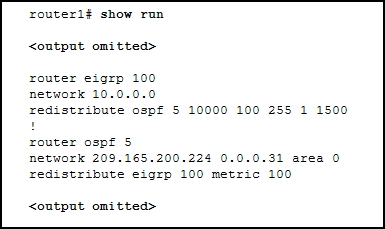
2. Refer to the exhibit. After configuring two-way redistribution, an administrator notices that none of the EIGRP routes are being advertised in the OSPF network. What is a possible reason that the routes are not being advertised?
The metric value is wrong for the redistribute command under OSPF.
The subnets keyword is missing on the redistribute command under OSPF.
The metric value is wrong for the redistribute command under EIGRP.
The wrong EIGRP AS is being redistributed.
Explanation: Topic 8.3.0
The exhibit shows the EIGRP process is configured as AS 100, but the OSPF configuration is attempting to redistribute EIGRP 5. When the redistribute command references an incorrect process or Autonomous System (AS) number, the router will find no routes in that process to inject into the target protocol.
3. Which two redistribution techniques are least likely to introduce routing loops into a network? (Choose two.)
multipoint one-way redistribution
multipoint two-way redistribution
one-point one-way redistribution
multipoint multi-way redistribution
one-point multi-way redistribution
one-point two-way redistribution
Explanation: Topic 7.7.0
One-point redistribution (whether one-way or two-way) is considered safe because it represents a single entrance and exit between routing domains. Routing loops are significantly more likely to be introduced in multipoint scenarios where feedback loops can occur.
4. Which two tools can be used in a distribute list to match traffic? (Choose two.)
access lists
route maps
prefix lists
class maps
match lists
Explanation: Topic 7.10.0
Distribute lists are used to control routing updates by applying access control lists (ACLs) or prefix lists. These tools define which specific subnets are permitted to be advertised or redistributed and which should be filtered out.
5. A route is redistributed into OSPF using the default values. As the route propagates across the OSPF domain, how will the metric be treated by neighboring routers?
The route will be advertised as a type N1 route.
The route will be advertised as a type E1 route.
The route will be advertised as a type E2 route.
The route will be advertised as a type N2 route.
Explanation: Topic 7.4.0
By default, routes redistributed into OSPF are assigned as External Type 2 (E2) routes. An E2 route maintains a constant external cost (the seed metric, which defaults to 20 for most IGPs) regardless of the internal OSPF cost of the links the packet crosses.
6. Route redistribution has been configured from an OSPFv3 domain into an EIGRP for IPv6 domain. However, the OSPFv3 directly connected routes are not being redistributed into EIGRP for IPv6. Which option would successfully resolve this issue?
There are no directly connected OSPFv3 interfaces.
The EIGRP redistribute command requires the connected keyword.
The EIGRP redistribute command command requires the include-connected keyword.
The EIGRP redistribute command command requires the static keyword.
Explanation: Topic 7.5.1
When redistributing OSPFv3 into EIGRP for IPv6, the router does not automatically include OSPF-enabled interfaces that are directly connected. To redistribute these connected prefixes, the include-connected keyword must be explicitly added to the redistribute command.
7. What two actions can be taken within a route map statement? (Choose two.)
deny
in
out
set
match
permit
Explanation: Topic 7.13.0
A route map uses match statements to define the conditions or traffic to be identified. If a match is found, set commands are used to take action by modifying the attributes of the packet or route, such as the metric or next-hop.
8. What is the administrative distance of an external OSPF route that was learned from EIGRP through redistribution?
10
170
110
20
90
Explanation: Topic 7.14.6
In Cisco IOS, the default Administrative Distance (AD) for OSPF is 110. Unlike EIGRP, which uses different ADs for internal (90) and external (170) routes, OSPF applies an AD of 110 to all its routes (intra-area, inter-area, and external) by default.
9. Which prefix list matches all host routes only?
ip prefix-list C permit 0.0.0.0/0 le 32
ip prefix-list A permit 0.0.0.0/0 ge 32
ip prefix-list D permit 0.0.0.0/0
ip prefix-list B permit 128.0.0.0/2 ge 17
Explanation: Topic 7.12.3
The prefix 0.0.0.0/0 matches any network address. The ge 32 operator specifies that the subnet mask must be greater than or equal to 32. Since 32 is the maximum length for an IPv4 address, this command matches only host routes (prefixes with a /32 mask).
10. When policy-based routing (PBR) is being implemented, which set command will override explicit entries in the routing table?
set ip precedence
set default interface
set ip next-hop
set ip default next-hop
Explanation: Topic 9.4.1
The set ip next-hop command (without the "default" keyword) causes the router to apply PBR logic before checking the normal destination-based routing table. In contrast, the set ip default next-hop command only applies the policy if the router fails to find an explicit (non-default) match in the routing table.
11. What does the redistribute eigrp 100 subnets metric-type 1 command do when used in router configuration mode under OSPF process 1?
redistributes from EIGRP and processes the first 100 subnets of metric type 1
redistributes only from EIGRP AS 100 subnets of metric type 1
redistributes from EIGRP AS 100 into OSPF and changes the metric type from type 2 to type 1
redistributes from EIGRP AS 100 into OSPF process 1 and changes the metric value of each subnet
Explanation: Topic 7.5.2
The command redistribute eigrp 100 identifies the specific EIGRP Autonomous System to be redistributed. The subnets keyword is mandatory in OSPF to allow the redistribution of classless (subnetted) networks. By default, OSPF redistributes routes as External Type 2 (E2); the metric-type 1 parameter explicitly changes this to External Type 1 (E1), which allows the router to add internal path costs to the external seed metric.
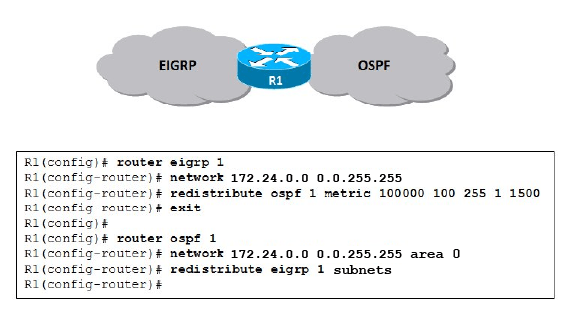
12. Refer to the exhibit. How will R1 redistribute routes between the two routing domains?
One-way redistribution will occur with EIGRP routes being redistributed into OSPF.
Redistribution will not occur between routing domains.
Two-way redistribution will occur between the OSPF and EIGRP routing domains.
One-way redistribution will occur with OSPF routes being redistributed into EIGRP.
Explanation: Topic 7.7.0
The configuration shows that under the EIGRP 1 process, OSPF 1 is being redistributed with a specific metric. Simultaneously, under the OSPF 1 process, EIGRP 1 is being redistributed with the subnets keyword. Because the configuration enables the exchange of routing information from OSPF into EIGRP and from EIGRP into OSPF on the same router, this is defined as two-way redistribution.
13. PBR is implemented using which Cisco IOS feature?
route maps
distribute lists
tracking objects
IP SLA
Explanation: Topic 9.3.0
Policy-Based Routing (PBR) is implemented using route maps. Within the route map, match commands are used to select specific traffic (such as by source IP or application), and set commands are used to define the routing action that overrides the standard destination-based routing table. While IP SLA and tracking objects can be used with PBR for health monitoring, the primary implementation tool is the route map.
14. Which of the following is not a recommendation for avoiding routing loops when configuration multipoint redistribution?
using PBR
inserting only internal routes from routing protocol A to B
using default routes
using tags to filter redistributed routes
Explanation: Topic 7.8.0
Specific recommendations to prevent routing loops in multipoint redistribution include inserting only internal routes, using route tags to filter already redistributed routes, and using default routes to avoid complex two-way redistribution. PBR is a tool used for path optimization and bypassing the routing table, but it is not listed as a standard recommendation for preventing loops caused by mutual redistribution feedback.
15. What happens to packets that do not meet any of the defined match criteria of a route map?
They are routed using the default route.
They are dropped.
They are routed through the normal routing process for forwarding.
They are flagged as undeliverable.
Explanation: Topic 9.3.0
In the context of Policy-Based Routing (PBR), if a packet does not match any of the criteria defined in the route map, or if the set actions cannot be performed (e.g., the next-hop is unreachable), the packet is not dropped. Instead, it falls back to the normal destination-based routing process using the routing table.
16. What is the default seed metric for routes redistributed into OSPF?
90
110
1
20
5
Explanation: Topic 7.4.0
When routes are redistributed into OSPF, they are assigned a default seed metric of 20 and are categorized as External Type 2 (E2) routes. The only exception is BGP, which has a default seed metric of 1.
17. Refer to the exhibit. The EIGRP subnets such as 10.10.0.0/16 and 10.20.0.0/16 are not being seen inside the OSPF domain. What is a possible reason for this?
The metric configuration for OSPF is set too high.
The redistribute command is missing the subnets keyword in the OSPF configuration
The network statement for EIGRP is missing the network mask configuration.
A seed metric for EIGRP has not been set.
Explanation: Topic 8.3.0
OSPF requires the subnets keyword to be explicitly included in the redistribute command to allow the redistribution of classless (subnetted) networks. Without this keyword, OSPF only redistributes classful (major network) routes, causing specific subnets like 10.10.0.0/16 to be ignored.
18. Which of the following is not a reason for using route redistribution?
during conversion or migration
application-specific support
simple routing solution
mixed vendor environment
Explanation: Topic 7.2.0
Route redistribution is actually a complex undertaking that increases the potential for routing confusion, loops, and suboptimal paths. It is used as a necessity during mergers/migrations, to support mixed-vendor environments, or for application-specific needs, but it is never considered a "simple" solution.
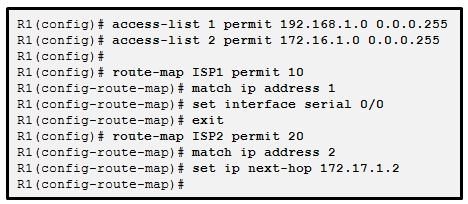
19. Refer to the exhibit. Based on the information that is presented, which statement is true?
Access list 2 specifies that packets sourced from the 172.16.1.0/24 network will be policy routed.
Packets that match access list 1 will be sent to the next-hop address 172.17.1.2.
Access list 1 specifies that packets destined to the 192.168.1.0/24 network will be policy routed.
Packets that match access list 2 will be denied access.
Both match statements must be true for the ISP1 route map to be true.
Explanation: Topic 9.4.0
Based on the exhibit, Access list 2 permits the 172.16.1.0/24 network and is referenced by route-map ISP2 using a match statement. In PBR, this match usually identifies the source IP address of incoming packets to override destination-based routing and send them to the defined next-hop (172.17.1.2 in this case).
20. Examine the PBR and IP SLA configuration snippet given below. What happens to a packet when the status of the tracked object is ”down”?
Router(config-route-map)# set ip next-hop verify-availability 10.1.1.1 10 track 1
The packet is just dropped.
The packet is dropped and an ICMP ”destination-unreachable” message is returned to the sender.
The packet is processed with the next route-map statement.
The packet is forwarded using a routing table.
Explanation: Topic 9.5.4
When PBR is combined with IP SLA and object tracking using the verify-availability keyword, the router checks the status of the tracked object (e.g., a next-hop's reachability) before forwarding the packet. If the status of the tracked object is "down," the router considers the set action for that specific route-map statement to be invalid. If there are no subsequent route-map statements that provide an alternative policy, the packet is not dropped; instead, the router falls back to the normal destination-based routing process and forwards the packet using the standard routing table.
21. Which four tools can be used for route filtering? (Choose four.)
summarization
QoS
route maps
uRPF
distribute lists
prefix lists
access lists
Explanation: Topic 7.9.0
Cisco IOS provides several tools to manipulate and filter redistributed routing information. These include distribute lists (which use access lists or prefix lists to identify subnets) and route maps, which are more sophisticated tools used for both filtering and modifying route attributes.
22. Which function should be disabled on a Cisco router before enabling BFD echo mode?
ICMP redirect
ICMP rate limit
Split horizon
ICMP unreachable
ARP
Explanation: Topic 9.7.2
Before enabling BFD echo mode, the sending of ICMP redirect messages must be disabled using the no ip icmp redirect command. This is done to prevent the router from experiencing high CPU utilization when it receives and loops back BFD echo packets.
23. Router R1 is redistributing routes from OSPF into EIGRP and advertises them to R2. How will R2 mark the redistributed route that it receives in its routing table?
O E2
O
O E1
D
D EX
Explanation: Topic 7.3.0
When a router redistributes routes into EIGRP, those routes are considered external. EIGRP neighbors will identify these redistributed routes in their routing table using the code D EX (EIGRP external).
24. Which routing protocol does not support BFD?
BGP
LISP
IS-IS
EIGRP
OSPF
Explanation: Topic 9.6.0
The Cisco implementation of BFD supports several Layer 3 routing protocols as clients, specifically BGP, EIGRP, IS-IS, and OSPF. It also supports static routing and HSRP, but LISP is not listed among the supported protocols in the sources.
The ITExamAnswers Editorial Team is a dedicated group of certified IT professionals and network engineers. We rigorously review, verify, and update all exam materials to ensure you receive the most accurate and reliable resources for your certification journey.