
1. Refer to the exhibit. How will R1 redistribute routes between the two routing domains?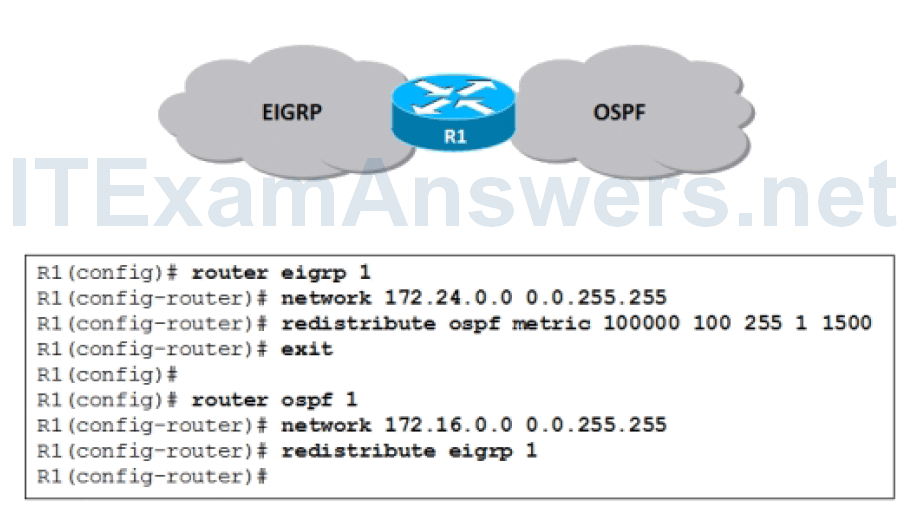
- Redistribution will not occur between routing domains.
- Two-way redistribution will occur between the OSPF and EIGRP routing domains.
- One-way redistribution will occur with OSPF routes being redistributed into EIGRP.
- One-way redistribution will occur with EIGRP routes being redistributed into OSPF.
2. Route redistribution has been configured from an OSPFv3 domain into an EIGRP for IPv6 domain. However, the OSPFv3 directly connected routes are not being redistributed into EIGRP for IPv6. Which option would successfully resolve this issue?
- There are no directly connected OSPFv3 interfaces.
- The EIGRP redistribute command requires the connected keyword.
- The EIGRP redistribute command command requires the include-connected keyword.
- The EIGRP redistribute command command requires the static keyword.
3. What two methods can be used to filter routes?
- route maps with ACLs or prefix lists
- Cisco NetFlow
- default routes
- distribute lists with with ACLs or prefix list
- IP SLA
4. Which two routing protocol redistribution statements are true? (Choose two.)
- Redistribution is always performed inbound.
- Redistribution is performed inbound and outbound.
- The routing table on the router doing the redistribution does not change.
- Redistribution is always performed outbound.
- The routing table on the router doing the redistribution changes.
5. When configuring a seed metric for redistributed routes, what is the recommended metric setting?
- Set the seed metric to a value matching the largest metric within the autonomous system.
- Set the seed metric to a value greater than the largest metric within the autonomous system.
- Set the seed metric to a value less than the largest metric within the autonomous system
- Do not set a seed metric.
6. Which ip prefix-list command would only permit the aggregate address 192.168.0.0/16 to be advertised when applied using the distribute-list prefix FILTER-ROUTES out router configuration command on R1?
- R1 (config)#ip prefix-list FILTER-ROUTES permit 192.168.0.0/16 ge 16
- R1 (config)#ip prefix-list FILTER-ROUTES permit 192.168.0.0/16 eq 16
- R1 (config)#ip prefix-list FILTER-ROUTES permit 192.168.0.0/16
- R1 (config)#ip prefix-list FILTER-ROUTES permit 1921 68.0.0 / 0 le 16
7. Which ip prefix-list line will be used when multiple lines match a given prefix?
- line with the largest sequence number
- line with the lowest sequence number
- line with the longest prefix mask length
- all matching lines
8. Which routing feature is implemented to exchange routing information between autonomous systems?
- route redistribution
- floating static routes
- routing policy
- route summarization
- default route
9. Which is the default seed metric for an OSPF route that is redistributed into an EIGRP autonomous system?
- 20
- 110
- infinity
- 1
- 90
- 170
10. What is the final step when configuring a route map for redistribution?
- Apply match commands.
- Define access lists.
- Apply policy to an interface using ip poicy route-map interface configuration command.
- Apply policy to a routing process using the redistribute router configuration command.
11. Which two redistribution techniques are least likely to introduce routing loops into a network? (Choose two.)
- multipoint one-way redistribution
- one-point two-way redistribution
- one-point multi-way redistribution
- one-point one-way redistribution
- multipoint multi-way redistribution
- multipoint two-way redistribution
12. Refer to the exhibit. After configuring two-way redistribution, an administrator notices that none of the EIGRP routes are being advertised in the OSPF network. What is a possible reason that the routes are not being advertised?
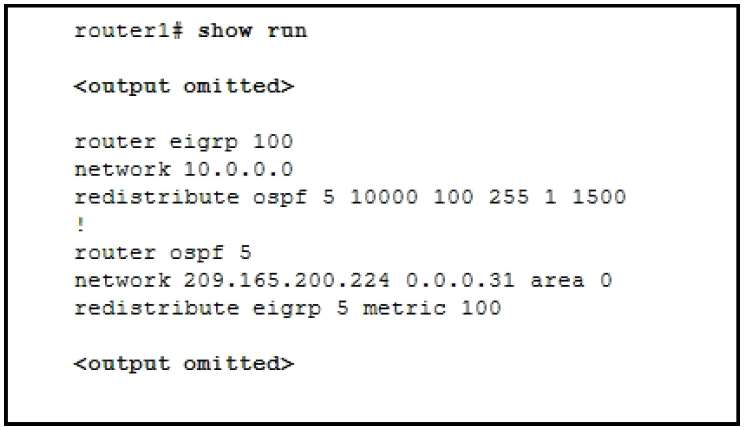
- The wrong EIGRP AS is being redistributed
- The metric value is wrong for the redistribute command under OSPF
- The metric value is wrong for the redistribute command under EIGRP
- The subnets keyword is missing on the redistribute command under OSPF
13. Refer to the exhibit. The EIGRP subnets such as 10.10.0.0/16 and 10.20.0.0/16 are not being seen inside the OSPF domain. What is a possible reason for this?
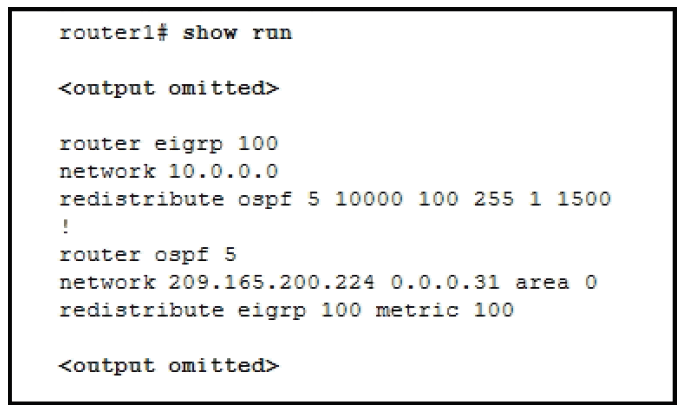
- The network statement for EIGRP is missing the network mask configuration
- A seed metric for EIGRP has not been set.
- The redistribute command is missing the subnets keyword in the OSPF configuration
- The metric configuration for OSPF is set too high.
14. What is the administrative distance of an external OSPF route that was learned from EIGRP through redistribution?
- 10
- 20
- 170
- 90
- 110
15. A router has learned the route 192.168.254.0/24 from multiple sources. These sources are as follows:
- RIPv1 route with a metric of 12
- EIGRP with a metric of 125689
- OSPF E2 route with a metric of 125
- EIGRP external route with a metric of 3489
- OSPF type 1 route with a metric of 632
- OSPF route with a metric of 4
What route will be injected into the routing table?
- O with a metric of 4
- EX with a metric of 3489
- R with metric of 12
- E1 with a metric of 632
- D with metric of 125689
- E2 with a metric of 125
Download PDF File below:

