
Month: May 2019
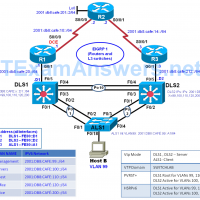
CCNP SWITCH Chapter 6 Lab 6-2, Hot Standby Router Protocol for IPV6 (Version 7)
Topology Objective Configure inter-VLAN routing with HSRP for IPV6 to provide redundant, fault-tolerant routing to the internal network. Configure HSRP object tracking Adjust HSRP times for optimization. Background Hot Standby Router Protocol (HSRP) version 2 is a Cisco-proprietary redundancy protocol for establishing a fault-tolerant default gateway. It is …
CCNA Cyber Ops (Version 1.1) – Chapter 9 Test Online Full
CCNA Cyber Ops (Version 1.1) – Chapter 8 Test Online Full
CCNA Cyber Ops (Version 1.1) – Chapter 7 Test Online Full
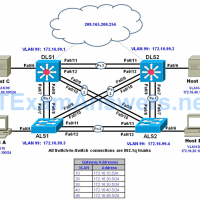
CCNP SWITCH Chapter 6 Lab 6-1, First Hop Redundancy Protocols – HSRP and VRRP (Version 7)
Topology Objectives Configure inter-VLAN routing with HSRP and load balancing Configure HSRP authentication Configure HSRP interface tracking Configure VRRP Configure VRRP object tracking Hot Standby Router Protocol (HSRP) is a Cisco-proprietary redundancy protocol for establishing a faulttolerant default gateway. It is described in RFC 2281. HSRP provides a …
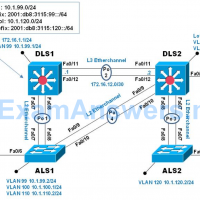
CCNP SWITCH Chapter 5 Lab 5-2 – DHCP (Version 7)
Topology Objectives Configure DHCP for IPv4 Configure Stateless DHCP for IPv6 Configure Stateful DHCP for IPv6 Background To practice the various configuration and options associated with DHCP for IPv4 and IPv6, you will configure a DHCP server on switch DLS1. Hosts A and B will receive IP addresses …
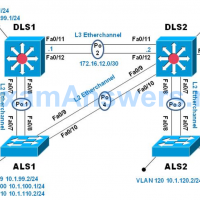
CCNP SWITCH Chapter 5 Lab 5-1 – Inter-VLAN Routing (Version 7)
Topology Objectives Implement a Layer 3 EtherChannel Implement Static Routing Implement Inter-VLAN Routing Background Cisco's switching product line offers robust support for IP routing. It is common practice to use only multi-layer switching in the distribution layer of the network, eliminating routers in all but special use cases, …
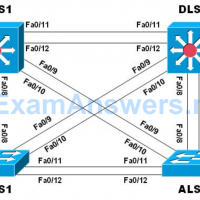
CCNP SWITCH Chapter 4 Lab 4-2 – Multiple Spanning Tree (Version 7)
Topology Objectives Implement Multiple Spanning Tree Leverage VTP version 3 with MST Background Cisco’s Per VLAN Spanning Tree (PVST) provides a significant step up from standard spanning tree in terms of flexibility, allowing each VLAN to have its own independent spanning tree, thereby make better use of available …
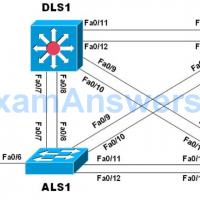
CCNP SWITCH Chapter 4 Lab 4-1 – Implement Spanning Tree Protocols (Version 7)
Topology Objectives Observe default Spanning Tree behavior Implement Rapid Spanning Tree Implement STP tool kit components Background The potential effect of a loop in the layer 2 network is significant. Layer 2 loops could impact connected hosts as well as the network equipment. Layer 2 loops can be …