4. A BGP routing policy has been created using route maps. The command route-map TEST permit 10 is part of the configuration. What does the argument 10 indicate?
It identifies the access list number to be used by the route map statement.
It identifies the position of the route map in relation to other instances.
It indicates the local preference to be set for routes that match the route map.
It indicates the metric to be set for routes that match the route map.
It specifies the route map to be used on autonomous system 10.
Explanation: A route map uses the command syntax route-maproute-map-name [permit | deny][sequence-number]. It has four components:
- Sequence number - dictates the processing order of the route map
- Conditional matching criteria - identifies prefix characteristics (network, BGP path attribute, next hop, and so on) for a specific sequence
- Processing action - permits or denies the prefix
- Optional action - allows for manipulations, depending on how the route map is referenced on the router
5. A network administrator is configuring an ACL to match networks for BGP route filtering. The administrator creates an ACE permit ip 10.0.128.0 0.0.63.0 255.255.255.0 0.0.0.0. Which network matches the ACE?
10.0.63.0/24
10.0.130.0/24
10.0.192.0/24
10.0.128.0/25
Explanation: One method for conditional matching of routes in BGP is through extended ACLs. When using extended ACLs for this purpose, the source fields match against the network portion of the route, and the destination fields match against the network mask. The matching networks are 10.0.128.0/24 through 10.0.191.0/24.
6. A network administrator is configuring a prefix list to match networks for BGP route filtering. Which network matches the prefix match specification 10.160.0.0/14 ge 22?
10.158.0.0/22
10.162.0.0/14
10.163.0.0/24
10.128.0.0/28
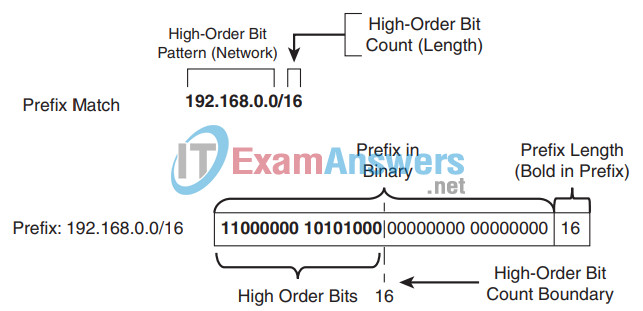
Explanation: Prefix lists provide another method of identifying networks in a routing protocol. A prefix list identifies a specific IP address, network, or network range and allows for the selection of multiple networks with a variety of prefix lengths by using a prefix match specification. A prefix match specification contains two parts: a high-order bit pattern and a high-order bit count, which determines the high-order bits in the bit pattern that are to be matched. The high-order bit pattern is also known as the network address and the high-order bit count as the mask length. The network portion of the matching networks is 10.160.0.0 and higher. The mask length of the matching networks must be greater than or equal to /22.
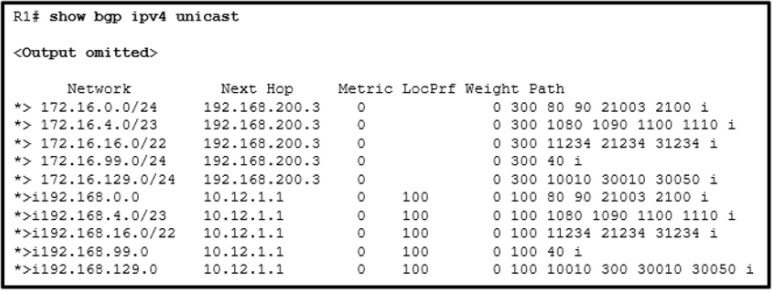
7. Refer to the exhibit. A network administrator is troubleshooting BGP configuration and wants to verify routes that carry the 100 AS in the AS_Path value. Which regular expression should the administrator use in the command show bgp ipv4 unicast regex regex-pattern?
show bgp ipv4 unicast regex .100.
show bgp ipv4 unicast regex $100
show bgp ipv4 unicast regex 100_
show bgp ipv4 unicast regex ^100^
Explanation: In troubleshooting BGP, regular expressions (regex) can be used to parse through the large number of available ASNs. Regular expressions are based on query modifiers used to select the appropriate content. The regex pattern 100_ indicates to only include the lines that contain the exact phrase of 100. Some regex query modifiers are as follows:
- _ (underscore) - Matches a space
- ^ (caret) - Indicates the start of a string
- $ (dollar sign) - Indicates the end of a string
- . (period) - Matches a single character, including a space
8. What is the first attribute to be used in determining the best path when a BGP router has multiple paths for the same network prefix length?
Weight
Lowest MED
Local originated
Local preference
Explanation: The BGP best-path algorithm uses the attributes, in the following order, for the best-path selection:
1. Weight.
2. Local preference.
3. Local originated (network statement, redistribution, or aggregation).
4. AIGP.
5. Shortest AS_Path.
6. Origin type.
7. Lowest MED.
8. EBGP over IBGP.
9. Lowest IGP next hop.
10. If both paths are external (EBGP), prefer the first (oldest).
11. Prefer the route that comes from the BGP peer with the lower RID.
12. Prefer the route with the minimum cluster list length.
13. Prefer the path that comes from the lowest neighbor address.
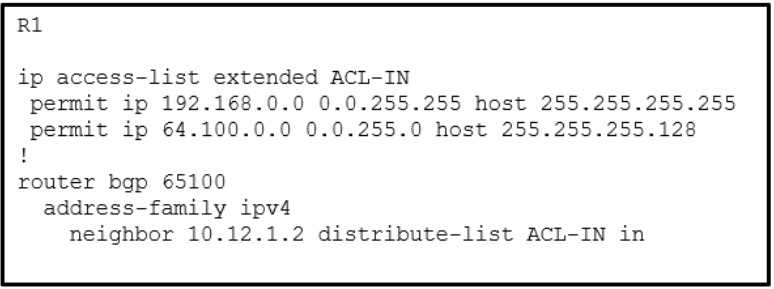
9. Refer to the exhibit. A network administrator is configuring BGP route filtering on R1. The router ID for R1 is configured with lookback address 192.168.1.1. Which three routes are allowed from the BGP neighbor router 10.12.1.2 to inject into the BGP table of R1? (Choose three.)
192.168.1.1/32
192.168.2.2/32
192.168.3.3/32
10.12.1.0/24
64.100.3.0/25
64.100.2.192/26
Explanation: Per the distribute list filtering ACL-IN, two loopback networks (192.168.2.2/32 and 192.168.3.3/32) are allowed because they match the first ACE in the ACL-IN. The network 64.100.3.0/25 is allowed because it matches the second ACE in the ACL-IN. The networks 192.168.1.1/32 and 10.12.1.0/24 are local routes. The network 64.100.2.192/26 would not be allowed because it does not match entries in the ACL-IN.
10. A network administrator is configuring a prefix list with the ip prefix-list command. How does the IOS process the prefix list if the administrator does not specify a sequence number?
It will present a prompt to ask the administrator to enter one.
It will present an error message that indicates the entry fails.
It automatically increments by 5 based on the highest sequence number.
It automatically increments by 10 based on the highest sequence number.
Explanation: Prefix lists are configured with the global configuration command ip prefix-listprefix-listname [seqsequence-number] {permit | deny} high-order-bit-pattern/high-order-bit-count [gege-value] [lele-value]. If a sequence is not provided, the sequence number automatically increments by 5 based on the highest sequence number.
11. A company is deploying BGP multihoming to provide network connection redundancy for several branch sites. Which method can be used to avoid the branch transit routing situation?
ensuring that no IGP session is running on branch site BGP routers
designating a data center or a specific location to handle the transit traffic
applying inbound BGP route policies so that only data packets from other branch sites can enter local networks
applying outbound BGP route policies so that branch sites do not advertise routes learned from the WAN connection
Explanation: Multihomed environments should be configured so that branch routers cannot act as transit routers. In most designs, transit routing of traffic from another branch is undesirable, because WAN bandwidth may not be sized accordingly. Transit routing can be avoided by configuring outbound route filtering at each branch site so that the branch sites do not advertise what they learn from the WAN but advertise only networks that face the LAN.
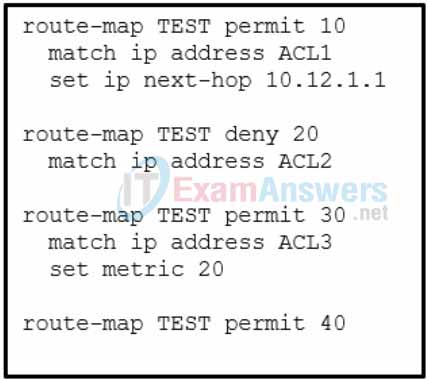
12. Refer to the exhibit. When considering the route map configuration for BGP, what is the result when inbound traffic is received with a source IP that matches ACL1?
The incoming network traffic will go through the whole route map.
The optional action is processed, and the route map completes.
If the incoming network traffic does not match ACL2 and ACL3, it will be dropped.
The optional action is processed, and route map continues to test with ACL2.
Explanation: A route map uses the command syntax route-maproute-map-name [permit | deny][*sequence-number*]. The rules that apply to route map statements are as follows:
If a processing action is not provided, the default value permit is used.
If a sequence number is not provided, the sequence number is incremented by 10 automatically.
If a matching statement is not included, an implied all prefixes is associated with the statement.
Processing within a route map stops after all optional actions have processed and after matching a conditional matching criterion.
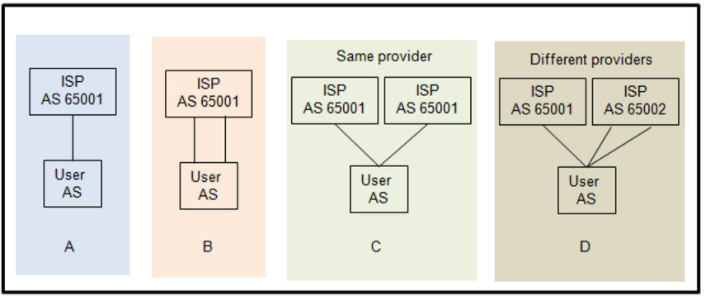
13. Each line in the diagram represents a single connection from a user AS to an ISP AS. In which multihomed configuration is it necessary, if not required, to use BGP to exchange routing information?
A
B
C
D
Explanation: BGP should be used when multihomed or connected to multiple autonomous systems.
14. Which three options are well-known BGP community sets? (Choose three.)
Internet
Test_Only
No_Export
No_Transit
Transit_Only
No_Advertise
Explanation: Three common well-known communities are as follows:
Internet: This is a standardized community for identifying routes that should be advertised on the Internet.
No_Advertise: Routes with this community should not be advertised to any BGP peer (IBGP or EBGP).
No_Export: When a route with this community is received, the route is not advertised to any EBGP peer. Routes with this community can be advertised to IBGP peers.
15. A network administrator is configuring a prefix list with the command
ipv6 prefix-list IPV6-1 seq 5 permit 2001:db8:abcd:20::/59 ge 62
Which network matches the prefix match specification?
2001:db8:ab:20::/62
2001:db8:abcd:2::/59
2001:db8:abcd:36::/62
2001:db8:abcd:60::/64
Explanation: The prefix matching logic works exactly the same for IPv6 networks as for IPv4 networks. The third hexadecimal group of the match specification is 0x0020, which is 00000000 00100000 in binary. To match /59 prefix length, the third hexadecimal group of a network must match 00000000 001, that is, between 0x0020 and 0x003F. The prefix length must be /62 or higher.
"Do I Know This Already?" Quiz Answers:
1. Transit routing between a multihomed enterprise network and a service provider is generally not recommend in which scenarios? (Choose all that apply.)
Internet connections at data centers
Internet connections at branch locations
MPLS data centers
MPLS branch locations
Explanation: Transit routing for enterprises is generally acceptable only for data centers connecting to MPLS networks.
2. True or false: An extended ACL used to match routes changes behavior if the routing protocol is an IGP rather than BGP.
True
False
Explanation: IGPs use the destination field to select the smallest prefix length, whereas BGP uses it to match the subnet mask for a route.
3. Which network prefixes match the prefix match pattern 10.168.0.0/13 ge 24? (Choose two.)
10.168.0.0/13
10.168.0.0/24
10.173.1.0/28
10.104.0.0/24
Explanation:
Basic Prefix Match Pattern
4. What is the correct regular expression syntax for matching a route that originated in AS 300?
^300_
$300!
_300_
_300$
Explanation:
Regular Expression
Meaning
^$
Local originating routes
permit ^200_
Only routes from neighbor AS 200
permit _200$
Only routes originating from AS 200
permit _200_
Only routes that pass through AS 200
permit ^[0-9]+ [0-9]+ [0-9]+?
Routes with three or fewer AS_Path entries
5. What happens when the route map route-map QUESTION permit 20 does not contain a conditional match statement?
The routes are discarded, and a syslog message is logged.
All routes are discarded.
All routes are accepted.
An error is assigned when linking the route map to a BGP peer.
Explanation: All routes are accepted and processed.
6. What happens to a route that does not match the PrefixRFC1918 prefix list when using the following route map?
route-map QUESTION deny 10
  match ip address prefix-list PrefixRFC1918
route-map QUESTION permit 20
  set metric 200
The route is allowed, and the metric is set to 200.
The route is denied.
The route is allowed.
The route is allowed, and the default metric is set to 100.
Explanation: Because the route does not match the prefix list, sequence 10 does not apply, and the route moves on to sequence 20 which sets the metric to 200. It is implied that the route proceeds because it was modified.
7. True or false: A BGP AS_Path ACL and a prefix list can be applied to a neighbor at the same time.
True
False
Explanation: A distribute list and a prefix list cannot be used at the same time for a neighbor. All other filtering techniques can be combined.
8. Which of the following is not a well-known BGP community?
No_Advertise
Internet
No_Export
Private_Route
Explanation: The other communities are common global communities.
9. Which of the following techniques is the second selection criterion for the BGP best path?
Weight
Local preference
Origin
MED
Explanation: Local preference is the second selection criterion for the BGP best path.
10. True or false: For MED to be used as a selection criterion, the routes must come from different autonomous systems.
True
False
Explanation: For MED to be used, the routes must come from the same AS.
The ITExamAnswers Editorial Team is a dedicated group of certified IT professionals and network engineers. We rigorously review, verify, and update all exam materials to ensure you receive the most accurate and reliable resources for your certification journey.