
- Which option describes the purpose of traffic policing?
- A. It prioritizes routing protocol traffic.
- B. It remarks traffic that is below the CIR
- C. It drops traffic that exceeds the CIR.
- D. It queues and then transmits traffic that exceeds the CIR.
Show (Hide) Explanation/ReferenceThe following diagram illustrates the key difference between traffic policing and traffic shaping. Traffic policing propagates bursts. When the traffic rate reaches the configured maximum rate (or committed information rate), excess traffic is dropped (or remarked). The result is an output rate that appears as a saw-tooth with crests and troughs. In contrast to policing, traffic shaping retains excess packets in a queue and then schedules the excess for later transmission over increments of time. The result of traffic shaping is a smoothed packet output rate.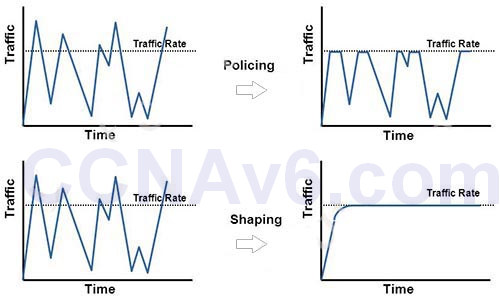
Note: Committed information rate (CIR): The minimum guaranteed data transfer rate agreed to by the routing device.
- Which statement about QoS default behavior is true?
- A. Ports are untrusted by default.
- B. VoIP traffic is passed without being tagged.
- C. Video traffic is passed with a well-known DSCP value of 46.
- D. Packets are classified internally with an environment.
- E. Packets that arrive with a tag are untagged at the edge of an administrative domain.
- What 8-bit field exists in IP packet for QoS?
- A. Tos Field
- B. DSCP
- C. IP Precedence
- D. Cos
- E. ?
Show (Hide) Explanation/ReferenceThe IP datagram header contains an 8-bit field called ToS (Type of Service). The field has been part of the IP header since the beginning, but it was rarely used until the recent introduction of Differentiated Services (Diff-Serv).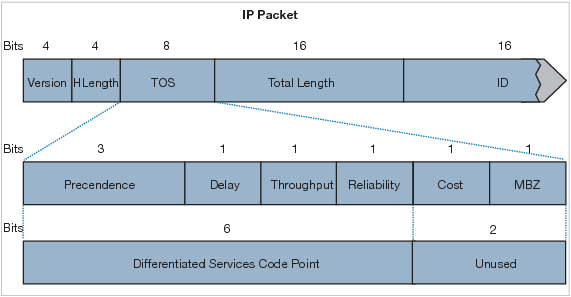
Note:
+ CoS does not exists in an IP header. It appears in the header of a 802.1Q frame only. CoS is used for QoS on a trunk link.
+ DSCP uses the first 6 bits of the TOS field. - What does traffic shaping do to reduce congestion in a network?
- A. buffers and queues packets
- B. buffers without queuing packets
- C. queues without buffering packets
- D. drops packets
The following diagram illustrates the key difference between traffic policing and traffic shaping. Traffic policing propagates bursts. When the traffic rate reaches the configured maximum rate (or committed information rate), excess traffic is dropped (or remarked). The result is an output rate that appears as a saw-tooth with crests and troughs. In contrast to policing, traffic shaping retains excess packets in a queue and then schedules the excess for later transmission over increments of time. The result of traffic shaping is a smoothed packet output rate.Note: Committed information rate (CIR): The minimum guaranteed data transfer rate agreed to by the routing device.
- In which byte of an IP packet can traffic be marked?
- A. The CoS byte
- B. The ToS byte
- C. The DSCP byte
- D. The QoS byte
Show (Hide) Explanation/ReferenceLayer-3 marking is accomplished using the 8-bit Type of Service (ToS) field, part of the IP header. A mark in this field will remain unchanged as it travels from hop-to-hop, unless a Layer-3 device is explicitly configured to overwrite this field. There are two marking methods that use the ToS field:+ IP Precedence: uses the first three bits of the ToS field.
+ Differentiated Service Code Point (DSCP): uses the first six bits of the ToS field. When using DSCP, the ToS field is often referred to as the Differentiated Services (DS) field.Reference: http://www.routeralley.com/guides/qos_classification.pdf
- Which function does traffic shaping perform?
- A. It buffers and queues excess packets
- B. It buffers traffic without queuing it
- C. It queues traffic without buffering it
- D. It drops packets to control the output rate
Show (Hide) Explanation/ReferenceThe following diagram illustrates the key difference between traffic policing and traffic shaping. Traffic policing propagates bursts. When the traffic rate reaches the configured maximum rate (or committed information rate), excess traffic is dropped (or remarked). The result is an output rate that appears as a saw-tooth with crests and troughs. In contrast to policing, traffic shaping retains excess packets in a queue and then schedules the excess for later transmission over increments of time. The result of traffic shaping is a smoothed packet output rate. - Which option is the main function of congestion management?
- A. discarding excess traffic
- B. queuing traffic based on priority
- C. classifying traffic
- D. providing long-term storage of buffered data
- Which QoS tool can you use to optimize voice traffic on a network that is primarily intended for data traffic?
- A.WRED
- B. FIFO
- C. PQ
- D.WFQ
Show (Hide) Explanation/ReferenceWith Priority Queueing (PQ), traffic is classified into high, medium, normal, and low priority queues. The high priority traffic is serviced first, then medium priority traffic, followed by normal and low priority traffic. -> Therefore we can assign higher priority for voice traffic.Also with PQ, higher priority traffic can starve the lower priority queues of bandwidth. No bandwidth guarantees are possible -> It is still good because this network is mostly used for data traffic so voice traffic amount is small.
With First In First Out (FIFO) or Weighted Fair Queueing (WFQ), there is no priority servicing so they are not suitable here.
Reference: https://www.cisco.com/c/en/us/td/docs/ios/solutions_docs/qos_solutions/QoSVoIP/QoSVoIP.html
Weighted Random Early Detection (WRED) is just a congestion avoidance mechanism. WRED measures the size of the queues depending on the Precedence value and starts dropping packets when the queue is between the minimum threshold and the maximum threshold -> It does not have priority servicing either.
- Which two QoS tools can provide congestion management? (Choose two)
- A. CBWFQ
- B. FRTS
- C. CAR
- D. PQ
- E. PBR
Show (Hide) Explanation/ReferenceThis module discusses the types of queueing and queueing-related features (such as bandwidth management) which constitute the congestion management QoS features:Class-based WFQ (CBWFQ): extends the standard WFQ functionality to provide support for user-defined traffic classes. For CBWFQ, you define traffic classes based on match criteria including protocols, access control lists (ACLs), and input interfaces. Packets satisfying the match criteria for a class constitute the traffic for that class.
Priority queueing (PQ): With PQ, packets belonging to one priority class of traffic are sent before all lower priority traffic to ensure timely delivery of those packets.
Note: Committed Access Rate (CAR) is only used for bandwidth limitation by dropping excessive traffic.
