
Packet Tracer - Configuring IPv4 and IPv6 Interfaces
(Instructor Version)
Instructor Note: Red font color or Gray highlights indicate text that appears in the instructor copy only.
Topology
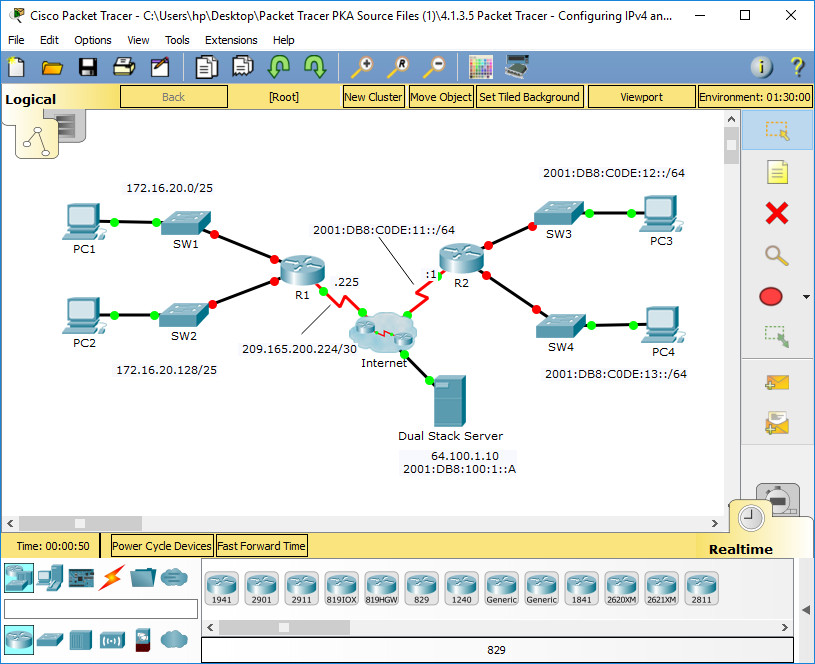
Addressing Table
| Device | Interface | IPv4 Address | Subnet Mask | Default Gateway |
|---|---|---|---|---|
| IPv6 Address/Prefix | ||||
| R1 | G0/0 | 172.16.20.1 | 255.255.255.128 | N/A |
| G0/1 | 172.16.20.129 | 255.255.255.128 | N/A | |
| S0/0/0 | 209.165.200.225 | 255.255.255.252 | N/A | |
| PC1 | NIC | 172.16.20.10 | 255.255.255.128 | 172.16.20.1 |
| PC2 | NIC | 172.16.20.138 | 255.255.255.128 | 172.16.20.129 |
| R2 | G0/0 | 2001:DB8:C0DE:12::1/64 | N/A | |
| G0/1 | 2001:DB8:C0DE:13::1/64 | N/A | ||
| S0/0/1 | 2001:DB8:C0DE:11::1/64 | N/A | ||
| Link-local | FE80::2 | N/A | ||
| PC3 | NIC | 2001:DB8:C0DE:12::A/64 | FE80::2 | |
| PC4 | NIC | 2001:DB8:C0DE:13::A/64 | FE80::2 | |
Objectives
- Part 1: Configure IPv4 Addressing and Verify Connectivity
- Part 2: Configure IPv6 Addressing and Verify Connectivity
Background
Routers R1 and R2 each have two LANs. Your task is to configure the appropriate addressing on each device and verify connectivity between the LANs.
Note: The user EXEC password is cisco. The privileged EXEC password is class.
Part 1: Configure IPv4 Addressing and Verify Connectivity
Step 1: Assign IPv4 addresses to R1 and LAN devices.
Referring to the Addressing Table, configure IP addressing for R1 LAN interfaces, PC1 and PC2. The serial interface has already been configured.
Step 2: Verify connectivity.
PC1 and PC2 should be able to ping each other and the Dual Stack Server.
Part 2: Configure IPv6 Addressing and Verify Connectivity
Step 1: Assign IPv6 addresses to R2 and LAN devices.
Referring to the Addressing Table, configure IP addressing for R2 LAN interfaces, PC3 and PC4. The serial interface is already configured.
Step 2: Verify connectivity.
PC3 and PC4 should be able to ping each other and the Dual Stack Server.
Device Configs - Final
ROUTER R1
! ==============================================================
!--- 1.1.3.5 Packet Tracer - Configuring IPv4 and IPv6 Interfaces
!--- ANSWER SCRIPT FOR ROUTER R1
!--- Usage: log in to R1 (user EXEC password: cisco), type "enable" and enter the privileged EXEC password "class", then copy this whole file and paste it at the R1# prompt. Every line beginning with "!" is a comment; IOS ignores it, so pasting a comment by accident is harmless.
! ==============================================================

enable
configure terminal

! --------------------------------------------------------------
!--- Part 1: Configure IPv4 addressing on the R1 LAN interfaces.
! --------------------------------------------------------------

!--- G0/0 - LAN gateway for PC1 (172.16.20.1/25).
interface gigabitethernet 0/0
 ip address 172.16.20.1 255.255.255.128
 no shutdown
 exit

!--- G0/1 - LAN gateway for PC2 (172.16.20.129/25).
interface gigabitethernet 0/1
 ip address 172.16.20.129 255.255.255.128
 no shutdown
 exit

end

! --------------------------------------------------------------
!--- Save the configuration to NVRAM. (Press Enter when prompted for the destination filename.)
! --------------------------------------------------------------
copy running-config startup-config


! ==============================================================
!--- Verification:
!---   show ip interface brief  -> G0/0 and G0/1 up/up with the correct IPv4 addresses
!---   show ip route            -> 172.16.20.0/25 and 172.16.20.128/25 appear as connected (C) routes
!---   (on PC1) ping 172.16.20.138  -> PC1 reaches PC2 across R1
!---   (on PC1) ping 64.100.1.10    -> PC1 reaches the Dual Stack Server over S0/0/0
!--- Note: S0/0/0 (209.165.200.225/30) and the route toward the Internet are
!--- preconfigured - do not change them. PC1/PC2 must also have their static
!--- IPv4 address, mask and default gateway set (see the Addressing Table),
!--- otherwise the pings fail even though R1 is correct.
! ==============================================================
ROUTER R2
! ==============================================================
!--- 1.1.3.5 Packet Tracer - Configuring IPv4 and IPv6 Interfaces
!--- ANSWER SCRIPT FOR ROUTER R2
!--- Usage: log in to R2 (user EXEC password: cisco), type "enable" and enter the privileged EXEC password "class", then copy this whole file and paste it at the R2# prompt. Every line beginning with "!" is a comment; IOS ignores it, so pasting a comment by accident is harmless.
! ==============================================================

enable
configure terminal

! --------------------------------------------------------------
!--- Part 2: Configure IPv6 addressing on the R2 LAN interfaces.
! --------------------------------------------------------------

!--- Enable IPv6 routing so R2 forwards IPv6 between its LANs and the serial link (harmless if already preconfigured).
ipv6 unicast-routing

!--- G0/0 - LAN gateway for PC3: global unicast 2001:DB8:C0DE:12::1/64, link-local FE80::2 (the PCs' default gateway).
interface gigabitethernet 0/0
 ipv6 address 2001:DB8:C0DE:12::1/64
 ipv6 address FE80::2 link-local
 no shutdown
 exit

!--- G0/1 - LAN gateway for PC4: global unicast 2001:DB8:C0DE:13::1/64, link-local FE80::2 (the PCs' default gateway).
interface gigabitethernet 0/1
 ipv6 address 2001:DB8:C0DE:13::1/64
 ipv6 address FE80::2 link-local
 no shutdown
 exit

end

! --------------------------------------------------------------
!--- Save the configuration to NVRAM. (Press Enter when prompted for the destination filename.)
! --------------------------------------------------------------
copy running-config startup-config


! ==============================================================
!--- Verification:
!---   show ipv6 interface brief  -> G0/0 and G0/1 up/up, each showing FE80::2 and its 2001:DB8:C0DE:1x::1 address
!---   show ipv6 route            -> 2001:DB8:C0DE:12::/64 and 2001:DB8:C0DE:13::/64 appear as connected (C) routes
!---   (on PC3) ping 2001:DB8:C0DE:13::A  -> PC3 reaches PC4 across R2
!---   (on PC3) ping 2001:DB8:100:1::A    -> PC3 reaches the Dual Stack Server over S0/0/1
!--- Note: PC3 and PC4 use FE80::2 as their default gateway. Without the
!--- "ipv6 address FE80::2 link-local" lines, R2 auto-generates an EUI-64
!--- link-local address (FE80::2xx:xxFF:FExx:xxxx), the gateway FE80::2 does not
!--- exist, and every ping off the local subnet fails. S0/0/1 is preconfigured.
! ==============================================================
Download Packet Tracer (.pka) file:

