Author: ITExamAnswers Editorial Team
The ITExamAnswers Editorial Team is a dedicated group of certified IT professionals and network engineers. We rigorously review, verify, and update all exam materials to ensure you receive the most accurate and reliable resources for your certification journey.
5.5.2 Packet Tracer - Examining a Route Answers Topology Addressing Table This activity does not include an addressing table. Learning Objectives Use the route command to view a PT-PC routing table Use the command command prompt to telnet and connect to a Cisco router Examine router routes using …
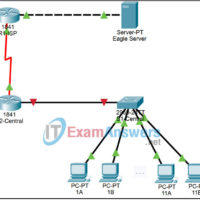
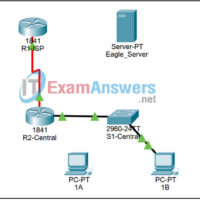
5.5.1 Packet Tracer - Examining a Device's Gateway Answers Topology Addressing Table Device Interference IP Address Subnet Mask Default Gateway R1-ISP S0/0/0 10.10.10.6 255.255.255.252 N/A Fa0/0 192.168.254.253 255.255.255.0 N/A R2-Central S0/0/0 10.10.10.5 255.255.255.252 N/A Fa0/0 172.168.255.254 255.255.255.0 N/A Eagle Server FastEthernet 192.168.254.254 255.255.255.0 192.168..254.25 Host 1A FastEthernet 172.16.1.1 …
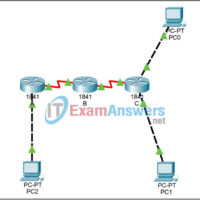
5.4.3 Packet Tracer - Observing Dynamic Routing Protocol Updates Answers Topology Learning Objectives Examine the behavior of a dynamic routing protocol, RIP v1 Introduction: Routers can learn about routes from other routers by using dynamic routing protocols. In such protocols, which may run according to timers or triggering …
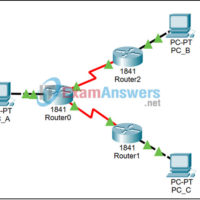
5.3.7 Packet Tracer - Router Packet Forwarding Answers Topology Learning Objectives Examine how routers forward packets when a route to the destination exists in the routing table Examine how routers forward packets when no specific route exists, but a default route has been configured Examine how routers forward …
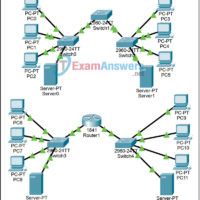
5.2.2 Packet Tracer - Routers Segment Broadcast Domains Answers Topology Learning Objectives Examine the behavior of pinging the broadcast address on an un-segmented, switched network Examine the behavior of pinging the broadcast address on a segmented, routed network Introduction: Broadcast packets are sent to every host in a …
4.6.1 Packet Tracer - Skills Integration Challenge-Analyzing the Application and Transport Layers Answers Topology Diagram: Partial topology given; must be completed. Device Interface IP Address Subnet Mask Default Gateway R1-ISP Fa0/0 192.168.254.253 255.255.255.0 N/A S0/0/0 10.10.10.6 255.255.255.252 R2-Central Fa0/0 172.16.255.254 255.255.0.0 N/A S0/0/0 10.10.10.5 255.255.255.252 S1-Central VLAN 1 …
4.5.3 Packet Tracer - Application and Transport Layer Protocols Examination Answers Topology Addressing Table This activity does not include an addressing table. Learning Objectives Capture a web request using an URL from a PC Run the simulation and capture the traffic Examine the captured traffic Introduction: Wireshark provides …
4.4.4 Packet Tracer - UDP Operation Answers Topology Learning Objectives Setup and run the simulation Examine the results Introduction: UDP is a connectionless protocol. It is used in place of TCP where speed is important and reliability is not a concern. Domain Name System (DNS) uses UDP as …
4.2.5 Packet Tracer - TCP Session Establishment and Termination Answers Topology Learning Objectives Setup and run the simulation Examine the results Introduction: TCP is a connection-oriented protocol. Before information, such as a web page, can be exchanged, the peers must establish a connection. A connection is established by …
4.1.6 Packet Tracer - UDP and TCP Port Numbers Answers Topology Learning Objectives Setup and run the simulation Examine the results Introduction: UDP and TCP are TCP/IP Protocols that correspond to OSI Layer 4, the Transport layer. The PDUs for UDP and TCP differ substantially, but they share …